
Fargo Public Schools details $3.5 million annual utility bill, facility upgrades after 2023 assessment
Get AI-powered insights, summaries, and transcripts
Subscribe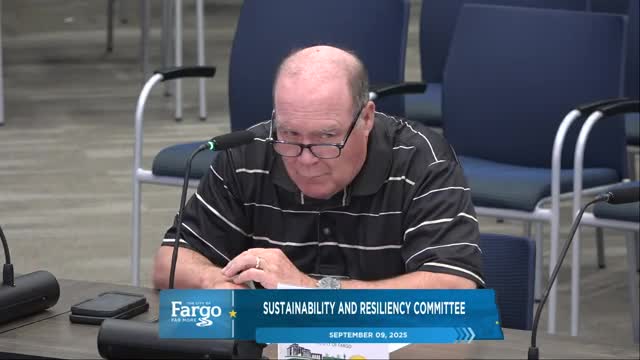
Summary
James Hand, director of facilities for Fargo Public Schools, summarized a 2023 facilities condition assessment covering nearly 3,000,000 sq ft across 27 buildings, noting roughly $2.8 million in annual electricity costs and $860,000 in gas costs and describing recommended energy, ventilation and life‑cycle measures now in implementation.
James Hand, director of facilities for Fargo Public Schools, told the Sustainability and Resiliency Committee that a 2023 facilities condition assessment covered almost 3,000,000 square feet across 27 district buildings and included a preliminary energy audit. "We were spending about $2,800,000 on electricity and $860,000 on gas, totaling about 3 and a half million dollars in annual utility expenses across the district," Hand said. The assessment produced building-by-building energy metrics — energy cost index (ECI) and energy use intensity (EUI) — that Hand said identify both efficient sites, including several geothermal schools, and facilities with significant opportunity for improvement. "Davies is a smaller portion of the pie than, say, north or south, partially because it's a geothermal facility," he said. The findings led to a list of recommended actions the district is pursuing. Hand described near-term and longer-term measures: LED lighting conversions (including athletic and parking-lot lighting), plumbing fixtures and water-efficiency upgrades, envelope repairs (roofs and windows), building automation system updates, demand-controlled ventilation, duct sealing and replacement of aging HVAC equipment. "We updated our sequence of operations," Hand said, noting updates to building automation software and a newly defined comfort standard of roughly 68 to 72 degrees. Hand said the district uses a computerized maintenance and asset-management system to track about 6,000 line items from the facility assessment and to prioritize projects by disruption risk, safety and energy performance. He said the district will continue to leverage state and federal grant programs where feasible and that some projects are more expensive now because lighting upgrades often require newer controls that increase upfront costs and lengthen payback periods. Hand also described the district’s sustainability vision and design standards, developed with a working group that included board members, community representatives, facility staff and external utility partners. The vision, he said, prioritizes occupant health and wellness first, followed by energy efficiency and building life-cycle performance. On renewable energy, Hand said adding solar was evaluated but was not yet financially justified at the time of the report. He cited site constraints and variable grant opportunities for future consideration. "Today, it doesn't as far as a from a cost standpoint... it did not quite pencil out," he said. Committee members asked clarifying questions during the presentation. Bruce Grubb, city administration, asked whether the district used a maintenance-management system; Hand confirmed the district uses a computerized maintenance and management system and described it as an important but maintenance‑intensive tool. Mike Williams, a committee public representative who identified himself as a risk manager, asked whether the district uses UV in HVAC systems; Hand said UV systems were added during COVID, funded in part by ESSER resources, and that the district has incorporated UV into its standards. Hand also noted planned design work that could apply sustainability choices in future projects; he said design work would begin the following day for a project to replace Horace Mann and that geothermal and other options will be considered where site conditions and life-cycle analysis make sense. Committee chair John Strand closed the item by thanking Hand for the presentation and noting the district’s work will be recorded for the committee’s year‑end wrap-up.