
Iowa City staff explain proposed 1% local option sales tax, outline ballot uses and revenue estimates
Get AI-powered insights, summaries, and transcripts
Subscribe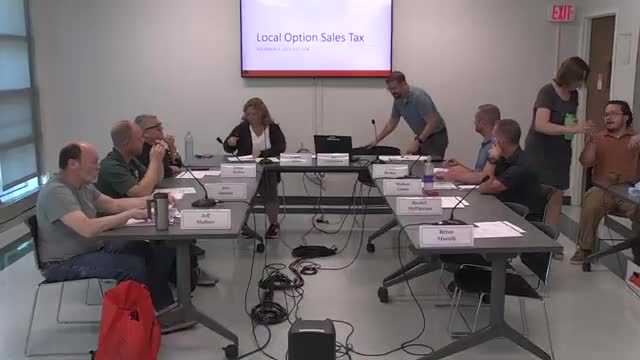
Summary
Iowa City Assistant City Manager Kirk Lame told the Parks and Recreation Commission that the City Council voted Aug. 5 to place a 1% local option sales tax (LOST) on the Nov. 4 ballot to provide a new revenue source for the city and to diversify funding beyond property taxes.
Iowa City Assistant City Manager Kirk Lame told the Parks and Recreation Commission that the City Council voted Aug. 5 to place a 1% local option sales tax (LOST) on the Nov. 4 ballot to provide a new revenue source for the city and to diversify funding beyond property taxes.
Lame said LOST is “essentially an additional 1% tax, on sales” and that state law requires ballot language to specify how proceeds will be used. He said the council’s proposed split is 50% for property tax relief, 25% for affordable housing, 10% for public streets, parks and facilities, and 15% for community partnerships. Lame said the city currently projects roughly $8 million to $10 million in annual revenue for Iowa City if only Iowa City adopts the tax; that amount could be higher if neighboring jurisdictions with large retail bases (notably Coralville) also adopt LOST.
The nut graf: LOST would require a council vote to place the measure on the ballot and a majority of voters to approve it; if approved, the earliest enactment date Lame cited is July 1 of the following fiscal year. Lame noted that changes in state law have reduced the city’s ability to capture property-tax growth and that LOST is one of the remaining local revenue options within state caps.
Lame described why low-income protections factor into the council’s allocations: many items exempt from sales tax (rent, groceries, prescription drugs, gasoline, vehicle purchases and utilities) reduce some regressive effects of a sales tax, but the council sought to direct a substantial share of proceeds toward property tax relief and affordable housing to benefit vulnerable households. He said recent state changes now require that 50% of LOST funds be used for property tax relief in jurisdictions that allocate funds that way.
Lame reviewed past local experience: a LOST referendum adopted after the 2008 flood produced roughly $34 million between 2010 and 2013 and paid for projects including the Dubuque Street (Gateway) reconstruction, expansion of the South Wastewater Treatment Facility and Riverfront Crossings Park; a later 2014 referendum did not pass under an earlier rule that required contiguous jurisdictions to approve LOST together. He said that rule has changed and now each city may adopt LOST independently.
On revenue mechanics, Lame said LOST collections are pooled at the county level and reallocated among participating jurisdictions according to a formula based on population and property-tax base; therefore, Iowa City’s eventual revenue will depend materially on which Johnson County jurisdictions opt in. He warned that LOST revenue can be volatile—sensitive to economic cycles and retail activity—and therefore is commonly used for capital and one-time expenditures rather than ongoing staffing costs.
Lame detailed the process and timeline: council adopted the resolution Aug. 5; early voting begins Oct. 15 and the election is Nov. 4; if voters approve the measure, the earliest implementation would be July 1 following certification. He also said state-level changes remain possible and that local LOST arrangements are subject to state law and future state action.
Commissioners asked technical and programmatic questions about how the city would allocate amounts within the stated buckets (for example, whether a parks project could be funded either from the 10% parks bucket or by using LOST proceeds to avoid bonding under the 50% property tax relief bucket). Lame said the categories overlap and that the City Council would make annual decisions during the budget process to determine how to apply funds within the ballot-defined buckets.
Lame also identified Greater Iowa City (a regional economic/advocacy organization) as an outside advocacy group that has encouraged neighboring cities to adopt LOST. He noted that city staff’s role is informational only and that, under state law, city staff may not advocate for or against a ballot measure; individual board or commission members retain the right to speak as private citizens.
Ending: Lame invited further questions from the commission and said staff are in an informational phase; he offered to provide follow-up data on the specific revenue impacts of past state property-tax reforms if the commission requested it.