
Iowa City airport stakeholders weigh National Register nomination for 1953 terminal while commissioning HVAC and space study
Get AI-powered insights, summaries, and transcripts
Subscribe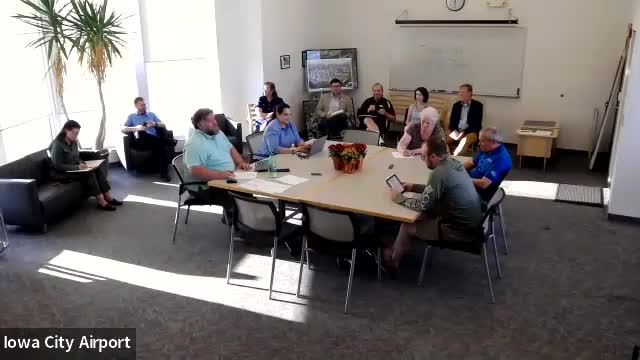
Summary
Friends of Historic Preservation urged listing the 1953 terminal on the National Register of Historic Places; airport commissioners agreed to scope immediate HVAC and envelope work and seek funding options while continuing discussion about replacement versus rehabilitation.
Friends of Historic Preservation members asked the Iowa City Airport Commission on Monday to pursue listing the airport’s 1953 terminal on the National Register of Historic Places and outlined how that process could affect future work on the building. Airport staff and commissioners said they favor continuing to study options and authorized staff and the airport’s engineer to scope immediate HVAC and envelope work to stop ongoing deterioration.
The preservation group, led at the meeting by Marty Goler of Friends of Historic Preservation, described the terminal as an uncommon example of mid‑century airport architecture and said the listing would open new grant and tax‑credit opportunities. “We have a treasure that is quite unusual,” Goler said, noting the building’s combined pre‑World War II and jet‑age design and its 1953 opening.
Why it matters: the terminal serves as the airport’s passenger and administrative building but is approaching a point where repairs — roofing, wiring, heating and cooling — are required. Staff said a recent space‑needs study showed limited usable space and roughly comparable costs between replacement and retrofit, and that funding for large terminal projects from the FAA and state programs is hard to obtain without a dedicated program.
The preservationists discussed the National Register nomination process and emphasized that listing does not freeze a building in place. Dave, identified at the meeting as president of the Friends’ board, said the register “would encourage reroofing and upgrades” and could increase community support for renovation. The presenters recommended working with a preservation architect and cited potential benefits including prestige, grant opportunities, and federal historic tax credits for work on the existing building fabric.
Airport Director Michael (airport staff) and commissioners described technical and economic constraints. “Economically, it’s a problem,” one airport commissioner said, summarizing the terminal study that found replacement was marginally less expensive than full rehabilitation. Staff said federal FAA funding historically tied to the Bipartisan Infrastructure Law program that would have supported terminal replacement has effectively expired for this project and that even if funds are available, some portions of the building are ineligible for FAA funding.
On the regulatory side, Friends’ speakers and staff discussed Section 106 — the federal review that applies when federal funds or permits are involved — and said the process aims to avoid harm to historic properties but does not categorically prevent change. “Any work that’s done on it should be reviewed,” a preservation presenter said, adding that mitigation and negotiated solutions are available if objectives can’t be met without altering historic fabric.
Discussion also included interior and operational needs. Airport staff and the engineering firm proposed a phased action plan: Phase 1 would inventory existing reports and define immediate actions; Phase 1b would accelerate an HVAC replacement to “stop the bleeding”; Phase 2 would be a master plan for layout and long‑term expansion; Phase 3 would execute phased construction so airport operations could continue. Adam, an engineering representative, said an immediate HVAC scope could be designed to allow future integration with a larger remodel or addition.
Commission members and staff stressed tradeoffs. Commissioners emphasized the terminal’s role as a gateway to Iowa City and the need for passenger‑friendly space and for JetAir and other tenants to have usable work areas. Several commissioners said they were not prepared to make a final decision on nomination or replacement immediately but supported moving forward with scoping and seeking grant and rebate options, including conversations with the state preservation office, FAA, and local utility rebates.
The commission directed staff and the airport consultant to refine a scope, schedule and cost estimate for near‑term HVAC and envelope work and to return with a work order recommendation. Staff indicated the planning work could be funded from the airport’s CIP while larger construction funding would be pursued through state or federal grant programs if available.
The commission agreed this will be an extended process with opportunities for later formal positions on a National Register nomination once an application is submitted and reviewed.
Sources: meeting presentation and discussion with Friends of Historic Preservation and airport staff.