Get Full Government Meeting Transcripts, Videos, & Alerts Forever!
Get email alerts on the Charter Election topic
No spam. Unsubscribe anytime.
Barnstable County charter review committee pauses work, declines to add ballot questions ahead of 2026 election
Summary
The Barnstable County Charter Review Committee voted to recess its deliberations and not place additional charter-related questions on the 2026 ballot, forwarding a grammar-and-clarity draft to the full Assembly for consideration.
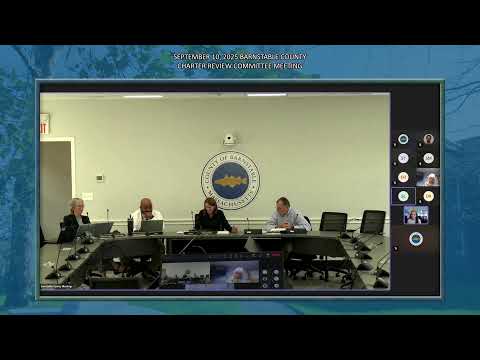
Barnstable County’s Charter Review Committee voted Sept. 10 to recess its deliberations and not add any additional charter-related questions to the 2026 ballot, and to forward a drafted cleanup of grammar and outdated references to the full Assembly of Delegates. The 6–0 roll call followed legal guidance from the committee’s counsel about how an elected charter commission would appear on next year’s ballot.
Attorney Lauren Goldberg of the firm KP Law told the committee the county resolution that placed the question on the ballot will be sent to the Secretary of the Commonwealth’s Elections Division and, if voters approve an elected charter commission, “there will also be 15 Charter Study Commission offices, one for each town on Cape Cod.” She said the office has not yet confirmed whether additional, county-level charter amendments could appear on the same ballot if submitted later.
The vote to pause further ballot work and to recess deliberations was introduced by Delegate Wayne Sampson. “I will make a motion for the purposes of discussion that we do not add any ballot questions regarding charter review,” Sampson said, and the motion was seconded and approved by roll call: Chair Sheila Lyons — yes; Clerk Susan Moran — yes; Chair Potash — yes; Dan Ravello — yes; Delegate Wayne Sampson — yes; Vice Chair Wyman Colombo — yes.
The committee’s action preserves the existing ballot plan approved earlier by the county commissioners, which, as Goldberg explained, will put the question to elect a charter commission on the 2026 biennial state election ballot. If the electorate approves the question, candidates for the 15 charter commission seats — one elected seat per town — would also appear on that ballot. Goldberg said votes cast for charter commission candidates would be recorded by machines but would have no effect if the question to elect a charter commission is rejected.
Committee members said the decision was intended to avoid confusing voters with multiple, overlapping charter questions on what Goldberg called a likely “crowded ballot.” Chair Sheila Lyons noted that “there’s going to be a lot of education that has to be done here for people,” and members agreed the committee’s draft cleanup document should be forwarded to the full Assembly so it can be used as a reference or starting point by future charter work.
The committee also discussed statutory provisions cited in the meeting, including references to Chapter 801 (as read on the record) and specific sections addressing participation by certain county officials and advisory board members in any charter commission process. Goldberg emphasized that some roles can serve as nonvoting advisers and that, depending on how the charter is implemented, appointed or ex officio participation could be required.
Next steps: the committee’s grammar-and-clarity draft will be submitted to the full Assembly of Delegates for their review. Committee members said they expect to reconvene depending on the outcome of the 2026 ballot question and after any direction from the Secretary of the Commonwealth about ballot formatting or the acceptance of multiple county questions.