Get Full Government Meeting Transcripts, Videos, & Alerts Forever!
Get email alerts on the Public Records topic
No spam. Unsubscribe anytime.
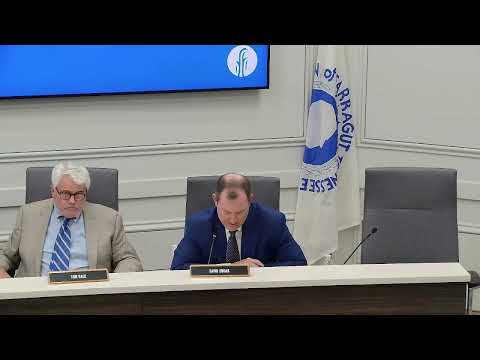
Farragut panel approves public-records ordinance language amid residentallegations of altered files
Summary
The Farragut Board of Mayor and Aldermen approved on first reading a revised public-records ordinance while a resident alleged staff withheld and altered responsive documents; the town attorney read guidance from the state Office of Open Records Counsel addressing format and conversion issues.
The Farragut Board of Mayor and Aldermen on Sept. 11 approved on first reading an ordinance (25-16) to update the town—s public-records rules, a measure the administration said is based on model guidance from the Tennessee Comptroller—s Office. The vote followed public comments alleging that a recent records inspection produced files that were not provided in their original state. The measure replaces the town code section on copies of records with new guidelines for access to and reproduction of public records and a schedule of charges. Allison Myers, town recorder, presented the ordinance materials and said the revision follows the state—s model policy; Bart Hose and Allison Myers provided staff background on the change. The board voted by roll call in favor (Alderman Burnette, Alderman Kane, Vice Mayor Meyer and Mayor Ron Williams: all yes). Resident Kimberly Parks told the board she used the Tennessee Public Records Act to request communications between the town and the state comptroller—s office and said the records she inspected in person were later presented to her on a flash drive in an altered form. "It is destruction, alteration, or concealment of a government record," Parks said, arguing the changes violated Tennessee Code Annotated 39-16-504 and that staff had removed responsive materials from the set provided to her. Town Attorney Tom Hale read a written response from the Office of Open Records Counsel (part of the state comptroller—s office) that the town had requested. Hale quoted the office: "The converted record must be accurate to the original, and converting from one file type to another cannot be used as an excuse to make a record unusable." Hale summarized the counsel—s view that producing records in a converted format (for example, PDF) is acceptable if the conversion faithfully reproduces the original in a usable way, and that custodians are not categorically required to deliver records in the original file type. Board members briefly discussed the presentation and public comment; no additional motion to alter the ordinance was presented. The ordinance advanced on first reading; the town said the change is intended to balance efficient government operation with public access under the Tennessee Public Records Act. The board also discussed that Parks may request any records she believes were inadvertently omitted; the Office of Open Records Counsel—s letter (read into the record) noted that accidentally included files do not automatically become permanently part of a responsive set and that citizens may request records separately if they want them included. The board did not take personnel action at the meeting. The public comment and the counsel—s response were entered into the record for the ordinance—s ongoing review.