
Delafield council approves resolution to advance Lake Country Fire & Rescue agreement amid lingering concerns
Get AI-powered insights, summaries, and transcripts
Subscribe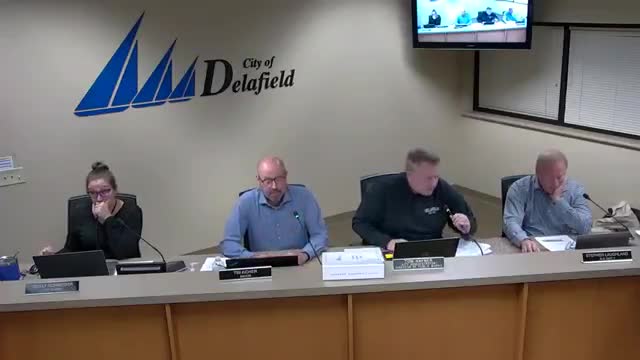
Summary
The Delafield Common Council voted to approve a resolution signaling support in principle for amendments to the Lake Country Fire & Rescue intermunicipal agreement and authorized city staff to finalize non‑substantive details, while members pressed for clarifications on funding, governance and statutory limits.
The Delafield Common Council on Oct. 20 approved a resolution (2025‑12) expressing the city's agreement in principle with proposed amendments to the Lake Country Fire & Rescue (LCFR) intermunicipal agreement and authorizing the mayor and staff to finalize non‑substantive changes.
Council members said the action was necessary so all seven LCFR member municipalities can move toward a unified budget by an early December deadline and avoid reverting to the 2025 budget with no capital funding.
Council members and city staff emphasized why the vote mattered. Administrator Tom Heffner and other municipal leaders said the amended agreement would enable phased hiring of additional full‑time firefighter/paramedics and adjust the funding formula to support staffing changes planned over the next few years. But several aldermen urged care with the details: they requested explicit preservation of the existing two‑year exit notice for municipalities, questioned how the funding formula is phased in, and sought clarity on governance voting thresholds and the handling of voluntary contributions from partner municipalities.
Speakers raised specific concerns during extended debate. Alderman Laughlin asked for additional clarifications and for items he wanted added to an attached list of remaining issues. Council members discussed language describing the agreement's relationship to existing levy limits and whether any memorandum language could be interpreted to bind the city beyond current IMA terms. City Attorney Kathy and Administrator Heffner told the council that, in the event of a legal dispute, the intermunicipal agreement (IMA) would govern and that the memorandum of understanding (MOU) accompanying the resolution is not intended to replace the IMA.
The council preserved several core points that had been sticking points in earlier negotiations: the existing two‑year notice provision for withdrawal from the agreement would remain, the funding formula timing was clarified (council members said anticipated annual fee impacts are modest for 2026–27), and the LCFR governance threshold was adjusted so certain board actions could proceed with a six‑of‑seven vote while major borrowing and budget approvals would still require municipal approval per the IMA.
The resolution approved a list of roughly two dozen remaining items for staff and counsel to resolve and authorized the mayor and city staff to finalize non‑substantive changes. Several council members called the resolution an imperfect but necessary step toward cooperation with partner municipalities; others said additional legal proofreading and clarification remain necessary.
Motion and outcome: a motion to approve resolution 2025‑12 (as amended to reference the appended list of open items and to permit non‑substantive edits by the mayor and city staff) was moved, seconded and passed by voice vote. No roll‑call vote with named tallies was recorded in the open session transcript.
What remains: council members identified a list of outstanding items to be resolved with partner municipalities and attorneys, including formal definitions (for example, of “call volume”), the precise mechanics of one partner village's proposed voluntary contribution, and final language addressing levy/fee treatment. The council noted a target of Dec. 1 for consistency among the seven municipalities’ budgets so capital funding would not revert to 2025 levels.
The council president and staff said they would continue negotiations with partner municipalities and return with final documents for recordation once the outstanding items are settled.
Funding and legal references mentioned during discussion were summarized in the packet and reiterated at the meeting; the resolution and the attached list of items are to be used by staff in finalizing the documents.
The council’s action does not itself amend the existing IMA; it approves a resolution to proceed with the MOU and to authorize staff to complete non‑substantive edits pending final agreement among the partner municipalities.