Get Full Government Meeting Transcripts, Videos, & Alerts Forever!
Get email alerts on the Stormwater Management topic
No spam. Unsubscribe anytime.
Committee seeks technical answers on stormwater rules after questions about gravel driveways and solar farms
Summary
Will County committee discussed how the draft stormwater chapter classifies gravel surfaces and how solar installations are treated for impervious-surface calculations. Members asked land-use and stormwater staff to attend the Executive Committee to explain enforcement and the definition of 'impervious.'
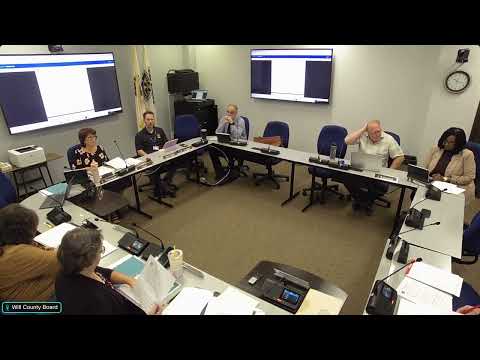
Committee members raised technical questions on Sept. 9 about Chapter 55, the proposed stormwater management ordinance, asking staff to clarify when gravel counts as impervious surface and why solar sites face stricter treatment than other land uses.
The exchange focused on whether stone/gravel driveways and unpaved surfaces should be counted as impervious for purposes such as retention-pond triggers and whether solar farms were being treated differently under the draft rules. Members cited specific local examples — including a nonprofit farm that sought to add greenhouses but was told a retention pond would be required because inspectors had treated compacted stone as impervious.
Why it matters: designation of surfaces as impervious determines when retention or detention facilities are required for development and redevelopment. For properties near the threshold (the draft cites 25,000 square feet of new development on sites of one acre or more), a change in classification can change whether a property owner must build costly stormwater controls.
Key points from the discussion - The draft ordinance includes a threshold for certain projects: new development on sites of one acre or more where new development in the aggregate exceeds 25,000 square feet may trigger additional stormwater requirements. - Committee members asked for clarification about what constitutes impervious surface, and whether compacted stone (grade 8) or three-quarter-inch gravel should be treated the same. One member summarized the local enforcement concern: gravel often drains and is not functionally impervious unless it is heavily compacted. - Committee legal staff indicated the formal draft defines impervious surfaces as those “that cause the majority of rainfall to be converted to direct runoff” and lists asphalt, concrete and roofing as clear examples; gravel may or may not be treated as impervious depending on compaction and local inspection findings.
At the meeting Member Newquist and other committee members asked stormwater and land-use staff to attend the Executive Committee so technical staff could explain how inspectors determine whether a surface is impervious and whether different gravel types should be treated differently. The committee approved forwarding Chapter 55 to Executive Committee and requested that land-use/stormwater staff be available to answer the specific questions.
Quotes from meeting Phil Mach, county legal representative, reported staff input had indicated the draft was consistent with current practice and that the proposed updates mainly clarified language and numbering.
Next steps Staff from land-use and stormwater management were asked to appear at the Executive Committee meeting to explain impervious-surface definitions and enforcement processes; the committee will retain the draft pending staff input.
Ending Because stormwater definitions affect whether property owners must construct retention systems, committee members requested specific examples and staff data before the Executive Committee reviews the chapter.