
Council denies variance for Silver Sage PUD; planning commission previously recommended denial
Get AI-powered insights, summaries, and transcripts
Subscribe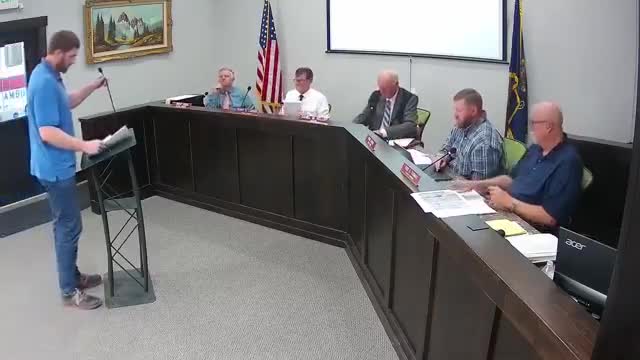
Summary
Preston’s council denied a request to allow six-unit townhome buildings in the proposed Silver Sage PUD where city code allows four-unit townhomes. Planning and zoning recommended denial; council members cited variance standards and concern that allowing six-unit buildings could set a precedent.
The Preston City Council voted to deny a variance request that would have allowed six-unit townhome buildings in the proposed Silver Sage planned-unit development (PUD) where city code limits attached townhome structures to four units.
Planning staff said the proposed PUD covers about 9.5 acres and that the difference between approving the variance and denying it would produce roughly the same number of units (66 units if variance granted, 64 units if denied) but a different building configuration: six-unit buildings would reduce the number of structures from 16 to 11 and concentrate open space into larger parcels, while four-unit buildings would increase the number of buildings and distribute more open space between structures.
The planning and zoning commission (PNC) reviewed the request and recommended denial. During council deliberations members reviewed the four standards for a variance in the city code: (1) not conflict with the comprehensive plan; (2) exceptional or extraordinary circumstances apply to the property; (3) granting would not be detrimental to public health, safety or welfare; and (4) variance shall not be recommended solely for convenience or profit. Council members agreed the proposal met standard (1) but had concerns about standards (2)–(4), especially the possibility that allowing larger building footprints for this development could become a precedent for others and that public-safety considerations such as egress and population density might be implicated.
One council member said he personally preferred the six-unit layout for its larger contiguous open space and reduced number of buildings but felt the request did not meet the legal standards for a variance. Another council member said the city code was changed two years earlier to set the fourplex limit, and allowing a sixplex would undermine that recent policy choice.
Council voted to deny the variance request; a motion to deny was seconded and carried unanimously. The council directed staff to prepare a reasoned decision, per state statute, documenting the findings and conclusions that form the basis of the denial.