
Lakeland City Commission adopts tentative FY 2026 budget, holds millage at 5.4323 mills
Get AI-powered insights, summaries, and transcripts
Subscribe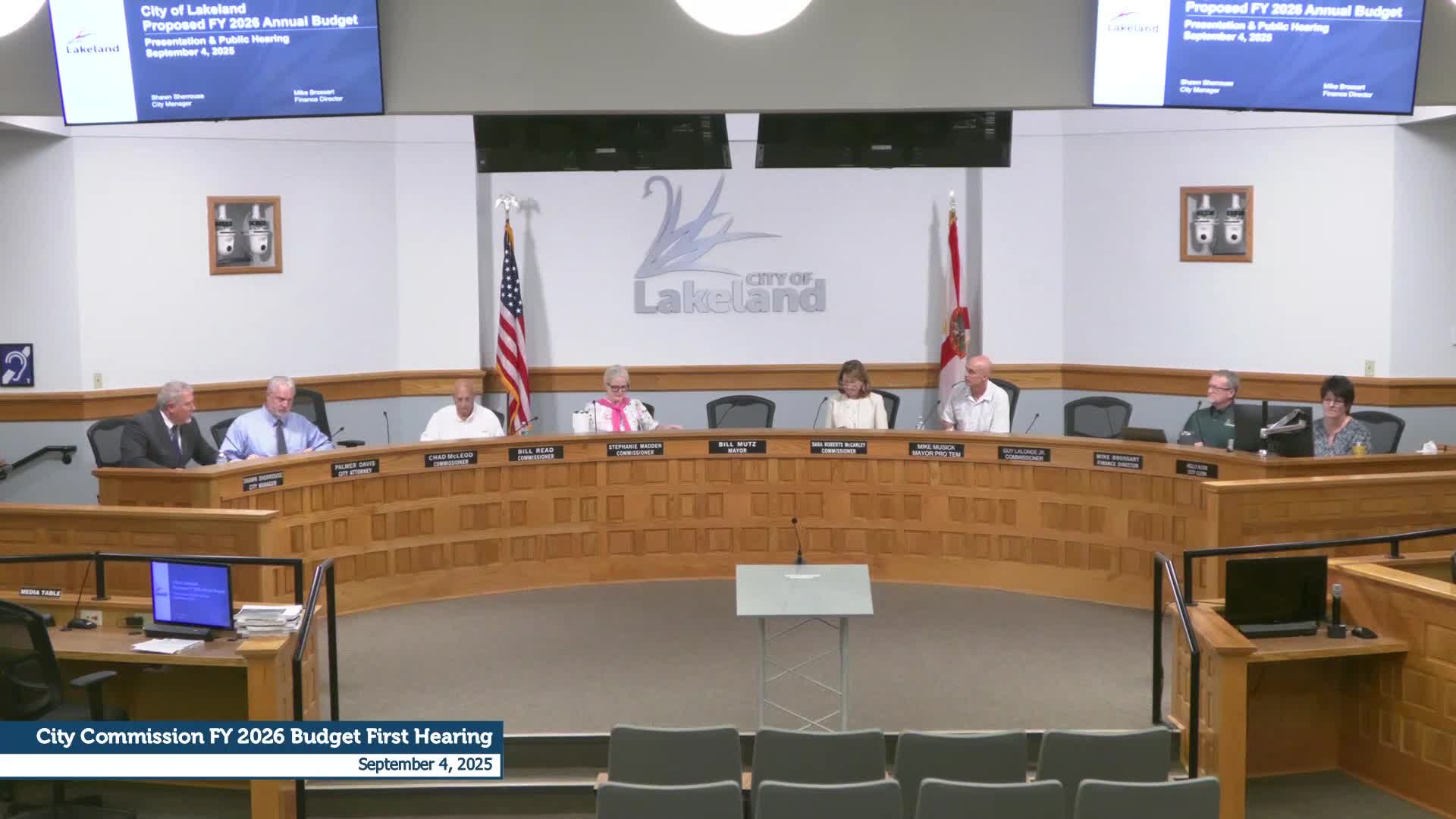
Summary
The Lakeland City Commission voted unanimously to adopt a tentative millage rate of 5.4323 mills and a tentative FY 2026 budget, preserving reserve policy and funding a mix of personnel, maintenance and capital projects while projecting modest property-value growth.
The Lakeland City Commission adopted a tentative millage rate of 5.4323 mills and approved a tentative budget for fiscal year 2026 during a public hearing, voting unanimously to advance the proposals to the required second hearing and final adoption.
City Manager Sean Charles told commissioners that the budget preserves the commission's reserve policy and is built on property-value growth information from the property appraiser. "This is one of our biggest nights of the year," Charles said as he opened the presentation. Finance Director Mike Brosart summarized the tax-rate options and told the commission the staff "is not recommending a millage increase. We're recommending staying at the 5.4323."
The nut of the proposal: the millage rate would remain unchanged from the current rate; the proposed budget programs a 6.84% growth in taxable value for FY 2026 based on the property appraiser's data and assumes a 6% average for the following two years for planning purposes. The budget keeps the general fund reserve at the policy target of 45 to 60 days cash on hand and includes ongoing operational costs, personnel changes and a set of capital and maintenance projects across utilities, public works, parks and public safety.
Major budget elements and staff explanations
- Property values and reserves: Staff said the property-appraiser figure of 6.84% was used in the FY 2026 revenue projections. The budget maintains the city's policy goal of 45–60 days of cash on hand; staff projected about 46 days by FY 2028 under current assumptions.
- Personnel and compensation: The budget programs a 2% across-the-board salary adjustment for general employees, and a 2% across-the-board adjustment for police bargaining unit scales and 1.5% for the fire bargaining unit. Merit increases are included where eligible (generally 2.5–3%, depending on position relative to the pay midpoint). City staff said they will commission a market-pay study in the coming year to confirm competitiveness. City Manager Charles described the PMF (program, manpower and funding) review process and explained that some positions were reclassified, some added and some deleted; staff reported a net reduction of one full-time position and one part-time position and an overall personnel net savings of about $25,000 compared with the prior year.
- Benefits and insurance: The proposed budget reflects a projected employee contribution increase in health-insurance costs and staff estimated a 13% increase to employee-paid health premium and a 14.5% increase to the city's portion of health insurance costs, driven primarily by industry cost trends and recent large claims.
- Department-level changes: Examples presented by staff included reclassifying 11 police records associates because of changes to duties and reporting requirements; deleting one vacant public-safety aide position in Police (net savings about $30,000 after reclassifications); adding three firefighter positions and one fire equipment mechanic (staff said adding firefighters reduces costly overtime and yields a projected overtime savings of about $180,000); deleting a vacant HR specialist position (estimated savings about $127,000); and several reclasses and additions in Lakeland Electric and water/wastewater utilities (Lakeland Electric net savings after proposed changes cited as about $167,000; water/wastewater changes include a cybersecurity manager and trade position adjustments, with a net cost increase noted at about $144,000 for certain water-utility changes).
- Capital and maintenance projects: Staff highlighted multiple projects across target areas tied to the city’s strategic plan. Notable items described included Larsson and McIntosh plant upgrades at Lakeland Electric (projects in the low millions each), a suite of wastewater and sewer-line maintenance projects (staff cited roughly $18 million in sewer-line work that includes downtown master-plan projects and Western Trunk-related work), a Glendale digester improvements design ($1.2 million), a Glendale plant boiler replacement ($1 million), airport projects including a taxiway-shoulder construction project (approximately $7.2 million) and an airport business-plan update ($354,000), and investments in sidewalks, roadway and downtown parking infrastructure. Staff also identified ongoing affordable-housing incentives and assistance programs (amounts in the mid-hundreds of thousands to low millions).
Why it matters
Keeping the millage rate steady while programming planned capital work and personnel adjustments signals that the city is relying on property-value growth and internal efficiencies to fund operations and projects without a tax-rate increase. Staff emphasized reserve policy and budget discipline to preserve the city's ability to respond to emergencies and to fund long-lived infrastructure.
Votes and next steps
The commission voted unanimously to adopt the tentative millage ordinance (Ordinance No. 25-032), which sets the tentative rate at 5.4323 mills, and to adopt the tentative appropriation ordinance (Ordinance No. 25-033) to set appropriations for the fiscal year. Both measures advance to a second public hearing and final adoption scheduled for 6 p.m. on Sept. 18, 2025.
Staff and commissioner comments
Commissioners praised the year-long workshop process and department reviews that preceded the hearing. Several commissioners noted the budgeting work made possible recent infrastructure investments and state legislative appropriations and credited staff for limiting requests and finding efficiencies through the PMF process. Finance Director Brosart emphasized the city's relative position among peers on the tax-rate comparison slides presented to the commission.
Looking ahead, staff said the FY 2026 budget will be refined only through the remaining public process and final adoption, and several commissioners requested continued updates once the market-pay study and other review items are completed.