Melbourne council adopts 7.0112 operating millage, approves $315.9 million budget to boost road and equipment funding
Summary
City of Melbourne council voted to set an operating millage of 7.0112 and adopt a $315,889,605 proposed budget, directing new property-tax revenue to pavement management and a machinery-and-equipment replacement program; police debt-service millage set at rollback of 0.2977.
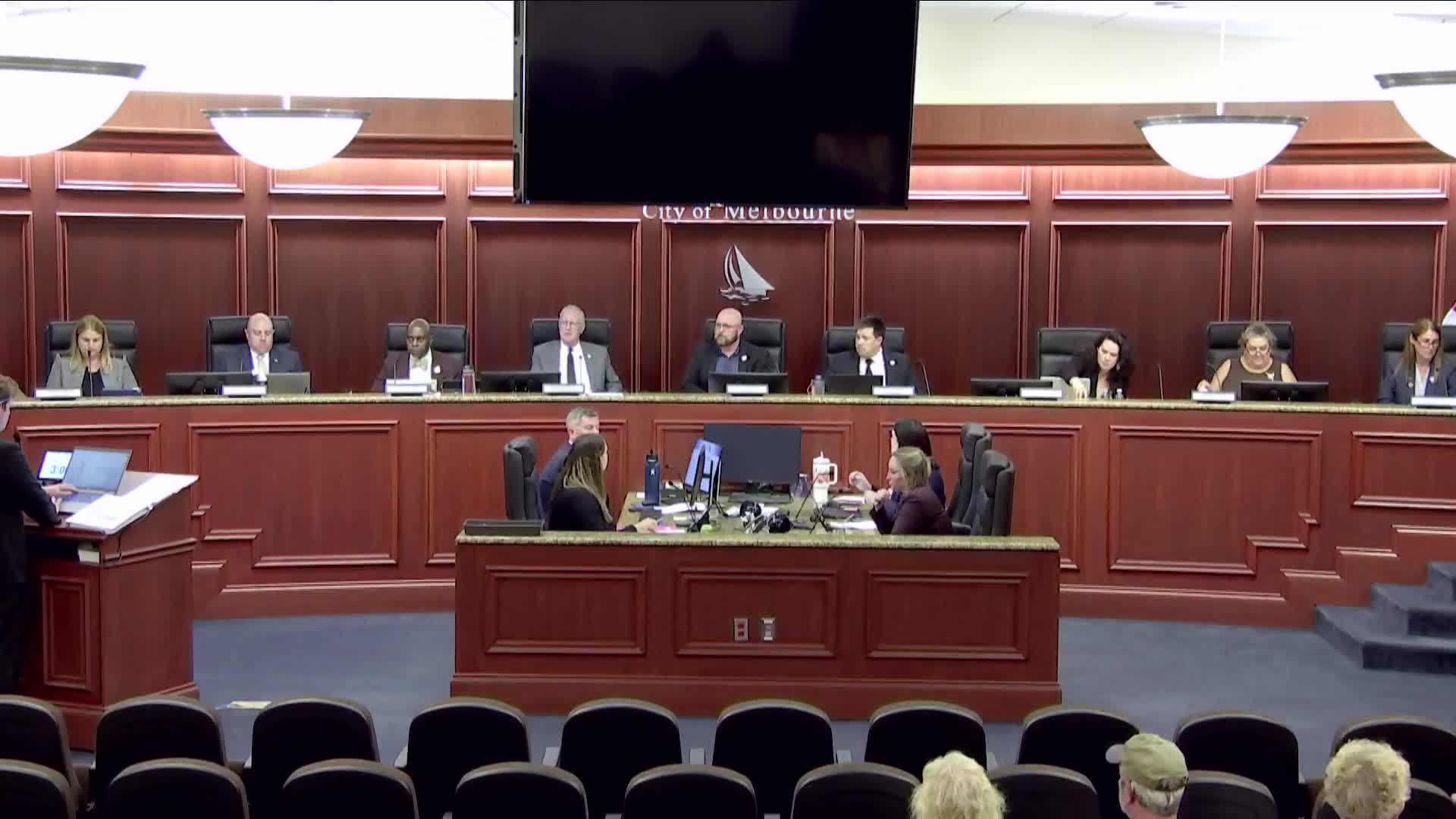
The City of Melbourne City Council voted Sept. 11 to set an operating millage rate of 7.0112 and to adopt a revised fiscal 2026 proposed budget of $315,889,605, with the separate police headquarters debt-service millage set at the rollback rate of 0.2977.
The council majority chose “option 8,” a package staff presented that raises property-tax revenue to add roughly $1 million annually to the pavement management program and increase recurring funding for the machinery and equipment (M&E) replacement fund. Council members said the additional revenue is intended to slow long-term deterioration of roads and to avoid deferring replacement of critical vehicles and equipment.
Ross McGinn, staff member, led the presentation and explained why staff recommended the higher millage: “we are, seeing increases in employee compensation and, are desiring to, dedicate additional funding to our pavement management program and MNE program,” McGinn said. He showed the city’s pavement-management target — originally set in 2015 at $5.1 million annually — and noted recurring funding currently totals about $4.0 million, including local-option gas taxes and property tax. He said that a more inflation-adjusted target would likely be higher than $5.1 million.
The council discussed tradeoffs between additional road funding and the M&E program, which staff said is targeted at an average need of about $3.6 million over the next 10 years based on fleet condition. Council member Hanley argued for the higher option as a long-term investment: “I think everybody up here wants to leave the cap the council better than what we even got it,” Hanley said, adding that steady funding could prevent future “significant increases.”
During the public hearing, resident David Graham of the Sarno Heights area urged the council to hold utility rates steady, telling the council, “the utility rates are already excessively high,” though the utility rates issue was not before the council as an action item that night.
On procedural matters, staff noted the police headquarters debt-service millage is set at 0.2977 by bond covenant and remains at its rollback rate. The operating millage of 7.0112 represents an 11.4% increase over the rollback rate of 6.2927 as calculated under Florida statute; staff described the increase as intended to preserve pavement condition and address deferred equipment replacement while meeting compensation and contract commitments.
The council then voted to adopt (1) the operating millage rate of 7.0112 and the police debt-service millage rate of 0.2977 and (2) the revised fiscal-year 2026 proposed budget of $315,889,605. The council separately adopted the Downtown Community Redevelopment Fund budget at $3,152,855 and the Old Oakley Riverfront Community Redevelopment Fund budget at $1,194,783. The votes were recorded by voice; the motion and second were made on the floor and the chair called for ayes, after which the motions passed.
Council members and staff emphasized the intent to make the pavement and M&E funding recurring so the programs do not continue to be underfunded year-to-year. McGinn said the city will continue to monitor and update assumptions as a new pavement study and ongoing fleet analysis provide more current data.
Votes at a glance
- Operating millage (City of Melbourne): 7.0112 — approved (voice vote) - Police Headquarters Debt Service millage: 0.2977 (rollback) — approved (voice vote) - Adopted fiscal 2026 proposed budget (revised): $315,889,605 — approved (voice vote) - Downtown Community Redevelopment Fund budget: $3,152,855 — approved (voice vote) - Old Oakley Riverfront Community Redevelopment Fund budget: $1,194,783 — approved (voice vote)
Looking ahead, staff said the city will present the budget documents updated to reflect the adopted millage rates and continue work on a modernized pavement-management study; council members asked staff to return with details on how the new recurring amounts will be appropriated within the capital program.