Get Full Government Meeting Transcripts, Videos, & Alerts Forever!
Get email alerts on the Local Finance topic
No spam. Unsubscribe anytime.
Finance committee urges no action on planning board short‑term rental limits, cites fiscal uncertainty
Summary
The committee unanimously recommended no action on a Planning Board article that would limit non‑hosted short‑term rentals to 49 days in high season and 21 additional days elsewhere, citing insufficient economic analysis and a conservative town projection of a $2.5 million drop in room‑occupancy tax revenue.
The Nantucket Finance Committee on Oct. 10 recommended no action on a Planning Board warrant article that would impose strict limits on short‑term rentals, saying the town lacks the financial analysis needed to judge economic consequences.
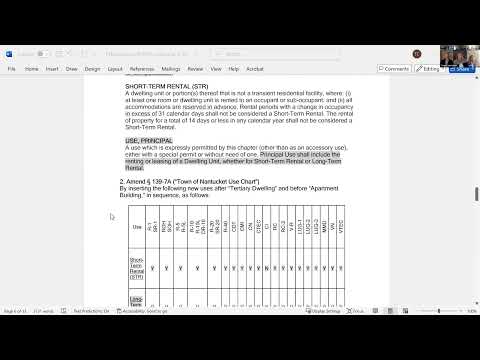
The planning board proposal would treat “hosted” stays differently from non‑hosted short‑term rentals; hosted stays (where an owner or operator remains on the same lot) would be exempt from the new limits. Under the draft language discussed in the meeting, non‑hosted short‑term rentals would be limited to 49 days during the high season (defined in the article as June 15–Aug. 31) and would be allowed an additional 21 days across the remainder of the year.
Town finance staff presented a conservative fiscal projection intended to inform the committee's decision. The finance director told the committee that, based on available state remittance data and conservative occupancy assumptions, the town could see roughly a $2.5 million reduction in room‑occupancy tax receipts if the proposed limits were enacted and market behavior followed the projected pattern. The director warned that a revenue shortfall of that magnitude would force difficult budget choices and could erode the town's reserve position.
Planning Board Chair Dave Iverson, who led drafting of the article, said the measure was intended to give a broad set of residents an option for limiting investor‑style churn while still allowing homeowner‑occupied hosted rentals. “The intention of what I have done was to give voice and options to a large part of our community,” Iverson said, adding he believed the article balances differing community interests.
Public testimony at the hearing reflected a wide split. Supporters of the Planning Board article said the limits would curb neighborhood churn and protect the island’s shoulder season from being eaten by short‑term rentals. Opponents, including resident business owners and long‑term property owners, said the limits would reduce rental income that many households rely upon to afford upkeep and local spending, and could harm off‑peak businesses.
On the enforcement question, speakers noted the town already operates a complaint line and registration system but that enforcement has been limited in practice. The planning board and town staff discussed platforms’ compliance with displaying the town registration number and said that step will help tracking and enforcement.
After hearing testimony and the finance presentation, the Finance Committee voted unanimously to recommend no action on Article 2, saying in its motion that the committee did not support the planning board's motion for favorable action because the proposal lacked sufficient supporting financial and economic analysis. The committee asked town administration to finalize conservative fiscal projections for the budget process and noted potential downstream impacts if the town were to lose several tenths of a million dollars to millions of dollars of annual revenue.
The planning board article remains on the warrant and can be amended on the special town meeting floor; the committee's recommendation will be included in the printed warrant materials.