Get Full Government Meeting Transcripts, Videos, & Alerts Forever!
Get email alerts on the Short Term Rentals topic
No spam. Unsubscribe anytime.
Finance committee backs citizens' article to codify rentals into Nantucket zoning
Summary
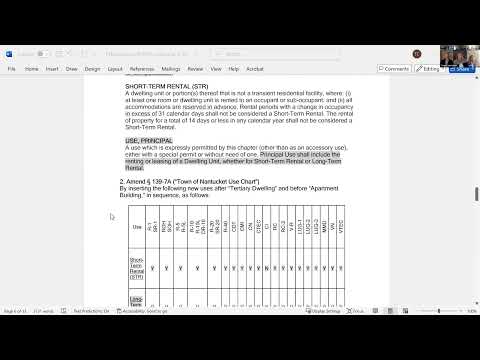
On Oct. 10 the Finance Committee recommended adoption of a citizens’ warrant article that would explicitly list rental uses in the town zoning bylaw, a move proponents say would end lingering litigation and opponents say could lock in protections that limit future regulation.
The Nantucket Finance Committee voted 4-3 on Oct. 10 to recommend adoption of a citizens’ warrant article that would place all residential rentals into the town’s zoning bylaw.
Proponents say the change is aimed at resolving legal uncertainty created by recent lawsuits. Penny Dye, speaking for the petitioners in lieu of sponsor Brian Borgeson, told the committee the article “codifies all rentals into our zoning bylaw, subject to existing and future regulations.” She said roughly 350 people signed the petition to call the special town meeting and that the measure would preserve the existing registration, safety, noise and parking requirements and the 24/7 hotline that receives complaints.
Supporters described the proposal as a narrow fix to prevent privately funded litigation from “pitting neighbor against neighbor.” Dye said town data show short‑term rentals make up roughly 11% of Nantucket properties and that the short‑term rental complaint line received five calls this year, two to verify whether a property was a short‑term rental. “Article 1 is simple,” she said. “It codifies all rentals into our zoning bylaw, subject to existing and future regulations.”
Committee members questioned how long‑term leasing was defined in the draft language. A planning board member identified as John explained the working definition used by proponents: a long‑term lease is “the rental or leasing of any residential dwelling unit or a portion thereof in exchange for compensation,” and any residential use not defined as a short‑term rental would be treated as a long‑term residential use under the proposed wording.
Several residents who spoke during the public comment period urged the committee to support Article 1, saying it would protect the local economy and clarify rights for homeowners. Opponents in the public record argued the change could make future limits harder to adopt by creating a protected zoning status for properties that are legal short‑term rentals when the zoning change takes effect.
After discussion the Finance Committee moved not to support the Planning Board motion to “take no action” and instead recommended adoption of Article 1. That motion passed 4 to 3.
The article now goes to the special town meeting warrant. If voters adopt it, the town’s zoning bylaw would explicitly list residential rental uses; proponents say that will blunt pending litigation and allow the town to continue enforcing existing registration and safety rules. Opponents say the change could constrain future zoning options and recommended careful follow‑up by town boards.