Get Full Government Meeting Transcripts, Videos, & Alerts Forever!
Get email alerts on the Single Use Foodware Policy topic
No spam. Unsubscribe anytime.
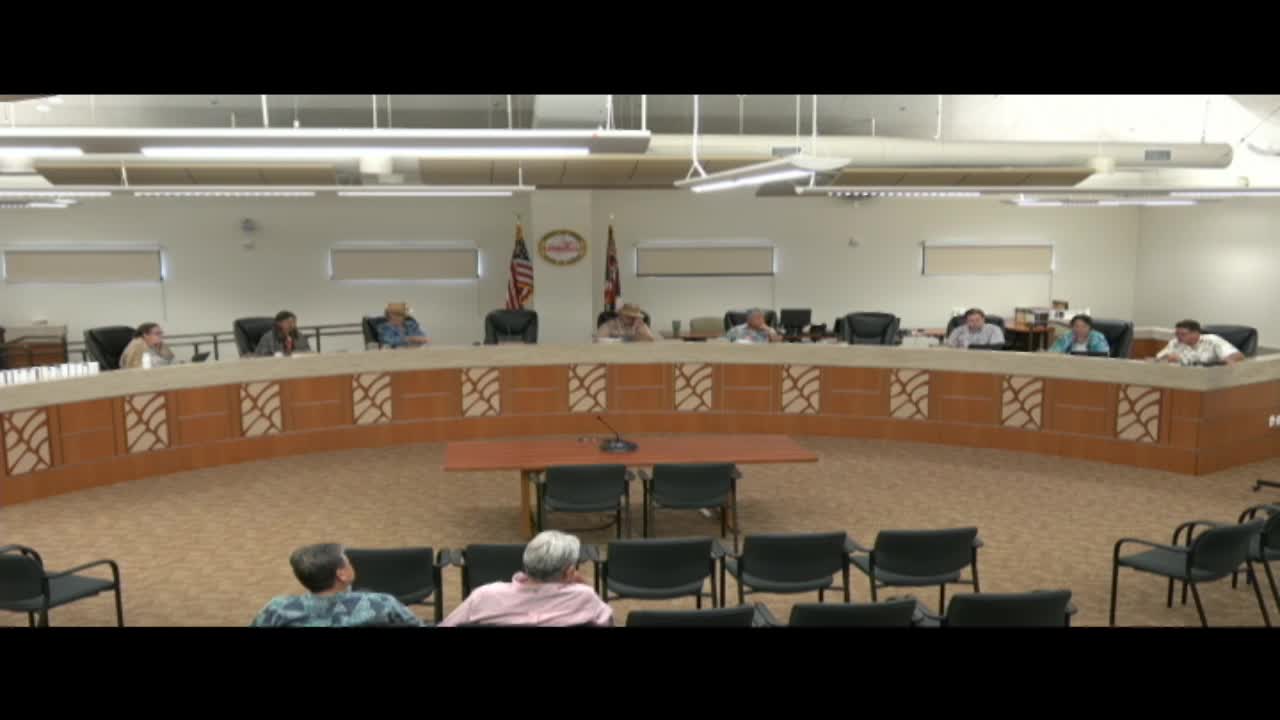
Hawaii County committee forwards Bill 83 to council after debate over composting capacity and costs
Summary
A Hawaii County policy committee voted 7–1 to advance Bill 83, which would restrict disposable plastic and polystyrene foodware and require certified compostable alternatives, after public testimony and discussion about composting infrastructure, business costs and labeling.
The Policy Committee on Environmental and Natural Resource Management voted to forward Bill 83 to the full Hawaii County Council with a favorable recommendation after a 7–1 roll-call vote on Oct. 21.
The measure, introduced by Council member Villegas and co-introduced by Council member Galimba, would amend Chapter 20 of the Hawaii County Code (1983, 2016 ed., as amended) to reduce disposable plastic and polystyrene foodware and service ware in alignment with the County of Hawaii Zero Waste Plan and the State of Hawaii's Aloha+ Challenge solid-waste reduction goals. The committee recorded seven votes in favor, one opposed and one member absent.
The vote followed more than two hours of public testimony and committee discussion that centered on two issues: whether Hawaii County currently has composting capacity to process certified compostable foodware, and the potential cost impact on local businesses and consumers.
Business representatives told the committee that without a local composting facility, certified compostable products would likely still end up in the landfill, imposing higher costs without delivering environmental benefits. Steven Ueda, president and CEO of Sui San Company Limited, said, "Bill 83, as it's written, won't actually achieve that goal" because "the county doesn't have a composting facility that can process these products." He added that compostable forks are "almost twice the price of plastic," and that containers cost "about 40% more." Jason Higa, CEO of Zippy's Restaurants, said his company had tested compostable containers and that they had performed poorly with hot, oily local foods: "Hot dishes leak. Lids warp. Utensils break." Both urged deferral or amendment to phase in requirements when composting is available.
Other testifiers and committee members pressed for clearer labeling standards and agreed transition timelines. John Veil, CEO of Sustainable Island Products, urged requiring visible BPI (Biodegradable Products Institute) markings on compostable items, stating, "BPI certification requires the product be visibly marked with a BPI logo. That mark is the only tool for proper waste diversion." Alexis Chapman of the Hawaii Food Industry Association asked the committee to amend the bill so BPI-certified items whose marks appear only on the case are still allowed.
Representatives from the Department of Environmental Management told the committee that the county currently has three recycling specialists on staff and that the contracted material processor (Hawaii Earth Recycling) accepts yard waste but is not permitted to receive food-service compostables today. Alex White, recycling specialist with the Department of Environmental Management, said, "Currently, we're only allowed to accept green waste" and that a separate composting facility and permitting would be needed to accept food-related compostables. He also said the county's landfill life estimates are now closer to 18 years and that a waste-characterization study planned for 2026 will provide more detailed data.
Council members who supported forwarding the bill said draft 2 addresses several earlier concerns and pointed to progress in product quality and availability since similar measures were considered in other counties. Council member Villegas told colleagues the clerk's office and corporation counsel advised that the Environmental Management Commission and Department of Environmental Management will have 45 days to review the draft and offer comments, and that the bill can proceed through committee but cannot be finally adopted at second reading until that 45-day period expires.
Opponents and business representatives asked for alignment among county rules to avoid requiring different products on multiple islands and for exemptions or phased implementation for high-heat or specialty uses. Council member Onishi cast the lone vote against forwarding the bill, citing lingering questions about cost and composting throughput.
Action taken: On a motion by Council member Villegas, seconded by Council member Galimba, the committee recommended passage of Bill 83, draft 2, on first reading and referred the measure to the Environmental Management Director and the Environmental Management Commission for review. Vote tally shown below.
Votes at a glance: Motion to forward Bill 83, draft 2, to council with a favorable recommendation — Passed (7'01, 1 absent) - Mover: Council member Villegas - Second: Council member Galimba - Roll call: Council member Galimba: Aye; Council member Eustace: Aye; Council member Inaba: Aye; Council member Connolly Kleinfelder: Aye; Council member Kirkewitz: Aye; Council member Kimball: Aye; Council member Onishi: No; Council member Villegas: Aye; Vice Chair Kakuahata/Kawhiwata: Aye; one member recorded absent.
Next steps: The bill will be sent to the Environmental Management Commission and Department of Environmental Management for the 45-day review period referenced by staff. Committee members encouraged continued dialogue among businesses, suppliers and bill authors on labeling, exemptions and phased implementation while the county evaluates composting capacity and awaits the 2026 waste-characterization study.
This article is based on public testimony and statements recorded in the Oct. 21, 2025 Policy Committee meeting on Environmental and Natural Resource Management for Hawaii County.