Get Full Government Meeting Transcripts, Videos, & Alerts Forever!
Get email alerts on the Shared Mobility topic
No spam. Unsubscribe anytime.
Council asks staff to craft plan for bicycle and scooter share pilot, citing safety, geofencing and campus partnerships
Summary
The Chico City Council unanimously directed staff to return with an implementation plan for a regulated bike/scooter share pilot that would include parking rules, maintenance standards, insurance and partnerships with Chico State and others.
The Chico City Council voted unanimously to refer a proposed shared-mobility program to staff for development of an implementation plan, directing that the plan address safety, parking enforcement, maintenance standards, and possible partnerships with Chico State and other local entities.
Council Member Winslow introduced the item, noting state law (Assembly Bill 1286, 2020) requires local governments to adopt permitting or regulatory frameworks if they want to allow commercial shared mobility services such as dockless bikes and scooters. Winslow said an adopted local framework would permit operators to apply rather than leaving the field unregulated.
Supporters and technical context
Public commenters included Jesse Horgan, chair of Chico State’s Alternative Transportation Committee, who told council the university aims to align campus sustainability goals with city policy. “Chico...has a gold designation for being a bicycle friendly community,” Horgan said, and he urged harmonizing a share program with campus goals and designated parking areas.
Local entrepreneur Raymond Swope, founder of the local operator proposal, described a small pilot model and said the operator would use geofencing, speed limits and insurance to reduce hazards and prevent clutter. “Our goal is to keep Chico’s streets, sidewalks, and bypass clear, accessible, and enjoyable for everyone,” Swope said.
Engineering and enforcement
Public Works engineering staff told council that technology has improved since earlier local attempts at shared mobility and that a permit framework and close coordination with the Police Department would be essential. Council members focused on enforcement of sidewalk riding bans, helmet requirements and speed limits under the California Vehicle Code, and on using geofencing to limit speeds or disable devices in sensitive areas.
Motion and outcome
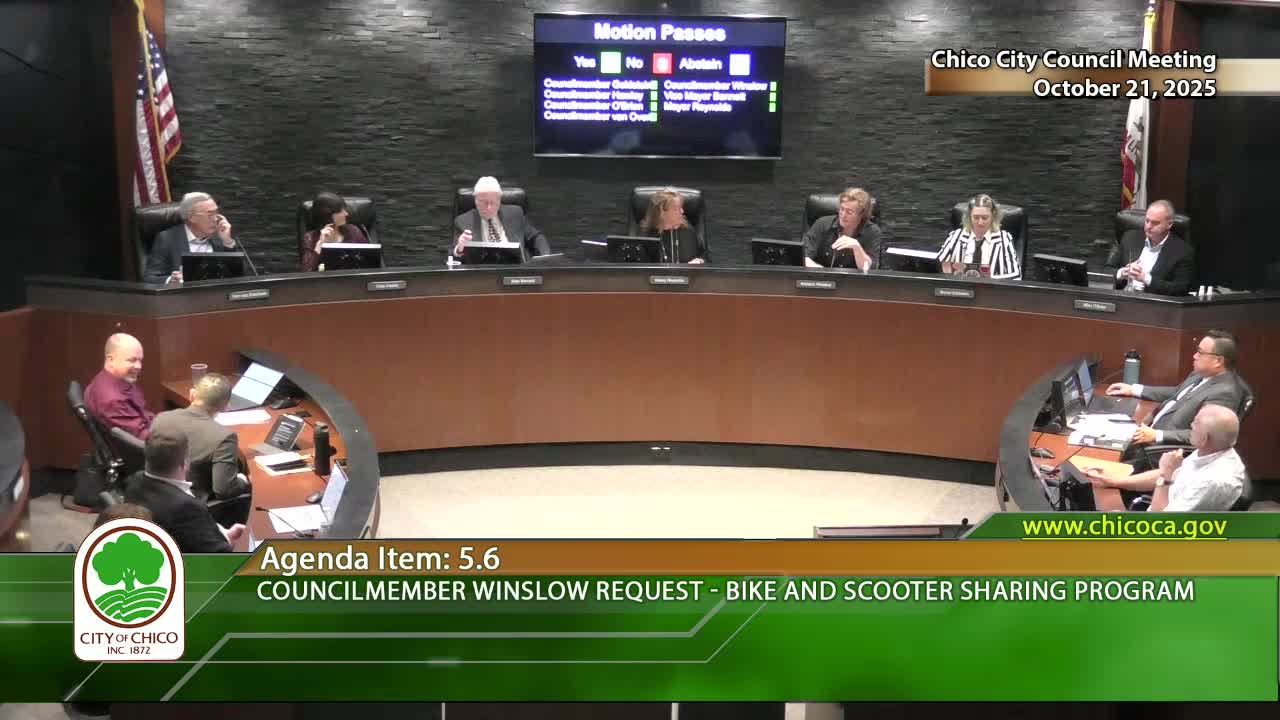
Council Member Winslow moved to refer the proposal to staff to return with an implementation plan that includes permitting, parking and maintenance standards, safety measures including geofencing and speed limits, and outreach/partnerships with Chico State and other stakeholders. The motion was seconded and passed on a roll-call vote (Goldstein—Yes; Holly—Yes; O’Brien—Yes; Van Overbeck—Yes; Winslow—Yes; Vice Mayor Bennett—Yes; Mayor Reynolds—Yes). Motion carries 7-0.
Next steps and council direction
Council asked staff to explore a limited pilot rather than a full citywide rollout, to propose parking “corrals” or designated parking zones, to identify insurance and indemnity requirements for operators, and to consult with the Police Department on enforcement protocols. Several council members suggested beginning with a small, locally managed pilot and expanding only if problems are manageable.
Why it matters: The referral sets the city on a path to authorize a regulated shared-mobility service that could increase transportation options for students and residents, support climate and bike-friendliness goals, and require clear city standards for safety and parking enforcement.