Get Full Government Meeting Transcripts, Videos, & Alerts Forever!
Get email alerts on the Homelessness Shelter topic
No spam. Unsubscribe anytime.
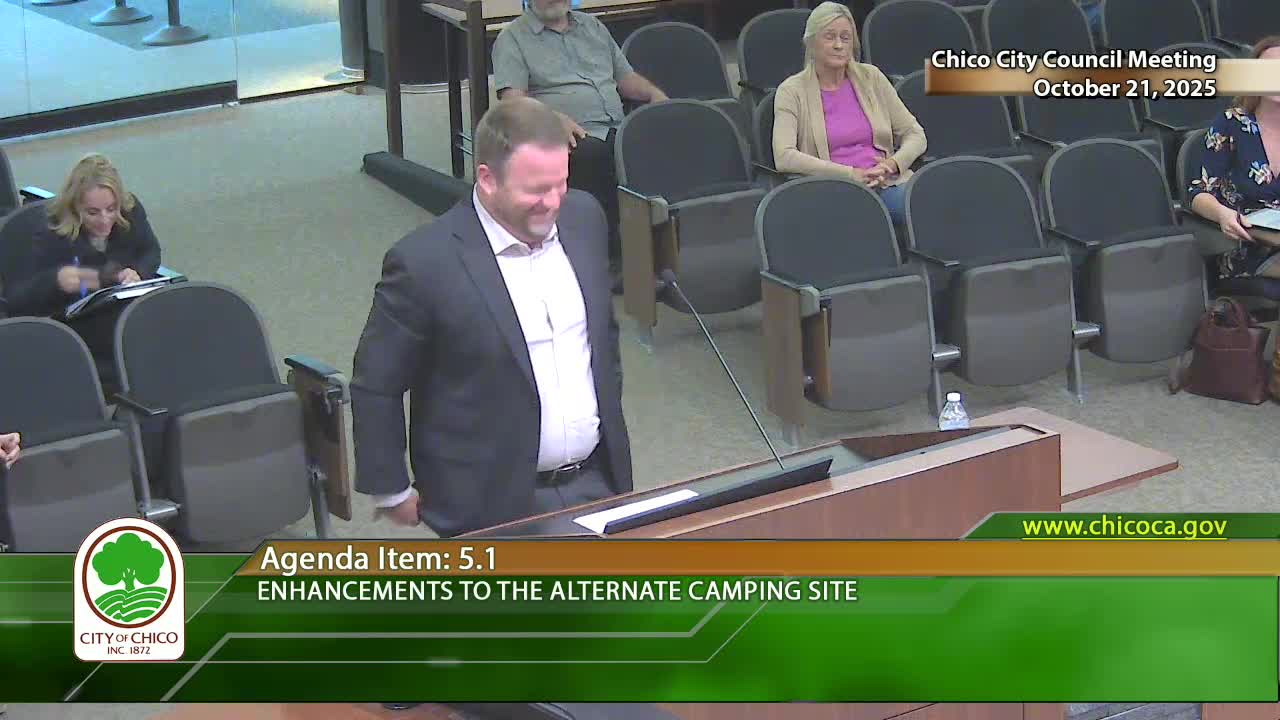
Council approves stepped-up staffing, enforcement and livability upgrades at Eaton and Cohasset alternate campsite
Summary
The Chico City Council voted 7-0 to adopt staff recommendations to tighten rules, increase outreach staffing and expand security around the Eaton and Cohasset alternate campsite, with an initial period of heavier staffing and a council review in two to three months.
The Chico City Council voted unanimously Tuesday to adopt a package of measures aimed at improving safety and livability at the alternate campsite located at Eaton and Cohasset.
City staff recommended adopting new rules for the site’s code of conduct, enforcing 20-by-20 assigned campsite footprints, expanding case management and outreach staffing provided by the Jesus Center, and using private security contractors to cover overnight hours. The council approved an implementation plan that directs staff to phase in the changes quickly and return with a progress report in two to three months.
The site has been used since 2022 as an authorized alternate camping location, and staff said it currently hosts 18 authorized occupants. “This is the existing site at Eaton and Cohasset that’s been here since 2022,” Public Works Director Eric Gustafson told the council during a detailed presentation of enforcement, livability and staffing options. Gustafson said six occupants have had their individual assessments updated and are eligible to move to the Genesis shelter; staff recommended encouraging those moves and departing people from the site if they decline.
Why it matters: Council members and residents said the nearby school, businesses and a community center have experienced spillover impacts from unauthorized camping and surrounding encampments. The council’s action aims to reduce public-safety risks (particularly fire hazards), improve site management through case management, and give nearby businesses and residents more consistent enforcement and patrols.
Key provisions and staff recommendations
- Code of conduct: staff will add and enforce rules that include no unauthorized people on site, a strict 20-by-20 campsite footprint, no structures beyond the assigned space, and prohibitions on generators, gasoline cans, loose electrical cords and propane tanks.
- Behavioral process: staff described a four-step corrective process (three progressive written warnings, then departure for continued violations) administered by on-site case managers.
- Property and storage: items that pose health or safety risks may be destroyed; personal property not posing an immediate risk will be placed in storage at 995 First Street for up to 90 days, staff said.
- Livability upgrades: short-term improvements such as pallet pads (raised platforms made of pallets and plywood), additional park-style barbecues and limited pet fencing for individual 20-by-20 sites were recommended; permanent structures or uniform tents would trigger building-code requirements and were described as cost- and time-prohibitive.
- Staffing options and costs: staff recommended expanding the Jesus Center’s operations and outreach presence (the presentation estimated two Jesus Center staff five days a week at about $9,500 per month / $114,000 per year) and using AG Security for overnight coverage (staff estimate for a graveyard shift: about $7,200 per month / $86,400 per year). Staff noted the full five-day-a-week / overnight configuration would total roughly $200,000 per year and that no dedicated budget had yet been identified; the council directed an incremental approach and initial heavy staffing for evaluation.
Council discussion and public input
Vice Mayor Bennett asked whether the security contractor could patrol adjacent shopping centers and residences; staff said expanded patrols could be arranged at incremental cost. Council Member Van Overbeck clarified that “no structures” meant no fixed additions beyond tents or pallet pads; staff said tents would remain feasible but that structures with doors, electrical service or fixed roofs would trigger building-code requirements.
Council Member Winslow emphasized fire hazards from large generators and linked the prohibitions on generators and gas cans to past fires. Gustafson said some occupants had previously linked multiple propane devices together and that the generator ban was aimed at reducing those risks.
Several residents and service providers spoke during public comment. Lynn Overholtzer urged repeated perimeter enforcement to prevent unauthorized people from returning, saying, “I think you need to do an official complete enforcement a quarter mile around the perimeter of that camp.” Robin McCollum and Laurie Mason of the North State Shelter Team urged continued investments in services and cautioned that removing people without alternatives could shift problems elsewhere.
Motion and outcome
Council Member O’Brien moved to support staff recommendations, including initially increasing Jesus Center staffing (the council asked for heavy staffing up front), expanding AG Security patrols to include neighboring businesses and residences, implementing the proposed code changes and livability upgrades (including pallet pads), and returning with a status report in two to three months. Council Member Van Overbeck seconded. Roll call votes: Goldstein—Yes; Holly—Yes; O’Brien—Yes; Van Overbeck—Yes; Winslow—Yes; Vice Mayor Bennett—Yes; Mayor Reynolds—Aye. Motion carries 7-0.
Clarifying details and next steps
Staff said the site’s current authorized capacity could accommodate up to about 50 occupants if expanded; at present there are 18 occupants. Of those 18, six had updated assessments indicating they are eligible for placement at the Genesis shelter; staff said the goal was to reduce occupancy toward 12 to make on-site management easier. Staff recommended incremental increases in Jesus Center coverage (two staff in a swing shift was a model presented) and possible limited AG Security overnight coverage. If the city decides to scale up staffing beyond small incremental steps, staff said a budget supplemental could be required; the council authorized an incremental approach and asked for a two-month evaluation period following implementation.
Staff will begin implementing the code changes and the staffing adjustments directed by the council and will return to council with a progress report in two to three months.