Get Full Government Meeting Transcripts, Videos, & Alerts Forever!
Get email alerts on the Governance topic
No spam. Unsubscribe anytime.
Commission considers revised ordinance to formalize ex officio tribal representation; staff will send summary for review
Summary
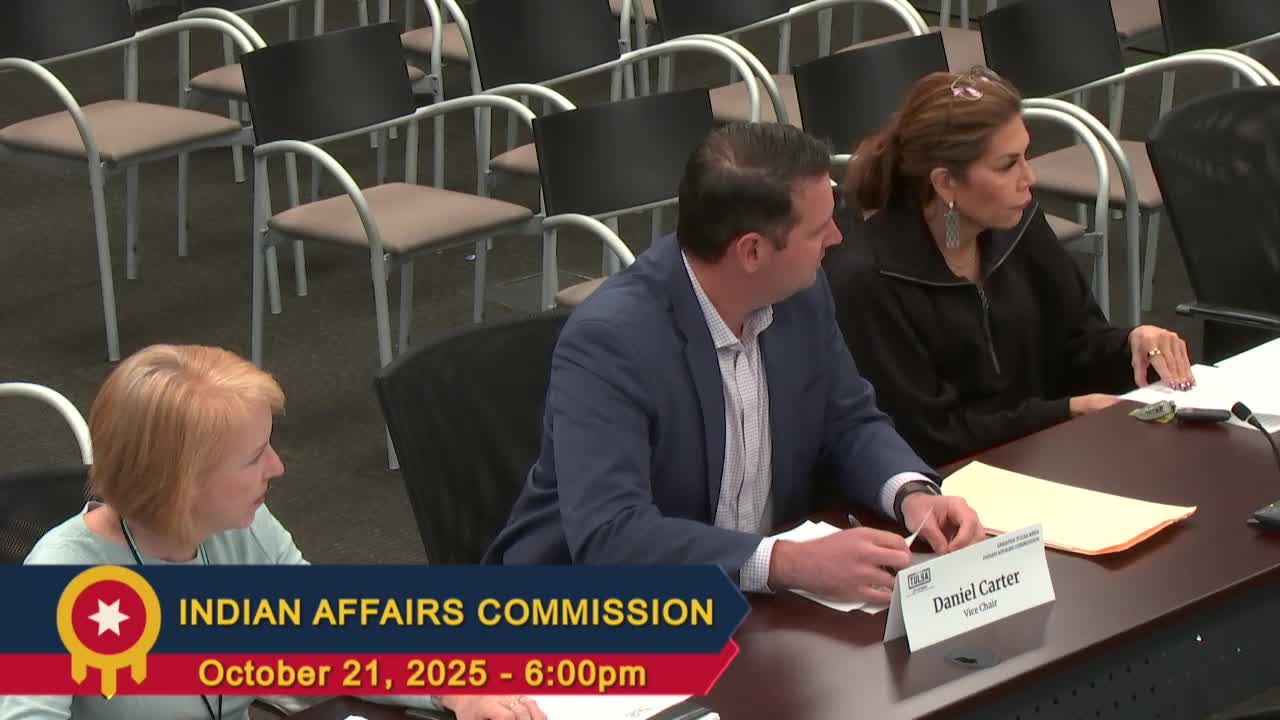
The Greater Tulsa Area Indian Affairs Commission’s bylaws committee on Oct. 21 presented a draft revised ordinance that would formalize permanent ex officio seats for the Cherokee Nation, the Muscogee (Creek) Nation and the Osage Nation and reorganize membership language for clarity.
The Greater Tulsa Area Indian Affairs Commission’s bylaws committee presented a draft revised ordinance on Oct. 21 that restructures the commission’s membership language and would make the Cherokee Nation, the Muscogee (Creek) Nation and the Osage Nation permanent ex officio positions on the commission.
A committee member said the draft reorganizes the ordinance for clarity — moving purpose and objectives to the top and describing appointments and delegates more clearly — and that the packet includes a summary of changes for commissioners to review. The committee asked commissioners to take two months to review the draft and return comments in early 2026; the ordinance would go to city council and the mayor for approval if the commission recommends it.
Committee members described the permanent ex officio seats as a response to concern that future councils or mayors could remove tribes’ representation if tribes were listed only as appointable organizations. The draft would keep space for other tribes and organizations to be appointed, the committee said, and staff emphasized the draft does not remove current organizations or individuals from the commission.
Several commissioners raised questions about membership eligibility language that requires individual appointees or organizational delegates to demonstrate American Indian ancestry “by tribal enrollment or CDIB card.” One commissioner asked whether that standard covers people enrolled in tribes that are not federally recognized; the committee said the language was borrowed from existing bylaws and flagged the provision for further discussion.
No formal vote was taken on the ordinance at the meeting. The committee said it will send the draft and a summary to commissioners and aims to advance the ordinance early in 2026, after an internal review period.