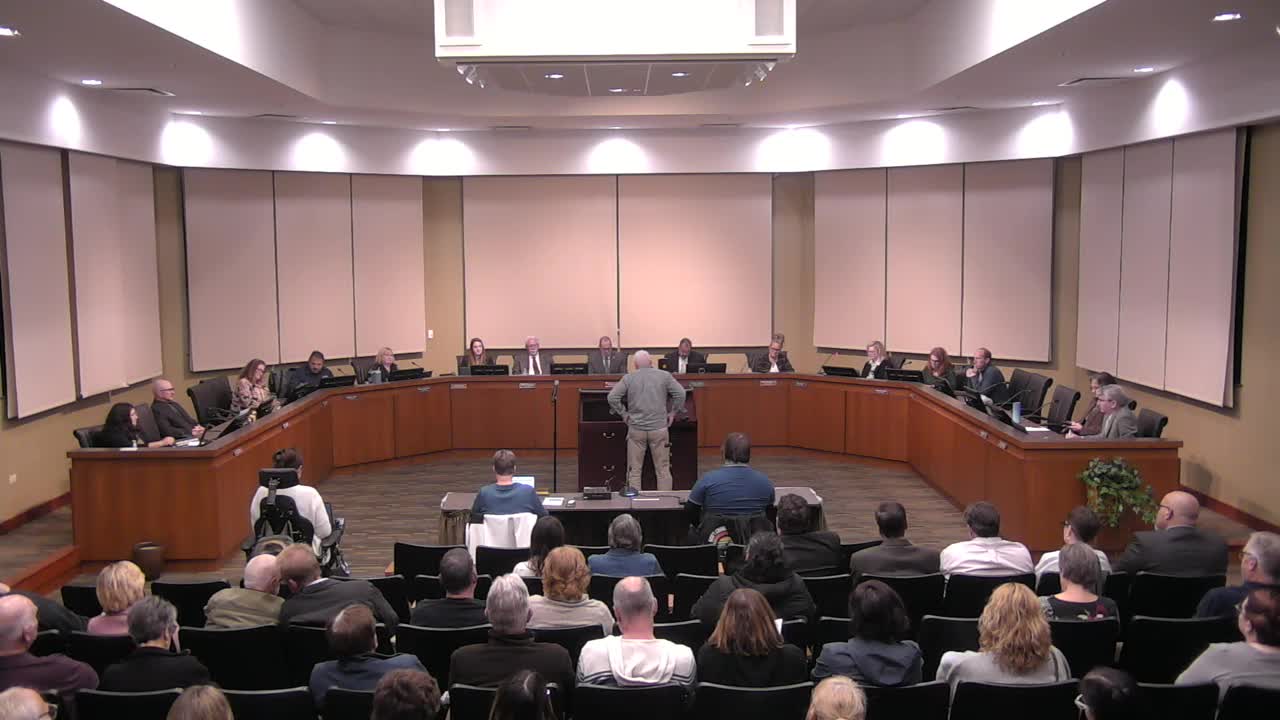
Residents and officials spar over 202‑unit proposal for former Traubber school site; no vote taken
Loading...
Summary
Village trustees and a developer debated a revised plan to build 202 housing units on the former Traubber Junior High site at Route 71 and Washington Street. Residents pressed traffic, stormwater and school‑capacity concerns; the board requested additional studies and design revisions but took no formal vote.
Developers presented a revised plan for the former Traubber Junior High School site to the Oswego Village Board on Oct. 21, drawing lengthy public comment and detailed questions from trustees about traffic, stormwater, school impacts and design. No formal approvals were sought or granted; the board asked staff to continue negotiations with the developer, the school district and technical consultants.
The proposal, submitted in response to a school‑district request for proposals, would redevelop roughly 12 acres at the northeast corner of Illinois Route 71 and Washington Street into a mix of for‑sale townhomes and rental apartments totaling 202 units. The developer said the concept now includes 30 two‑story townhomes, three three‑story apartment buildings (92 units total) and a larger building along Route 71 containing 80 units (described by the developer as four stories of apartments over one level of parking), for a total of 202 units and about 270 parking spaces.
The plan is a revision of an earlier concept that the Planning and Zoning Commission reviewed and recommended the board deny on Sept. 4. At the Oct. 21 meeting, the development team — including Brian Kronwitter and Michael Pulakidis of JM Development and architect Bridal Shah of Koredogan Clark — said they had reduced height in parts of the site, increased on‑site green space to about 3.53 acres and converted some multifamily buildings to two‑story townhomes to better transition to adjacent homes. The team said the design now includes a clubhouse, pool, gazebo, walking paths and dog park.
Why it matters: the site sits beside Oswego’s historic residential core and near Oswego High School. Residents and trustees framed their concerns around near‑term public safety and livability (traffic during school periods, parking overflow into adjacent streets, stormwater runoff and sewer capacity), and longer‑term issues including whether a high‑density project will preserve the character of the historic downtown.
Public concerns and developer replies
Several residents who live near the site urged the board to reject the project or require substantial changes. Don Draxler of 25 Garfield Street said the downtown corridor already faces heavy congestion at peak hours and predicted the project would worsen backups and push cut‑through traffic into neighborhood streets. "Development of an apartment complex where Traubber School currently is will only increase the congestion and negatively impact our property values," Draxler said.
Other speakers echoed traffic and parking worries and raised questions about stormwater detention, the likely student yield from new units, and whether units would accept housing vouchers. Dominic Liberatori, who said he attended the last class at the old Traubber junior high, told trustees the Planning and Zoning Commission had recommended denial and urged village leaders to "stand with the community you represent."
Developer representatives responded to the concerns with several commitments and explanations. They said the proposal is intended to include a mix of owner‑occupied townhomes and rental apartments to provide "missing middle" housing and generate tax revenue for local taxing bodies, including the school district. The team said the design has been altered to reduce building heights adjacent to single‑family homes, to increase tree plantings and to add pedestrian paths.
On vouchers and student yield, the developer said the project would not include project‑based Section 8 subsidies and that the unit mix favors studios and one‑bedroom units, which typically generate fewer school‑age children than larger units. "This is not Section 8," a developer representative said. "We will strive to meet the missing‑middle market."
School district rationale and finances
Dr. Calgatti, identified in the meeting as superintendent of School District 308, explained the district’s decision to solicit development proposals. He said the former Traubber building has sat out of educational service for about a decade, costs the district more than $250,000 a year in maintenance and utilities and would require multimillion‑dollar investment to make it usable. "Given these ongoing costs and competing priorities, we have aligned our approach with the district's strategic plan and long‑range facility plan," Calgatti said, adding that demolition or rehabilitation costs have previously deterred buyers.
Calgatti and the developer both told the board the district had marketed the site for years with little interest; the current request for proposals produced one respondent. Calgatti said selling or redeveloping the property could help the district reallocate funds to classroom needs.
Technical studies and next steps requested by the board
Trustees and staff stressed that the concept plan requires more technical work before any formal approvals. Specific items the board asked to be produced or expanded, and frequently referenced in the discussion, included:
- A traffic study with an expanded scope that examines nearby intersections (including the 71/Washington corridor, the Franklin/71 corner and the local entrances at Tyler/Farrow) and compares the projected traffic impacts of residential versus commercial reuse. - A stormwater management study demonstrating that post‑development runoff would be equal to or less than pre‑development runoff and confirming detention sizing and release rates per Kendall County and village standards. - A sanitary sewer downstream capacity assessment, coordinated with Fox Metro Water Reclamation District, to confirm connections and downstream constraints. - A market study and fiscal‑impact analysis to estimate probable rents/sales, student yield, and the incremental tax revenues a development would generate. - A detailed demolition budget (the superintendent and others cited demolition estimates in the $3–$5 million range) and a proposed structure for how any Tax Increment Financing (TIF) assistance or other incentives would be negotiated.
Developer concessions and financial transparency
The development team proposed an "open‑book" approach for any TIF or incentive package: they described willingness to grant a financial benchmark clause and a "clawback" if the project exceeds agreed returns, and the team said it would prefer to remain an ongoing steward of the property rather than build and resell immediately. The developer also said it would consider further design changes — including reductions to the five‑story element along Route 71 — if required to gain broader community support.
Board response and meeting outcome
Trustees repeatedly told the developer they appreciated the revisions but that the project should return to the Planning and Zoning Commission for additional review given the commission’s prior denial. Several trustees said they remain uncomfortable with the five‑story element along Route 71 and asked the developer to explore lower massing or more owner‑occupied units. The board did not vote on the proposal; instead trustees directed staff to continue to work with the developer, the school district, and outside consultants to produce the studies described above and to refine the design.
What remains open
Key outstanding questions include whether the village will offer TIF or other incentives (and if so, how any demolition expense or gap financing would be apportioned), whether technical studies will show that nearby sanitary and storm infrastructure can be upgraded or is sufficient, what the final unit mix and elevations will be, and whether revisions will satisfy residents and the Planning and Zoning Commission. The developer and district said they will return with further information if the board signals a path forward.
Provenance: excerpts from the meeting transcript (public comment and developer presentation) are cited below in the article metadata.