
Zoning board denies variance for Bodwell Road landscaping yard, gives owner one year to relocate
Get AI-powered insights, summaries, and transcripts
Subscribe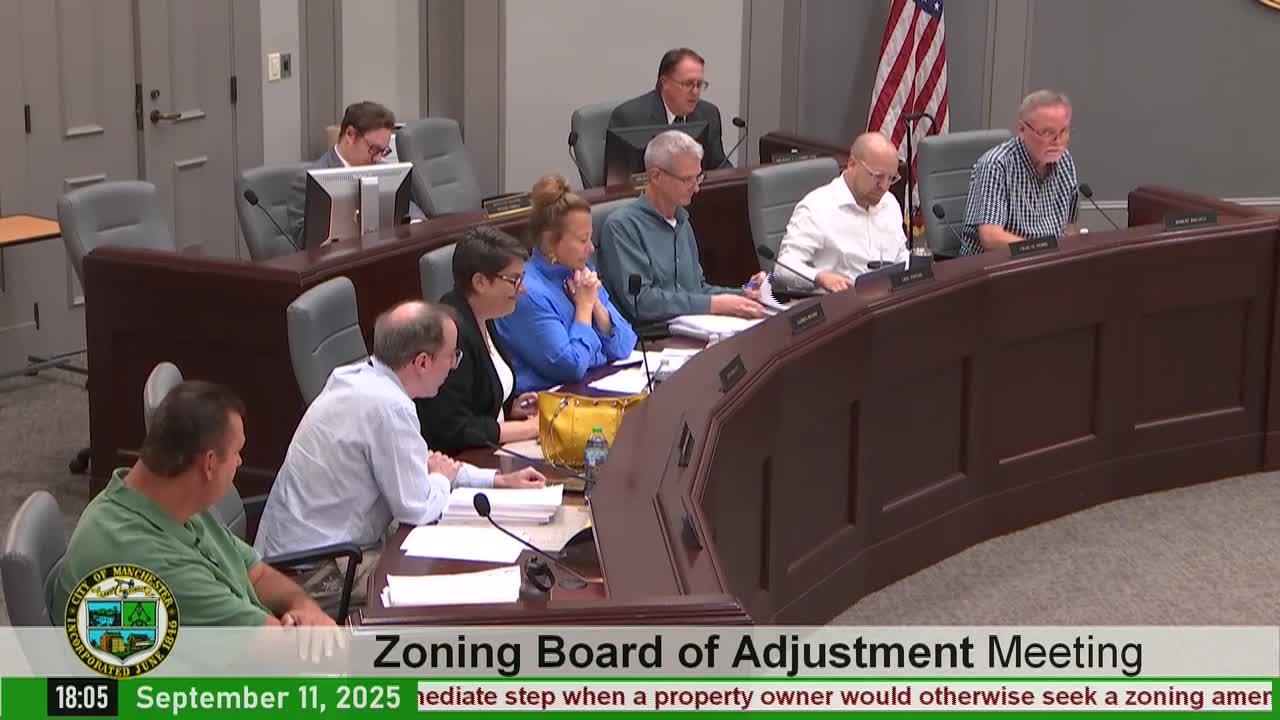
Summary
The Manchester Zoning Board of Adjustment on a September 2025 hearing denied a request from Sean Claypool to legalize a building-contractor/landscaping yard at 582 Bodwell Road, citing scale, encroachment and public-interest concerns, but gave the business one year to find a new site.
The Manchester Zoning Board of Adjustment denied a variance request for a landscaping contractor yard at Bodwell Road and told the applicant that he has one year to find a new location.
The board voted to deny variances requested by Sean Claypool for a property on Bodwell Road (ZVA 2025 — Bodwell Road). The motion denied relief from multiple sections of the city zoning ordinance related to contractor yards, outdoor storage, lot frontage, side-yard setbacks and parking; the board also said it would give the applicant one year to secure an alternative site. The motion passed 4–1; Member Catherine Bolesky voted in opposition.
The applicant, Sean Claypool, told the board he has operated a landscaping business at the property for about 10 years, stores equipment and materials there and registers his trucks with the city. He said his operation employs four people, that most trucks leave the property each morning and return at the end of the day, and that he was willing to add screening and paving if that would help his case. He also said he does snow removal and stores salt on the site, and that the property is owned by his 92‑year‑old grandmother.
Board members said they were sympathetic to Claypool’s livelihood but raised several concerns: that the business has outgrown a residential lot, that materials (including salt) are stored in proximity to neighbors and sensitive areas, and that granting the variances would effectively create a small industrial pocket in an R‑1A single‑family neighborhood that would run with the property and could encourage future expansion.
Greg (board member) summarized the board’s view that the use appears no longer to be a “light” home business and that long‑term approval would be difficult to enforce. June (alternate member, seated for this hearing) and other board members said they were reluctant to allow a level of use they considered inconsistent with the R‑1A district plan. Several board members suggested a limited transition period; the board ultimately settled on one year as a compromise so the owner could plan relocation.
Dale Claypool, who spoke during public comment and identified himself as the applicant’s father, urged the board to consider the family history at the site. The board acknowledged those circumstances but noted that the zoning criteria weigh the neighborhood character and the long‑term implication of a variance.
The denial lists the specific ordinance sections in the motion; the board noted its decision was based on the variances’ inconsistency with the public interest and the zoning district’s purpose, and on the finding that the hardships cited were largely self‑created by the business’s growth on a residential lot.
The board recommended the applicant work with the city’s economic development resources and local small‑business advisors to locate an appropriately zoned site for the operation.
Action and vote: Denial of the requested variances for ZVA 2025 Bodwell Road; board gave the applicant one year to find a new commercial location. Motion passed 4–1; Catherine Bolesky opposed.
What happens next: The denial stands; the applicant retains any administrative or appeal rights established by ordinance (not specified in board remarks). The board recorded the conditions and advised the applicant to pursue alternatives and possible extensions through future filings if needed.