Get Full Government Meeting Transcripts, Videos, & Alerts Forever!
Get email alerts on the Telehealth Kiosks topic
No spam. Unsubscribe anytime.
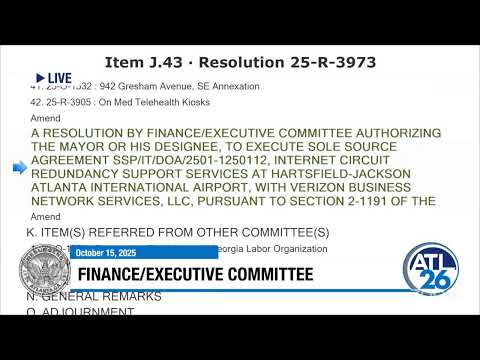
Finance committee approves $2.52 million sole-source OnMed telehealth kiosks, attaches IPRO report
Summary
The committee authorized a sole-source, three-year agreement with OnMed for telehealth kiosks for HR, approved the IPRO report, and answered council questions about privacy, insurance and usage; the resolution passed unanimously.
The City of Atlanta Finance and Executive Committee on Oct. 15 approved a sole-source agreement with OnMed to provide telehealth kiosks for city employees, authorizing up to $2,520,000 over a three-year term and attaching an IPRO report to the file.
The resolution (caption read and identified on the record as a sole-source award for telehealth kiosks with OnMed on behalf of the Department of Human Resources) passed after committee members moved to attach the independent procurement review office (IPRO) report and then approved the agreement. The committee voted in favor, with the chair announcing the vote closed and favorable.
Commissioner Calvin Blackburn (Department of Human Resources) described the system and answered council questions: visits are conducted in private kiosks with HIPAA-compliant, encrypted transmission to licensed providers; kiosks collect vitals (blood pressure, temperature, oxygen levels, weight) via built-in sensors; employees can verify identity with a work badge or employee ID and may use existing insurance coverage; and prescriptions can be sent to a local pharmacy. Blackburn said the kiosks provide privacy and referenced having toured a similar installation in Tampa.
Council members pressed for operational details. Blackburn said the current resolution contemplates two kiosks (the resolution’s language references deployment of two kiosks) and that the $2.52 million figure covers the multi-year agreement (the committee asked for confirmation whether that total included maintenance and services). Blackburn said he would provide more granular contract detail to the committee after the meeting; he noted he believed the package included services, but declined to represent specific line-item allocations without review of the contract.
Committee members also asked whether employees could use kiosks during work hours. Blackburn said HR would not penalize employees for seeking health care and advised employees to coordinate with supervisors as they would for any medical visit; usage during breaks or lunch would not typically require advance coordination.
Why it matters: the kiosks expand telemedicine access for city employees and could reduce barriers to care, but they raise operational questions about placement, ongoing maintenance costs and data-security practices. The committee attached the IPRO report and approved the sole-source award to proceed with implementation.
Next steps: HR will provide additional contract detail to the committee about services included in the $2.52 million price and confirm maintenance and ongoing-service responsibilities and any planned kiosk locations.