
Miami Beach committee backs bringing living seawall incentives back for policy development
Get AI-powered insights, summaries, and transcripts
Subscribe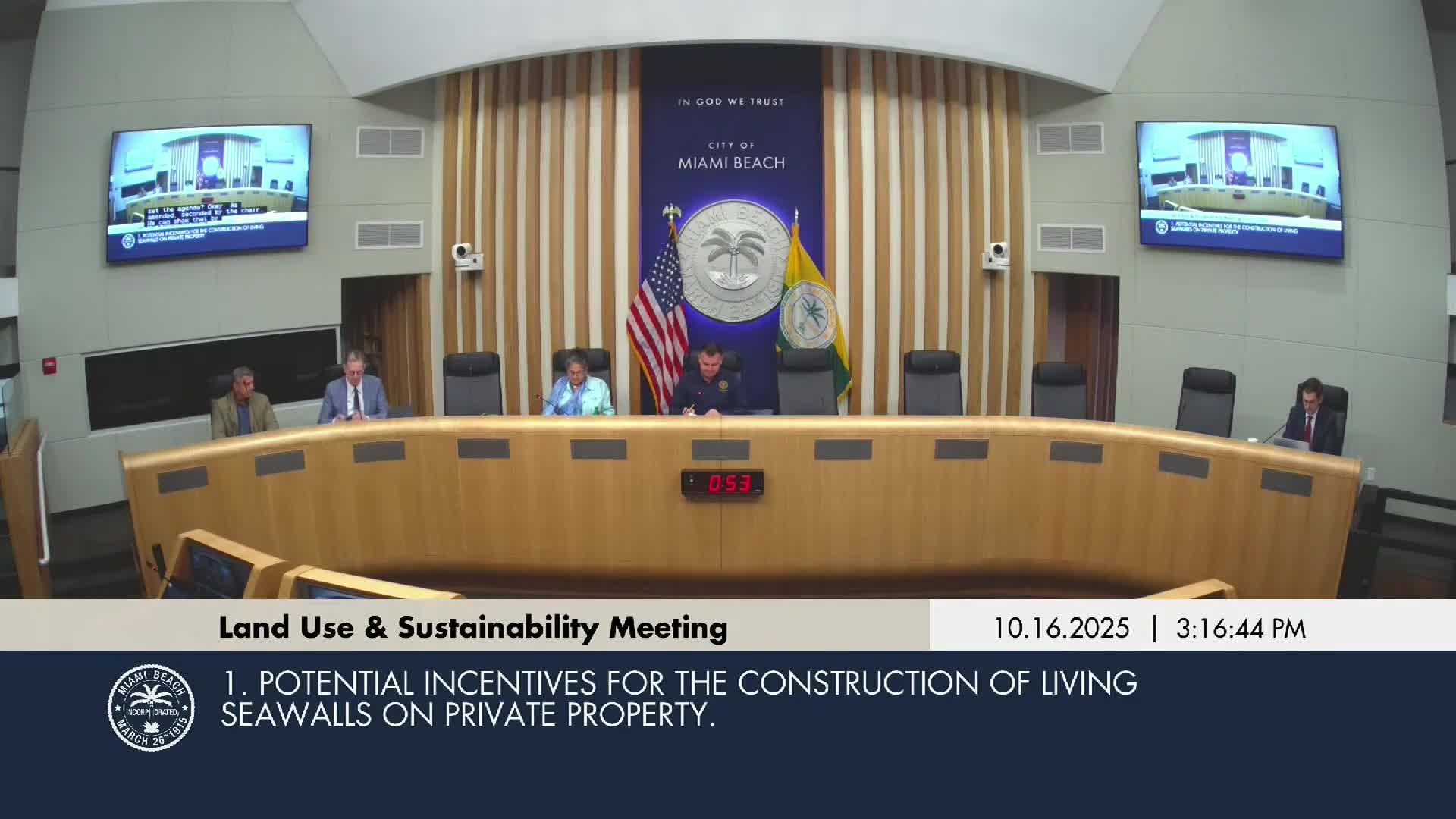
Summary
The Land Use and Sustainability Committee continued discussion of incentives for living seawalls and directed staff to return in January 2026 with recommendations on expedited permitting, fee waivers or abatements, streamlined applications and public project policy.
The City of Miami Beach Land Use and Sustainability Committee continued on Oct. 16 a discussion about incentives aimed at encouraging living seawalls on private property and in public capital-improvement projects and asked staff to return in January 2026 with policy recommendations.
Committee members and staff framed the item as an effort to use incentives such as expedited permitting, streamlined applications and permit fee waivers or abatements to expand use of living seawalls — engineered surfaces intended to support oysters, barnacles and other marine organisms — on the city’s roughly five miles of public seawalls and on private properties.
Public Works Director John Norris said the city is already considering living seawalls for at least two publicly owned projects: a section of the Collins Canal near the convention center and a pilot on West 60th Street. He urged staff to examine options including 3D-printed seawalls, tiles or panel systems and to evaluate cost and schedule implications for each site. “We definitely think there is a value in having living seawalls even if it’s a little more expensive,” Norris said.
Commissioners and public speakers recommended a broader approach. Commissioner Bond urged including a Bonita Drive site in the pilot program and suggested the city use its platform to evaluate technologies tested in Europe and Southeast Asia. “It would look amazing. It would do a lot for that part of the city,” Bond said.
Speakers from the public and private sectors described practical considerations. Colin Ford, a marine biologist and co-founder of the Reef Line, recommended defining “what constitutes a living seawall” and proposed creating receiving sites or sanctuaries — for example, using riprap at the Miami Beach Marina — to temporarily house corals and other organisms relocated during seawall replacement. “There’s a really great opportunity here in Miami Beach to utilize the riprap at the Miami Beach Marina to sort of serve as like a sanctuary where these organisms can be moved and then returned back to the seawall once it’s been completed,” Ford said.
Jack Khan, an audience speaker who described himself as a resident and naturalist, asked the city to develop monitoring plans so the species promoted on seawalls match local water conditions. Private-sector vendors including Nicholas Borden and others said tile or modular approaches can simplify installation and may reduce costs compared with full seawall replacement.
Staff and resilience officials noted existing regulatory frameworks and financing options. Amy Knowles, the city’s chief resilience officer, said the state PACE (Property Assessed Clean Energy) program was recently changed to allow seawalls and could be a financing option; she offered to confirm details and bring findings back to the committee. Staff also said private-property adaptation programs sometimes provide matching grants; speakers referenced a roughly $20,000 matching grant figure for private seawall adaptation during the discussion.
Committee members and staff discussed enforcement and protections for marine life during construction. Lindsay Pratt, deputy resilience officer and assistant director of environment sustainability, said environmental resources on seawalls are subject to review by other regulatory authorities and that permit conditions are used to minimize harm; she added enforcement actions and mitigation payments are options when contractors damage protected resources. Pratt acknowledged there are “bad actors” among contractors and said staff would check whether habitual offenders can be identified and barred from work.
The committee instructed staff to return with a formal memo and recommended policy language that would address expedited permitting, fee waivers or abatements, a streamlined application process for living seawalls, and a review of public-seawall replacement projects to evaluate feasibility of living seawalls (including 3D-printed options). The item was continued to the committee’s January 2026 meeting for those recommendations.
The committee received public comment and technical input but took no ordinance-level vote at the Oct. 16 meeting; staff will return with recommended policy language and clarifications about financing and permitting pathways.