
Developers pitch boutique hotel, social club and spa for Chandler House at 151 Walnut
Get AI-powered insights, summaries, and transcripts
Subscribe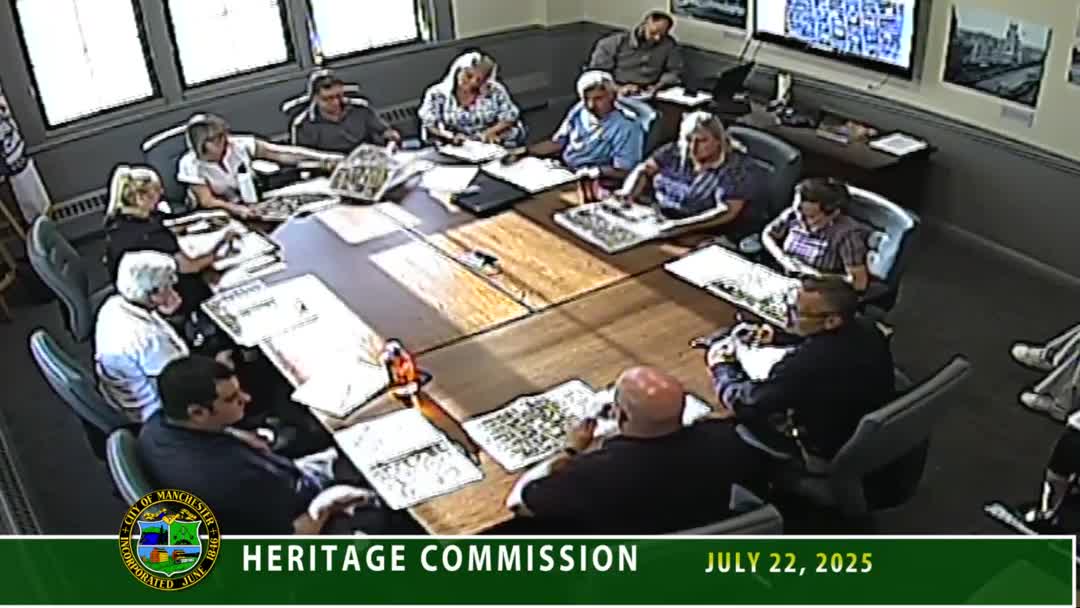
Summary
Project team told the Manchester Heritage Commission they plan to restore the Victorian-era Chandler House and add an exterior stair tower, ADA ramp, nine hotel rooms, a basement spa and a members' social club; planning-board review and parking agreements are pending and deed restrictions with the diocese are under legal review.
Project representatives presented plans on 151 Walnut for the Chandler House, a Victorian-era property the team says they will restore while converting it to an upscale social club, boutique hotel and spa.
The presentation to the Manchester Heritage Commission on an agenda item moved forward for discussion said the proposal would place a members’ social club on the first floor and parts of the second floor, with nine hotel rooms on the second and third floors and a spa in the basement. “We’re here to present an exciting project at 151 Walnut. That’s the Chandler House,” said Brian, a project representative, at the start of the presentation. Jessica Quaran, identifying herself as “the chief of staff to the owner of the building,” told commissioners she and the ownership team are pursuing historic preservation while making the project financially feasible.
The proposal matters to the commission because the house is in poor repair and carries historic value, commission members and public commenters said. The team said they have obtained variances from the Zoning Board of Adjustment and are scheduled for Planning Board review on Aug. 6 for a change-of-use site plan and a conditional-use permit related to parking.
Project details and design choices
Under the plan presented, the club would include programming, a workspace “pod” area, and events; some hotel rooms would be used for an artist-in-residence collaboration with the Courier Museum of Art. The team said part of the intent is to preserve and restore the turret, spire and interior features, while altering elements needed for code compliance. “We do have some challenges related to the building code,” the lead architect (Kevin) said, describing the team's plan to add an enclosed, rated stair tower attached to the exterior because an internal egress could not meet current requirements. He said the stair tower and enclosed egress will be designed to “make it look like it’s part of the building” and that the owner has discussed the approach with the city building department and the fire marshal.
The team described additional historic-preservation work: removing non-original siding to reveal and restore original trim and moldings, replacing or restoring windows to match historic profiles where possible, restoring chimneys that appear original, and rebuilding the wraparound porch to reproduce its curved profile. They also said they will add an accessible ramp integrated with a rebuilt porch and raise the porch elevation to meet code; a new guardrail and handrail will meet current height requirements.
Parking, access and operations
Because the existing driveway is too narrow for the proposed uses, the site plan calls for converting the current driveway into a valet-style drop-off and using the rear area for loading and employee parking. The project team presented a parking study modeled on usage at other “common house” locations and estimated demand based on an expected membership of roughly 800 people: about 20–25 spaces typical on most days, and up to roughly 45 spaces during peak events. The owner said they are negotiating shared-parking agreements with nearby properties; the presentation cited tentative agreements for up to 10 spaces at one nearby lot and letters from the Courier Museum offering 10–20 spaces when peak times do not coincide.
Public comment, heritage concerns and deed restrictions
Commission members and members of the public pressed the team on preservation details and deed restrictions tied to past sales. Several speakers urged retention or reproduction of original materials, including slate roofing, stained glass and decorative porch trim. “That one with the stained glass — that one will work,” a public commenter said when asked whether first-floor features would be retained. Another commenter asked that construction crews avoid obstructing church parking during services.
On deed restrictions, the project team said lawyers are reviewing covenants stemming from past transfers involving the diocese and the previous owner. “There are some deed restrictions; lawyers are working on that,” the presenter said. The team said those matters are legal, private concerns between sellers and buyers and not a zoning issue, but that they intend to preserve as much historic fabric as feasible.
Timeline and next steps
Project representatives said they expect the owner and a representative of the common‑house model to appear at the Planning Board meeting and that they are scheduling building-permit filing later in the year pending regulatory approvals. The owner’s representative offered to set site tours for commission members and others; the team asked interested commissioners to contact Jonathan (the commission chair) by email to arrange a visit. Jessica Quaran said the ownership team is “working with an interior designer” experienced on similar projects and that the owner intends to keep historic features where possible.
No formal approvals or votes on the Chandler House proposal were taken by the commission at the meeting; the item was a presentation and public comment period ahead of Planning Board review.
Ending
Commission members said they will follow the Planning Board process and requested that the project team return with final materials that show window profiles, porch details and sign proposals. Several members asked the team to document preservation decisions and to coordinate construction parking so as not to conflict with church services at nearby Saint Patrick’s Church.