
Manchester planning releases second draft of zoning ordinance after yearlong public engagement
Get AI-powered insights, summaries, and transcripts
Subscribe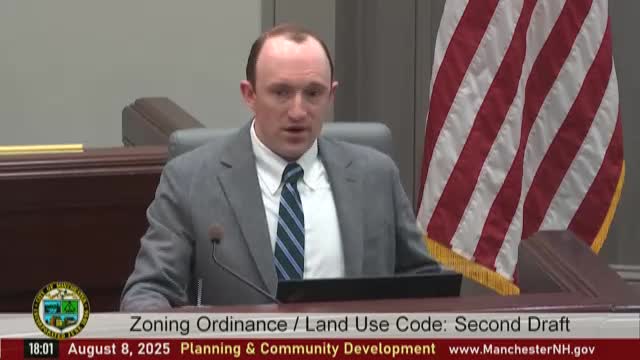
Summary
Jeff Belanger, director of Manchester’s Planning and Community Development Department, unveiled the second draft of the proposed Manchester Zoning Ordinance at a public presentation saying the document reflects input from more than 1,000 meeting attendees and 1,499 survey respondents.
Jeff Belanger, director of Manchester’s Planning and Community Development Department, unveiled the second draft of the proposed Manchester Zoning Ordinance at a public presentation, saying the document incorporates feedback gathered from more than 1,000 in‑person meeting attendees and 1,499 survey respondents.
Belanger said the draft was built from two UNH reports and the city’s master plan and is intended to advance housing affordability, preserve natural and historic features, allow small‑scale neighborhood businesses in selected places, and improve building design. “We heard you, we took your comments seriously, and the proposed zoning ordinance reflects them,” Belanger said.
Why it matters: The zoning ordinance shapes where housing, businesses and other development can occur across the city. Changes in lot sizes, new mixed‑use districts, updated wetland protections and design standards could alter the kinds of homes and commercial spaces that are built, who can build them and where — and the draft sets a timeline that could bring the ordinance to a vote of the Board of Mayor and Aldermen this year.
Key public engagement and process
Belanger told the audience the planning staff conducted an extensive public outreach program after the first draft (published June 21, 2024). Outreach included 12 ward meetings facilitated by UNH Cooperative Extension, mailed notices to more than 56,000 households, radio spots, Nixle alerts and printed materials. More than 1,000 people attended the ward meetings (average about 90 per meeting), and the UNH Survey Center recorded 1,499 survey responses between July 8 and Sept. 8, 2024. UNH produced two reports — a community‑meeting summary and a 200‑page survey analysis — that the staff used to write the second draft.
What the public told planners
Survey and meeting results that recur throughout the draft: 74% of survey respondents said housing prices in Manchester were “not reasonable,” and 87% said having a range of housing types is important. Respondents favored smaller single‑family homes on smaller lots, townhouses, duplexes and small multifamily buildings; they were less supportive of large apartment towers in neighborhoods that do not already have them. Other strong themes were protection of natural areas (94% agreement), preservation of historic character (90% agreement), improved design (windows, landscaping), and cautious support for allowing small neighborhood businesses in select residential areas (80% supported limited expansion).
Housing and land‑use changes
- Single‑family lot changes: The draft would retain a 40,000‑square‑foot minimum in the most rural RS district but reduce minimum lot sizes in many single‑family districts: R1A from 12,500 to 10,000 sq ft and R1B from 7,500 to 6,000 sq ft. The total land area zoned exclusively for single‑family homes would fall from about 55.1% of the city to 45.4%.
- ‘Missing‑middle’ and mixed‑use districts: The draft consolidates and replaces several existing districts with two mixed‑use districts, MX‑1 and MX‑2, to allow duplexes, triple‑deckers, townhouses and small multifamily development in more places. MX‑1 would allow up to four dwelling units per lot (with stricter placement rules and conditional use permitting for businesses); MX‑2 would allow up to nine dwelling units on appropriately sized lots. Belanger said MX‑1/MX‑2 would expand where medium‑scale housing is allowed but also cap building size in many places where current rules could permit much larger apartment blocks.
- Areas for larger residential buildings: The draft would increase the overall portion of the city where larger apartment buildings could be built (from about 18.3% under current rules to 26.36% under the proposal) but would shift and refine where those areas are located. Belanger cited the former Research Park area (the proposed “Innovation District”) as an example where the city and developer plans are expected to produce more than 400 dwelling units and roughly 48,000 sq ft of commercial space on over 80 acres that the city agreed to sell.
Design, historic preservation and form‑based code tools
The draft adopts a form‑based approach to give the city more direct tools to shape building frontage, windows, materials and landscaping. Belanger said the approach aims to prevent “blank wall” facades and to promote building types more pleasant to walk beside. The Amaskeag Mill Yard base district would be expanded to include additional blocks that retain mill‑era character; those newly included areas would be subject to basic architectural requirements (for example, a requirement that about 75% of exterior wall area be brick veneer or similar facing), while the existing Amaskeag Historic Overlay (where the Heritage Commission has regulatory review authority) would remain more rigorous for the overlay area.
A new Gaslight Historic Overlay would encourage Heritage Commission consultation without granting that commission regulatory veto power — a compromise Belanger described as intended to bring the commission into the review process without imposing “unduly burdensome” rules on property owners.
Natural resources and environmental protections
- Wetlands: The draft would require a minimum 10‑foot “no‑touch” buffer around all wetlands (no tree clearing or grading) and retain a 25‑foot setback for structures but explicitly extend the setback to impervious surfaces such as driveways. In a few sensitive locations (e.g., near Nuts Pond and Pine Island Pond) the draft includes a 50‑foot buffer where certain industrial or B‑2 parcels are adjacent to conservation land.
- Lake Massabesic (drinking‑water protection): The Lake Massabesic Protection Overlay District (LMPOD) would lower the maximum lot coverage in the most intensive subdistrict from 75% impervious surface to 60% to reduce runoff.
- Conservation District: Planning staff reinstated a Conservation District after public comment; the second draft restores the district on primarily city‑owned parkland and some conservation‑eased parcels and adds a small parcel next to Crystal Lake at the request of the Crystal Lake Preservation Association.
Accessory dwelling units and state law changes
Belanger told the audience that new state legislation (House Bill 557) forbids municipalities from imposing aesthetic requirements specifically on ADUs (accessory dwelling units). Because Manchester’s second draft includes broader aesthetic requirements that apply to houses generally (for example pitched roofs, minimum window area), the city staff believe they can still influence appearance of new units through those house standards rather than by singling out ADUs.
Parking and statutory limits
Staff spent substantial time revising parking rules after mixed public feedback. Key points in the draft: - The city reworked dimensional and layout requirements to allow more parking capacity on constrained lots (for example, permitting marked tandem parking in many smaller residential contexts and reducing some setbacks around accessory buildings where safe and appropriate). - Accessibility requirements were reviewed with state and federal guidance to avoid creating unusable reserved accessible stalls on small private lots while complying with law. - A newly enacted state law (Senate Bill 24) now limits municipal requirements to a maximum of one parking space per dwelling unit. Belanger said the draft will comply with that law; earlier proposals to reduce or raise parking requirements were adjusted accordingly.
Signs, murals and legal constraints
Survey respondents strongly preferred small attached signs over large freestanding signs, and opposed billboards and electronic message centers (EMCs) in most parts of the city. Belanger noted that recent U.S. Supreme Court decisions and a federal district court ruling in New Hampshire (a Conway bakery case) constrain municipalities’ ability to regulate sign content; as a result, the draft proposes allowing murals on commercial buildings (70% of survey respondents favored permitting murals, including advertising murals) while restricting billboards, EMCs and large freestanding signs to heavily automobile‑oriented commercial corridors.
Small businesses and neighborhood commercial uses
The MX‑1 and MX‑2 districts are the primary mechanisms to allow limited neighborhood businesses near residential areas. MX‑1 would be the most cautious option (corner lots only, conditional use review by the Planning Board, notice to abutters); MX‑2 would allow limited nonresidential uses (generally capped at about 3,000 sq ft) without the same conditional use requirement, though restaurants would require board review. Belanger emphasized the intent is incremental change that extends existing commercial nodes rather than letting businesses appear arbitrarily in quiet single‑family blocks.
Adoption timeline and next steps
Belanger said the second draft was published to the project website and that the staff plans to submit the ordinance to the Board of Mayor and Aldermen on Oct. 7, 2024, a 60‑day window after publication. The public comment period the staff requested runs through September; statutory notice and public‑hearing requirements will follow. Possible public hearing dates mentioned were Oct. 21 or Nov. 18, and possible Board votes were listed as Dec. 2 or Dec. 16, with implementation to begin March 1 of the following year if adopted. Belanger said staff invited aldermen to multiple briefings and that two aldermen also served on the zoning steering committee.
Context and limits on claims
The presentation and the draft reflect staff interpretations of public input and current law. Some provisions cited by Belanger respond directly to state legislative changes and recent court rulings; where federal or state law constrains local authority (for example on ADU aesthetics and parking minimums), the draft is framed to comply. Belanger repeatedly emphasized that not all desired outcomes can be solved by zoning alone — for example, he noted factors such as construction costs and maintenance of sidewalks are beyond the ordinance’s reach.
Ending
Belanger closed by directing residents to the project website (manchesternh.gov/landusecode) for the draft and accompanying materials, inviting comment and thanking residents, UNH partners, the steering committee and city staff for their participation and work on the second draft.