
Manchester commission reviews second draft of comprehensive zoning overhaul, focuses on buffers, parking, transparency and affordable-housing fee waiver
Get AI-powered insights, summaries, and transcripts
Subscribe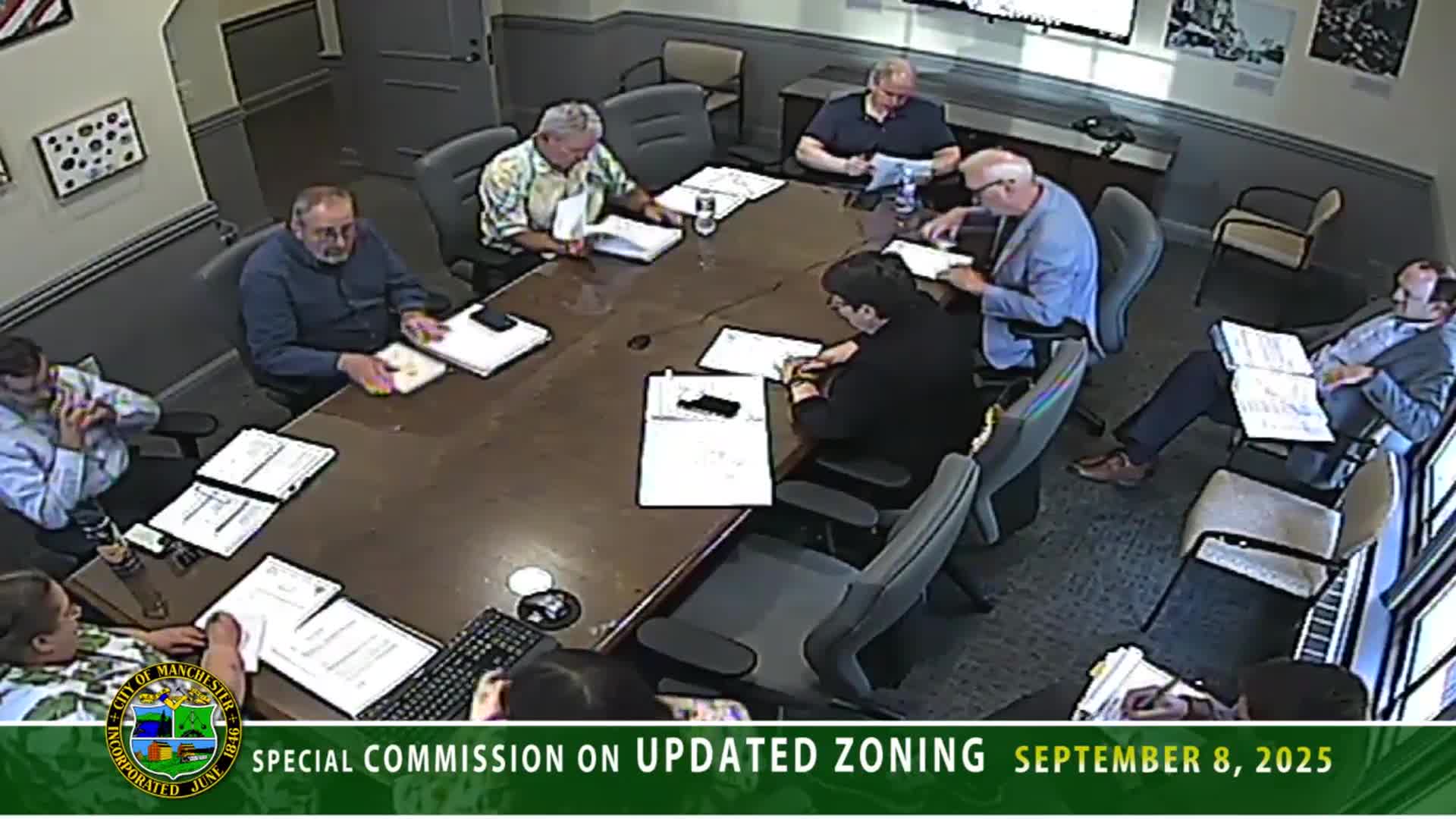
Summary
Manchester planning staff and commission members reviewed the second draft of a comprehensive zoning ordinance update, discussing industrial mapping near Procter Road, planned-development buffers and density, first-floor transparency for change-of-use conversions, parking for small multifamily buildings, townhouses in the Innovation District, and an impact-fee exemption for long-term affordable housing agreements.
Manchester planning staff and members of the commission spent the meeting reviewing the second draft of a comprehensive zoning ordinance update, discussing multiple detailed changes to how the city will treat industrial adjacency, planned developments, parking and conversions between residential and commercial uses.
Kristen, a city planning staff member, reported written public comments received on the second draft and walked the commission through several recurring issues: a misunderstanding about a map that made some readers think a large area was being rezoned to industrial (Kristen said the area south of Procter Road remains industrial in the draft), continued public concern about allowing industrial uses next to the rail trail, and several recent emails asking for changes to rules about backyard chickens.
Why it matters: the draft is written to reflect long-standing land uses and to accommodate housing supply and design goals. Changes discussed would adjust what building types are allowed where, set new expectations for designers and applicants, and create exemptions for certain permanently affordable projects.
Key discussion points and staff responses
Rezoning and existing industrial uses Kristen told the commission that much of the area south of Procter Road is already zoned industrial and that staff restored that designation in the second draft after an earlier mapping change. Commissioners and staff acknowledged public concern about placing industrial uses adjacent to the rail trail, but staff emphasized the intent to match zoning to legally established uses rather than to down-zone long-standing industrial lots.
Planned developments: buffers, setbacks and density Staff described a proposed buffer requirement around new planned developments intended to reduce impacts on adjacent neighborhoods. The draft originally proposed a 50-foot buffer for large planned developments; staff said they now plan a graduated approach (smaller buffers on smaller parcels, larger buffers on larger parcels) and will refine adjacency rules so that industrial adjacencies would not automatically require a large green buffer. The commission noted an existing 30-foot setback in the RSM district and asked staff to clarify how a buffer would differ from standard setbacks.
Staff also described a change in the per-unit land-area calculation used to limit density in the RSM: the draft reduces the existing requirement from 3,500 square feet per unit to 3,000 square feet per unit to allow modest increases in density. The commission and staff discussed using buffer width and other incentives (for example, greater allowable unit yield) to trade off with larger buffer commitments.
Community open space in planned developments The draft requires a percentage of buildable land area in new planned developments be reserved for on-site communal open space; staff reported a starting figure of 10 percent and asked the commission whether the definition should allow indoor community buildings (clubhouses) as well as outdoor usable space. Commissioners asked staff to clarify that the 10 percent is calculated on the buildable area after density is determined (buildable area → density → reserve 10 percent), and to define usable versus non-buildable land (for example, wetlands or steep continuous slopes would generally not qualify).
Change-of-use and first-floor transparency Staff described form-based transparency rules that set higher window/fenestration expectations for commercial first floors (staff said the typical transparency standard discussed is about 70 percent on the first floor for commercial uses). The commission discussed whether a change of use (for example, from residential to commercial or vice versa) should automatically force an owner to retrofit the building façade. Staff proposed an exterior-renovation threshold (draft language under consideration would trigger exterior compliance if an applicant modifies more than 50 percent of the street-facing first-floor façade); the commission asked staff to refine the metric (for example, measuring percent of first-floor façade rather than percent of total building façade) and to clarify how the rule would treat conversions that leave interior units without street-facing windows.
Parking for small multifamily and tandem parking questions The draft proposes looser driveway-parking provisions for small buildings. Staff said houses, duplexes and three-unit buildings would be allowed to use driveway parking configurations where practical; beyond three units a different parking layout would be required. Commissioners discussed allowing tandem/double-driveway layouts that would permit up to four units to have paired driveway parking (two 20-foot-wide driveways, one on each side of a building) so that four units could be served without mandating remote parking, provided local driveway width and safety standards are met. The commission asked staff for clear diagrams and a focused definition of when a project must go to the planning board (site-plan review) versus being handled through a building permit.
Accessory dwelling units, ADU owner-occupancy and backyard chickens Commission members discussed continued public interest in changing ADU owner-occupancy requirements and in loosening restrictions on backyard chickens (current zoning discussed in the meeting retains the half-acre minimum). Staff indicated they did not change the chicken rule in the second draft and noted that roosters remain prohibited under current practice and the draft. Commissioners suggested that if the public continues to press these topics they can be revisited in future amendments.
Innovation District and townhouses Staff proposed allowing townhouses in parts of the Innovation District but only as part of planned developments that include at least one mixed-use or nonresidential component. The commission emphasized the policy goal of preventing the Innovation District from becoming a single-use residential subdivision and asked staff to place townhouse allowances for the Innovation District in a conditional-use or planned-development path so that applicants must demonstrate the mixed-use intent.
Affordable-housing impact-fee exemption Members discussed impact-fee exemptions for deeply affordable projects. Staff reminded the commission that the draft already contains some fee exemptions (for single-room occupancy and age-restricted units) and that the commission had previously discussed exempting projects that record a permanent land-use restriction. Commissioners and staff agreed to include language exempting projects from school impact fees where the developer records a land-use restriction agreement (LURA) meeting a minimum term; staff recommended a 30-year minimum for the exemption (staff noted Low-Income Housing Tax Credit projects have shorter tax-credit compliance terms but that LURAs are typically longer and may run 30+ years or 60–99 years depending on program).
Administrative and next steps Staff said they will refine draft language on: graduated buffer distances keyed to parcel size, the usable-area definition for the 10 percent community open-space requirement, the exterior-renovation threshold (clarify whether the metric is percent of first-floor façade), and parking diagrams that show acceptable driveway/tandem arrangements. The draft will be sent through committee review; staff said October 7 is the target for the first committee hearing with additional committee and full-board hearings anticipated through December.
Votes at a glance The meeting recorded two procedural votes to approve past meeting minutes (motions to approve, seconded, voice votes recorded as "aye"). The transcript does not identify movers, seconders or a roll-call tally for those minute-approval motions; both motions were reported as carried on voice vote.
Ending note Staff will return with clarifying language and diagrams on the items above; the commission tasked staff to tighten definitions and conditional-use triggers so the ordinance is clear to applicants and to the public before it proceeds through committee and to the full board.