Get Full Government Meeting Transcripts, Videos, & Alerts Forever!
Get email alerts on the District Boundary Cleaning topic
No spam. Unsubscribe anytime.
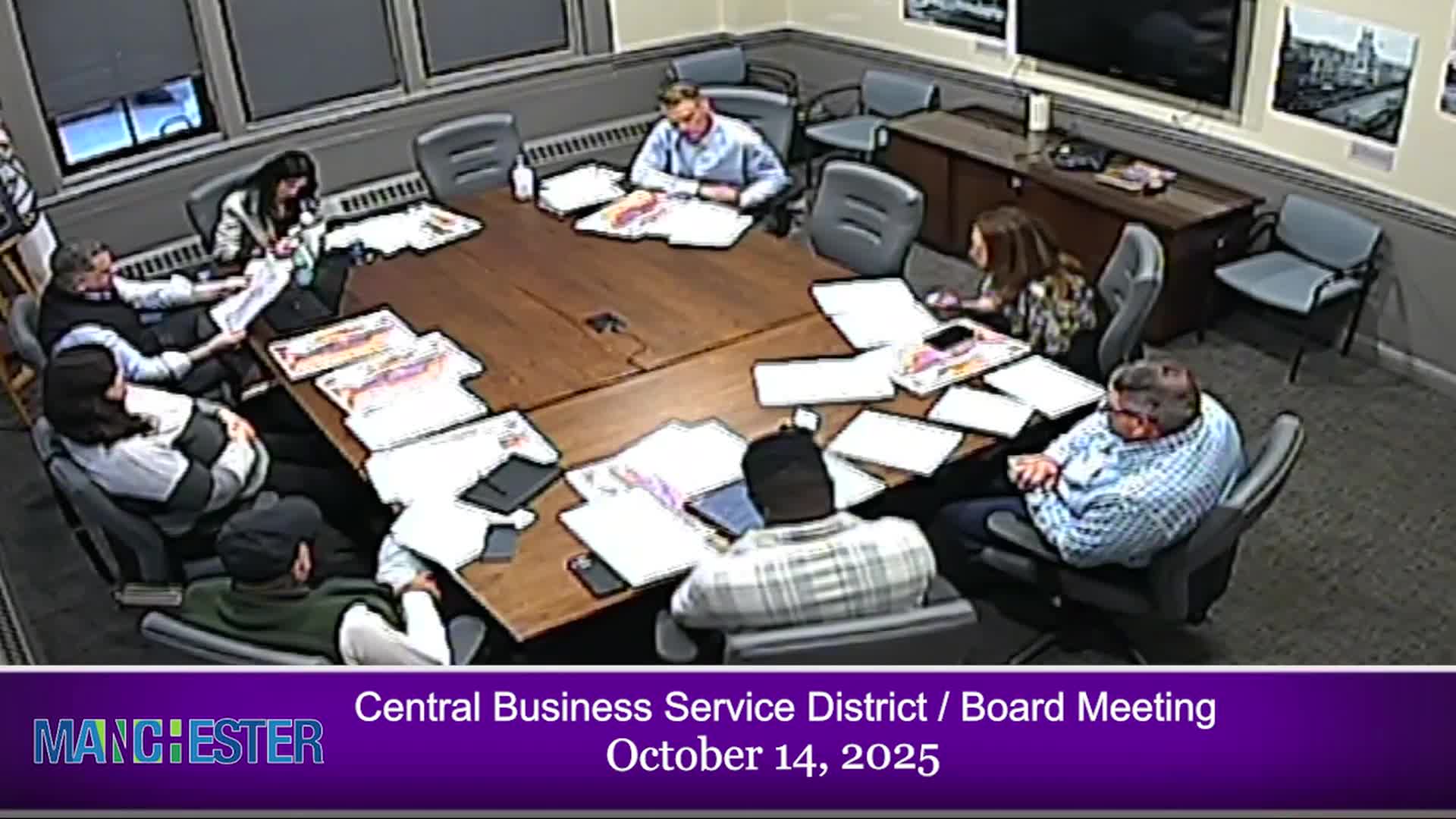
Manchester board debates shrinking downtown service district, requests financial breakdown
Summary
CBSD advisory board discussed whether to shrink or keep the Central Business Special District, weighing cleaning coverage, tax impacts on commercial properties and service equity. Board requested staff provide a breakdown of assessments by area and a list of anchor properties that contribute the most revenue.
Board members discussed redrawing the Central Business Special District boundary to better match where cleaning and activation services are delivered and to reduce what some described as an oversized service area. No boundary change was approved; board members asked staff for more financial detail before considering any formal vote.
Kristen, a senior planner in the city’s planning and community development office, explained proposed zoning categories that city planners are using in the zoning rewrite and how new “DT” downtown districts — DT‑1 and DT‑2 — would distinguish more and less intense downtown uses. “The Downtown 2 every time a number gets larger it means it’s more intense,” Kristen said, describing DT‑2 as the city core with fewer height limits and an emphasis on mixed-use development.
Board members said the current special district covers a large geographic area and includes commercial parcels that pay into the assessment plus many properties that are tax-exempt or residential and therefore do not. One board member summarized the contractor’s view of the district: “They’re like, oh my gosh, it’s huge. Usually they’re measured in blocks. Ours is measured in acres,” the staff member said.
Financial context discussed at the meeting included historical assessment levels and temporary budget support. Board members said the district previously collected about $258,000 annually; the rate is scheduled to rise to cover an expanded cleaning contract and the board said the city used roughly $200,000 in American Rescue Plan Act (ARPA) funds to cover a shortfall during the current year. Board members also noted that expanding the district eastward to include areas with many tax‑exempt institutions (libraries, churches, shelters) would add maintenance burden without proportional assessment revenue.
Service details: the contracted downtown cleaning team starts each day in central downtown and the Mill Yard and serves those core areas daily; it reaches the north and south ends of the district roughly twice per week. Board members said businesses just outside the district, including a stretch near Restoration Cafe, have complained about inconsistent service; staff suggested a targeted fee-for-service arrangement for specific blocks as an alternative to expanding the district.
Actions and next steps: the board requested that staff provide (1) a breakdown of assessments and tax revenue by sub-area within the district, and (2) a list of the commercial “anchor” properties that contribute the largest shares of assessment revenue. Staff also reported that an informational mailer had been distributed to district property owners and that two phone calls had resulted — one praising the street-cleaning team and one caller who raised park concerns.
No formal boundary change or new assessment was approved at the meeting; board members agreed to gather data, stakeholder feedback and precise financial impacts before bringing a formal proposal to the board.