Buncombe County advisory board OKs VAD applications and hears updates on easements, appraisal needs
Loading...
Summary
The Buncombe County Farmland Preservation Advisory Board approved five value‑added development (VAD) applications and received status reports on multiple conservation easement projects, including planned closings, appraisal updates and delays tied to a federal shutdown and Hurricane Helene.
The Buncombe County Farmland Preservation Advisory Board on Oct. 21 approved five value‑added development (VAD) applications and heard reports on a slate of conservation easement projects, including several tentative closings, appraisal updates and legal delays.
Board staff said the projects will move to the county commissioners for final transaction‑cost approval and that state Agricultural Growth Zone grant paperwork is under way. The board was also told two pending easements — the Rogers Farm Trust and David Rogers projects — will need supplemental appraisal work because earlier appraisals expired after Hurricane Helene, and one federally funded closing is likely delayed by a federal agency shutdown.
Bridal Zeiff, preservation manager for Buncombe Soil and Water, opened the meeting by introducing a new board member and reviewing administrative items. The board voted by voice to approve the Oct. 21 meeting agenda and to approve the September minutes with an addition to the list of attendees. Later the board voted to approve five VAD applications for the month; staff said three of those applications are for separate parcels owned by the same landowners tied to a recently closed donation easement and two are for parcels associated with a landowner in Fairview.
Zeiff said staff recently took seven easement projects to the county commissioners, who approved transaction costs to move the projects forward to appraisal and final purchase calculations. "We got those approved — we're starting funding appraisal on all of these so that we can get that final easement purchase amount and then go back to the commissioners and ask for those funds to be secured from the open space bond," Zeiff said.
Martha Ross, county initiative coordinator, told the board the county has a pot of bond funds already reserved for Agricultural Growth Zone projects and that staff will submit individual state grant applications for each parcel. "We've already gone to the commissioners and reserved that pot for the agricultural growth zone," Ross said, and staff expect the state's review to confirm eligibility before the board returns to the commissioners seeking bond disbursements.
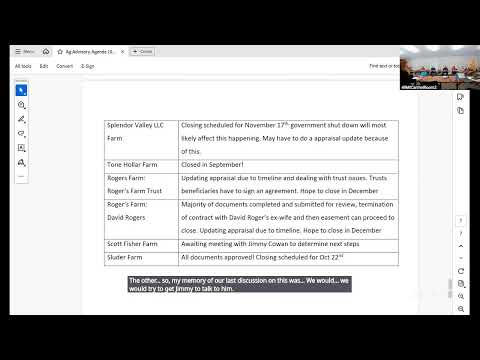
Staff provided project‑level updates: Okoboji Farm has a tentative closing date of Nov. 4; Splinter Valley Farm had a Nov. 17 closing on the calendar but is now unlikely to close on that date because federal closing steps required a month of processing and a federal shutdown has delayed those procedures. Splinter Valley and some other projects will require appraisal updates because of delays; staff said an appraisal update costs about $2,500.
Several other projects were described as nearing final steps: baseline documentation, deed and title work, and planned January closings for Kestrel, Herb Battle and Sandy Holler projects. Schluter Farm has a closing scheduled for the day after the advisory board meeting, staff said. Staff estimated the most recent group of easements under discussion would conserve about 600 acres; they also said county bond funds and prior transactions put the county at roughly 2,000 acres conserved to date.
Not all projects are moving smoothly. Staff said Southern Appalachian Highlands Conservancy has moved to legal action on a community farm expansion easement because of a disputed neighbor boundary, which will delay that project. For one project involving a landowner identified as Scott Fischer, staff reported repeated unsuccessful attempts to contact the landowner; they said if outreach fails the board may ask county legal to send a formal cancellation letter and may ultimately vote to cancel the project.
On the Rogers Farm matters, staff said the trust's attorney raised concerns that placing an easement on the trust's land could reduce the trust's asset values and that some beneficiaries are not the three siblings handling negotiations; the item remains under discussion and may require additional legal review and potential supplemental budget requests to cover new appraisal work.
The board heard that most of the projects moving forward have grant or bond funding lines identified: state Agricultural Growth Zone grant applications are being prepared for seven projects and staff expect those to be approved because projects meet eligibility requirements, after which staff will return to the commissioners for final bond allocations. For projects that require appraisal updates because of delays or contract extensions, staff said they will request those modest supplemental amounts from previously allocated local funds rather than new bond measures.
The advisory board did not take substantive new policy actions beyond the routine approvals; most items were status updates and requests that staff proceed with appraisals, grant submissions and scheduled closings. Staff said they will return to the board and to the county commissioners with final numbers when appraisals are complete or when any supplemental budget requests are required.
The board’s next steps include submitting the seven state grant applications, returning to the commissioners to request open space bond disbursements for finalized easement purchase amounts, updating appraisals where required and pursuing legal outreach for the Scott Fischer matter and the Rogers trust concerns. Several closings remain on near‑term calendars, but staff cautioned that federal procedures and weather‑related delays could push some dates back.