Get Full Government Meeting Transcripts, Videos, & Alerts Forever!
Get email alerts on the Public Safety Enforcement topic
No spam. Unsubscribe anytime.
Smithfield council votes to strengthen penalties for repeat tobacco and alcohol violations
Summary
After a police presentation and a public hearing, the Smithfield Town Council approved amendments to Chapter 236, Article 1 of the town code to add stiffer penalties for repeated violations of state tobacco and alcohol laws; council adopted the ordinance as amended.
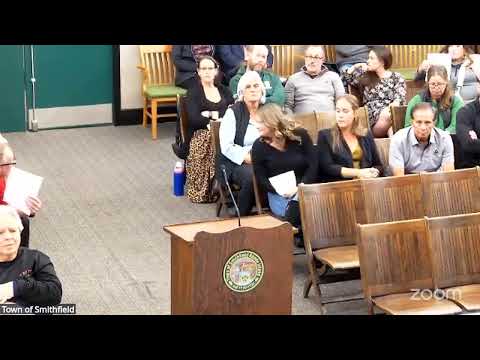
The Smithfield Town Council on Oct. 21 approved amendments to Chapter 236, Article 1 of the town code to add penalties for repeat violations of state tobacco and alcohol laws following a public hearing and a presentation from a police officer.
The ordinance, introduced by the council president, was presented in open session and was adopted as amended. Council discussion included a technical amendment to insert the specific section titles in the motion language before the final vote.
During the public hearing, Officer Ryan Perry of the Smithfield Police Department described the town’s compliance-check program, which the department runs in cooperation with Tri-Town partners. Perry said the checks find both tobacco and alcohol violations, and he noted enforcement limits when the licensed business owner is out of state or when corporate licensees do not respond to summonses sent to their listed addresses.
Perry described how tobacco compliance checks are conducted: two officers use an unmarked car and a decoy who is instructed to answer questions truthfully about age and about whether they carry identification. He said the department runs roughly 13–15 checks per compliance operation and that most local violations have involved locally owned businesses. When violations go to court, Perry said, they are adjudicated in Kent County district court in Warwick.
Council discussion included a suggested, technical amendment from Councilman Iannotti to ensure the ordinance inserts the two section titles that refer to penalties for repeated violations of state tobacco laws and repeated violations of state alcohol laws; that amendment was seconded and accepted. The council then voted; the president announced, “Ayes have it,” and the ordinance was adopted as amended.
The council did not record a roll-call tally in the public minutes; the vote was announced by the presiding officer as passed. The ordinance text cited at the hearing was limited to adding or clarifying penalties for repeat violators and referencing the applicable state laws; the record does not show specific fine amounts or escalation steps beyond the “repeat violator” language in the code amendment.
The police presentation and the ordinance discussion make clear the council’s intent to give local officials stronger administrative levers for repeat offenses where current enforcement has proved ineffective, especially when licensees are corporate entities based out of state.
The ordinance will take effect according to the town’s standard code-adoption procedures; council members did not specify an effective date during the hearing.