
Clarkdale resident urges town to press state and federal agencies on leaded aviation emissions and monitoring
Get AI-powered insights, summaries, and transcripts
Subscribe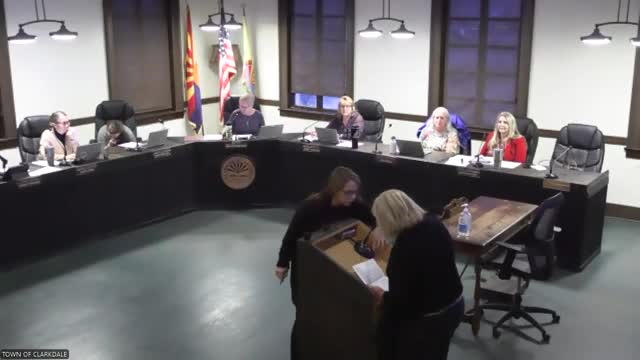
Summary
A Clarkdale resident told the Town Council that repeated flight‑training operations from nearby Prescott are releasing leaded aviation fuel particles over Clarkdale and asked the council to request continuous air monitoring and a ban on repetitive training flights over neighborhoods.
Mary Lou Rose, a Clarkdale resident, told the Town Council on Oct. 14 that residents are exposed to leaded aviation emissions from piston‑driven training aircraft based in Prescott and asked the town to request action from state and federal agencies.
"The EPA estimates that 70% of all airborne lead in the United States comes from piston driven aircraft," Rose said during the public‑comment period. She said the planes used in flight training burn leaded aviation fuel and that repeated touch‑and‑go operations release ultrafine lead particles that can settle into soil and be inhaled.
Rose told council members that lead is a neurotoxin and that "there is no safe level of lead," singling out children, pregnant women and older adults as groups at particular risk. She said most of the training flights she has seen come from Prescott flight schools and named Embry‑Riddle as an example.
Rose asked the council to formally request that the U.S. Environmental Protection Agency, the Arizona Department of Environmental Quality, and public health authorities ban repetitive flight training over residential areas and begin continuous air monitoring in Clarkdale.
The council did not take action on the request during the meeting. The public‑comment rules posted by the council and repeated by the presiding officer state that the council may direct staff to study a matter, respond to criticism, or place an item on a future agenda for decision; however, no staff direction or motion was recorded on this topic at the Oct. 14 meeting.
Council materials and the public‑comment record do not include formal staff reports or technical air‑quality data tied to the remarks at the time of the meeting.