Get Full Government Meeting Transcripts, Videos, & Alerts Forever!
Get email alerts on the Large Residential Development topic
No spam. Unsubscribe anytime.
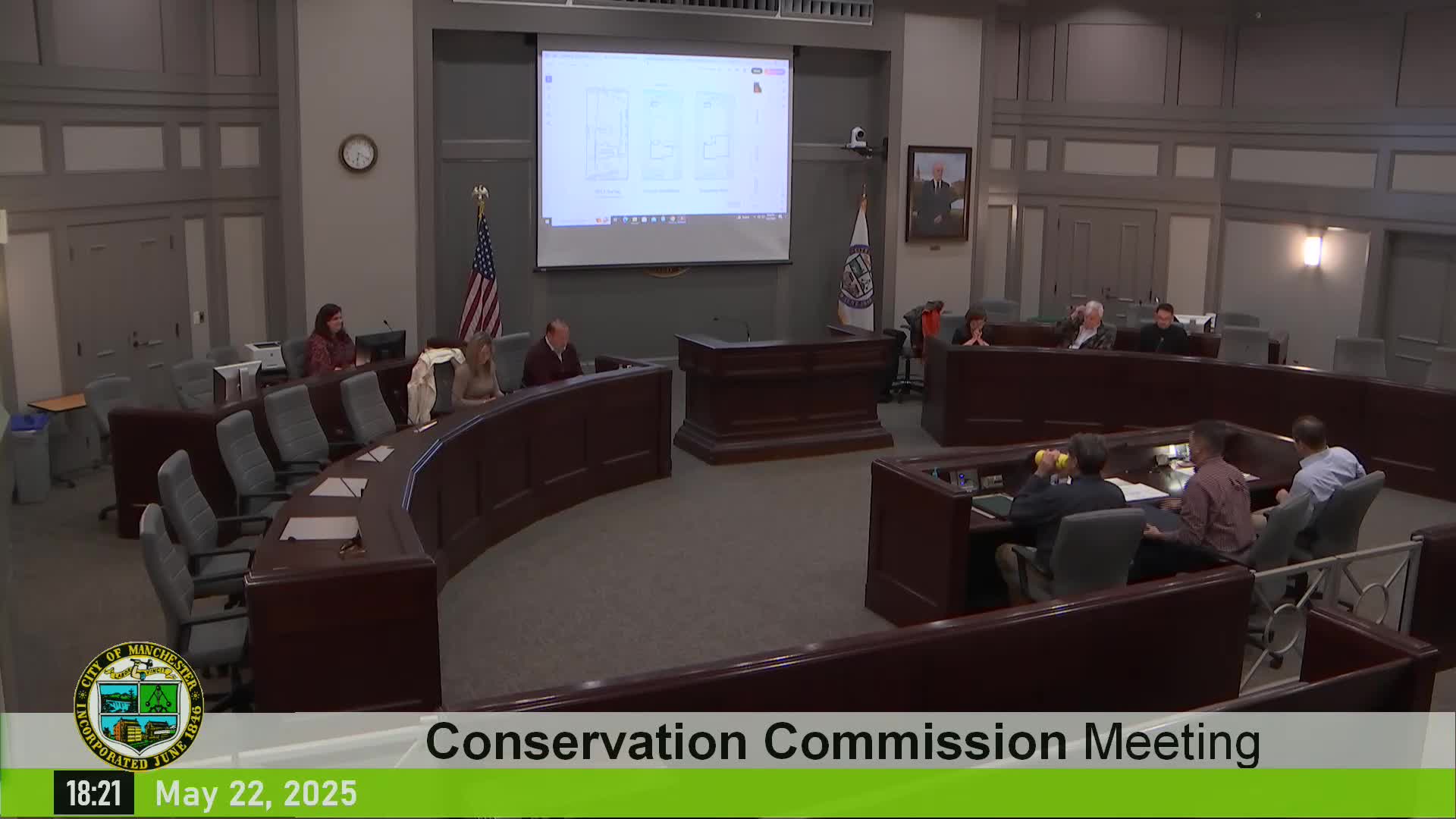
Conservation commission recommends approval of 220-unit Bartlett Preserve with conditions on plantings, snow management and wetland signage
Summary
The Manchester Conservation Commission on May 22 recommended the Planning Board approve Bartlett Preserve (PDSP 2025-001), a 220‑unit townhouse development on South Mammoth Road, contingent on native plantings, certified winter-maintenance, snow‑storage siting away from wetlands and wetland placards.
The Manchester Conservation Commission on May 22 voted to recommend approval of the Bartlett Preserve site plan (PDSP 2025-001), a proposed 220-unit townhouse-style development on roughly 46 acres at South Mammoth, Corning and Lucas Roads, with a set of conditions the commission said are intended to reduce impacts on wetlands and neighboring properties.
Tom Zajac, a civil engineer with IMEC (formerly Hainer Swanson), and project team members described the proposal as a clustered townhouse development that concentrates 220 units in 44 buildings across three upland areas bisected by two wetland systems. The project site contains about 10 acres of wetlands (about 20% of the parcel) and will require two wetland crossings and a New Hampshire Department of Environmental Services dredge-and-fill permit for impacts to wetlands and buffers.
Zajac said the project was designed after zoning-board variances were obtained in late 2024 and subsequent refinements included expanded no-cut buffers of 50 to 75 feet where the development abuts single-family properties. The plan shows three wet-pond stormwater-management areas with permanent pools and sediment forebays, LID features, and private roadways providing primary access from South Mammoth and Corning and a gated secondary emergency access on Lucas Road.
Commissioners focused questions on the wetland crossings, stormwater outfalls and snow removal. Members asked about culvert sizing, the potential for salt and snowmelt to convey into the downstream Great Cohos swamp complex, and placement of snow storage relative to wetlands. The project team said culverts sized at roughly 24 and 36 inches currently handle downstream flows, that the two new crossings were proposed as piped culverts (not box culverts) largely for cost and constructability reasons, and that stormwater design will be evaluated by the city and New Hampshire DES.
To reduce long-term impacts, the commission attached conditions to its recommendation: confirmation that all landscape plantings intended for screening and buffers are native species; that the condominium association require winter-maintenance contractors be Snow-Pro certified (or equivalent) to ensure judicious salt use; that snow containment areas be sited as far from wetlands as practicable; and that placards be installed along wetland edges to mark buffers and no-cut areas. Commissioners also asked that the applicant give additional consideration to locating snow storage to minimize concentrated salt melt entering retention ponds and downstream wetlands.
A motion to recommend approval with those conditions passed by voice vote; commissioners indicated assent and the chair offered the project team the commission’s “good luck” and appreciation for outreach, sidewalk visits and revisions made after neighbor meetings. The recommendation will be forwarded to the Planning Board, which holds final authority for site-plan approval and coordination with NH DES on dredge-and-fill permitting.
The commission also asked for follow-up information on landscaping species lists and final stormwater calculations as part of Planning Board review.