Get Full Government Meeting Transcripts, Videos, & Alerts Forever!
Get email alerts on the Public Health Needs Assessment topic
No spam. Unsubscribe anytime.
Manchester health director previews needs assessment, cites drop in teen births and fewer overdoses
Summary
Public Health Director Genna Thomas told the Manchester Board of Health and Senior Services Commission the department is compiling a triennial community needs assessment and highlighted recent public-health gains — including a sharp decline in teen births and a reduction in overdoses — while warning work remains on aging and injury prevention.
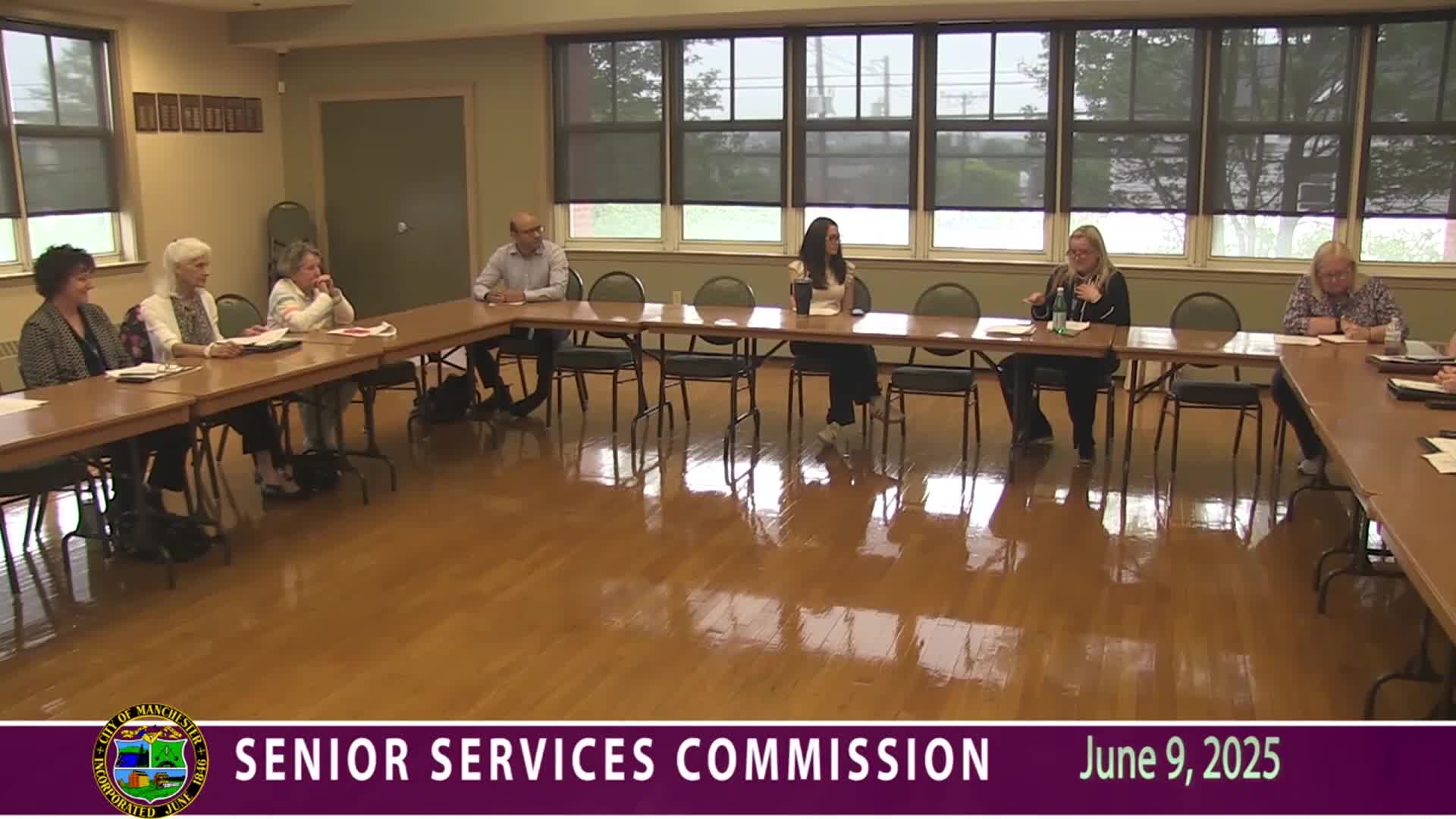
Genna Thomas, public health director for the Manchester Health Department, told a joint meeting of the Board of Health and the Senior Services Commission on June 30 that the department is conducting a required community needs assessment and strategic plan that will inform citywide priorities.
Thomas said the assessment, prepared in collaboration with major local health providers, will combine high-level community measures with program-specific data. "We do this in collaboration with the major health care providers and any of them who have a fund balance of a $100,000 or more," Thomas said. She named Dartmouth Health and Amisket Health among partners and said the document includes school-level measures, such as how many children experienced homelessness during the school year.
The needs assessment will also document recent public-health achievements, Thomas said. One example she cited: the city’s teen birth rate has fallen from levels that once produced roughly 185 births among teenage mothers in a year to "usually less than" about 50 births a year now, a change she attributed to coordinated community work, school health education and increased access to care. "That led to the school district hiring 16 health educators for the schools to teach appropriately, age appropriately, developmentally appropriate health education," Thomas said.
Thomas also described the department’s overdose surveillance work. Together with the Manchester Police Department the health department runs a nonpublic, near-real-time overdose dashboard that tracks calls every three hours; the tool has allowed staff to dispatch response teams to emerging hot spots. She said monthly overdose incident counts that previously reached as high as 122 have fallen, and that this year both overdose incidents and overdose fatalities have been cut roughly in half compared with last year. "This is one of those 25 achievements of 2025," Thomas said.
Thomas cautioned that the city faces continuing challenges: an aging population with rising rates of injurious falls and hip fractures and ongoing gaps in dental, hearing and vision access. She said the department will use the needs assessment and accompanying community health improvement plan to prioritize and align programs and to guide grant and system-level work.
The department expects to complete portions of the assessment and roll findings into a public-facing dashboard in the months ahead, Thomas said, and noted the assessment is part of the department’s statutorily guided planning rhythm that occurs every three years.
Votes at a glance from the meeting: board minutes were moved and seconded for acceptance during the meeting; the transcript records "Second. All in favor?" and indicates the motion carried, though a roll-call tally was not specified. A motion to adjourn was also moved, seconded and recorded as carried; a formal tally was not provided in the transcript.
For next steps Thomas said the department will continue cross-sector work with hospitals, school staff and community partners to convert assessment findings into targeted interventions and to publish performance dashboards for public review.