
Bay Area Air District outlines how $125 million in penalty funds could flow back to Richmond neighborhoods
Get AI-powered insights, summaries, and transcripts
Subscribe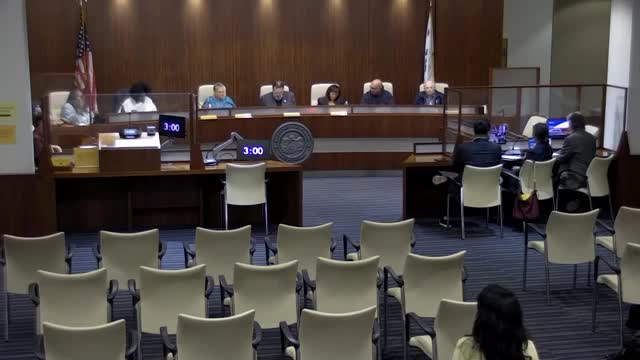
Summary
At a Richmond Neighborhood Coordinating Council meeting, the Bay Area Air Quality Management District presented a new Community Investments Office and draft rules for directing penalty and settlement funds back to communities affected by air pollution, with draft guidelines due in October and board approval targeted for December.
The Bay Area Air Quality Management District told neighborhood leaders in Richmond on Monday that it has established a Community Investments Office to direct penalties and settlement funds back into communities harmed by pollution and that draft local guidelines will be released in October.
The district’s board member and Contra Costa County Supervisor John Gioia and Emmy Wang, the district’s new community investments officer, outlined how the policy will allocate roughly $124–125 million collected through enforcement settlements and penalties and said the office will prioritize funding projects that reduce air pollution and improve health in impacted neighborhoods.
The district presented a multi-tier allocation structure that determines where money goes depending on the size of a penalty. According to the presentation, the first $100,000 of a penalty goes to the district budget to cover enforcement up to an annual budget cap; penalties from $100,000 to $1,000,000 are split with 50% to the district budget and the remainder distributed between regional and local community benefits funds; and penalties above $1,000,000 would be split roughly 20% to a regional fund and 80% to local community benefits funds. The district said it uses about 9% of the total for administrative expenses, leaving roughly $115 million for community investment.
Wang said the district expects to focus first on the local community benefits fund, with a Richmond-specific allocation of about $15 million drawn from penalty funds in addition to a separate Richmond Air Quality Community Fund of approximately $20 million that stems from an earlier settlement. “The local community benefits fund is focused on when there was a penalty incurred in a specific geographic community, the funds then go back to that specific geographic community,” Wang said.
Gioia and Wang repeatedly emphasized that the penalty funds are separate from the larger $550 million payment to the city of Richmond that stemmed from a separate agreement with Chevron. “This is totally separate. We have nothing to do with that,” Gioia said.
Neighborhood leaders pressed district staff on how the district will identify which places are ‘‘impacted’’ and who will be eligible to apply for funds. Wang said the draft guidelines due in October will include maps and eligibility criteria and that the Air District Board aims to approve the guidelines in December with an application process beginning in January. “We wanna also hear from you,” she told the RNCC meeting. “Your feedback is critical to making sure that that map accurately reflects the lived reality here in the Richmond area.”
Residents and council leaders raised project suggestions during the Q&A: planting and maintaining street trees, distributing indoor air filtration systems for schools and homes, and targeted health services. Gioia and Wang said projects will be weighed against community priorities collected during the district’s earlier outreach, which included a survey with more than 1,000 respondents and meetings with more than 60 neighborhood groups.
On specific refinery-related compliance, Gioia explained that a rule adopted by the district requires installation of a wet-gas scrubber on Chevron’s fluid catalytic cracking unit and that the district expects the installation to take several years. He said the district’s settlement includes stepped penalties if the company fails to meet the compliance date of July 20, 2026: an additional $17,000,000 per year for three years and a further larger payment in the fourth year (the presentation referenced $32,000,000 for the fourth year). He said the district hopes the scrubber will be permitted and installed, but that the compliance schedule could generate additional penalty funds if deadlines are missed.
Wang directed people who want updates or to join the mailing list to the Air District website and the Community Investments Office page. She said the draft guidelines will include the map and eligibility rules and that the district plans a pilot community investment initiative to test how applications and awards will work.
Why this matters: the district’s approach would direct penalty dollars into local projects in neighborhoods that experience high pollution levels, rather than routing most funds to regional programs or district administrative costs. Richmond leaders said they will pursue tree-planting, school filtration systems, and health programs as likely candidates but cautioned the funds are limited and will not, for example, pay to build a new hospital.
Looking ahead: the district will release draft local guidelines in October, seek board approval in December, and — if the schedule holds — begin accepting applications in January. The RNCC meeting recorded widespread interest in providing feedback and in coordinating city and community proposals for eligible projects.