
Committee approves ordinance change letting Public Works revoke curbside collection eligibility for cause
Get AI-powered insights, summaries, and transcripts
Subscribe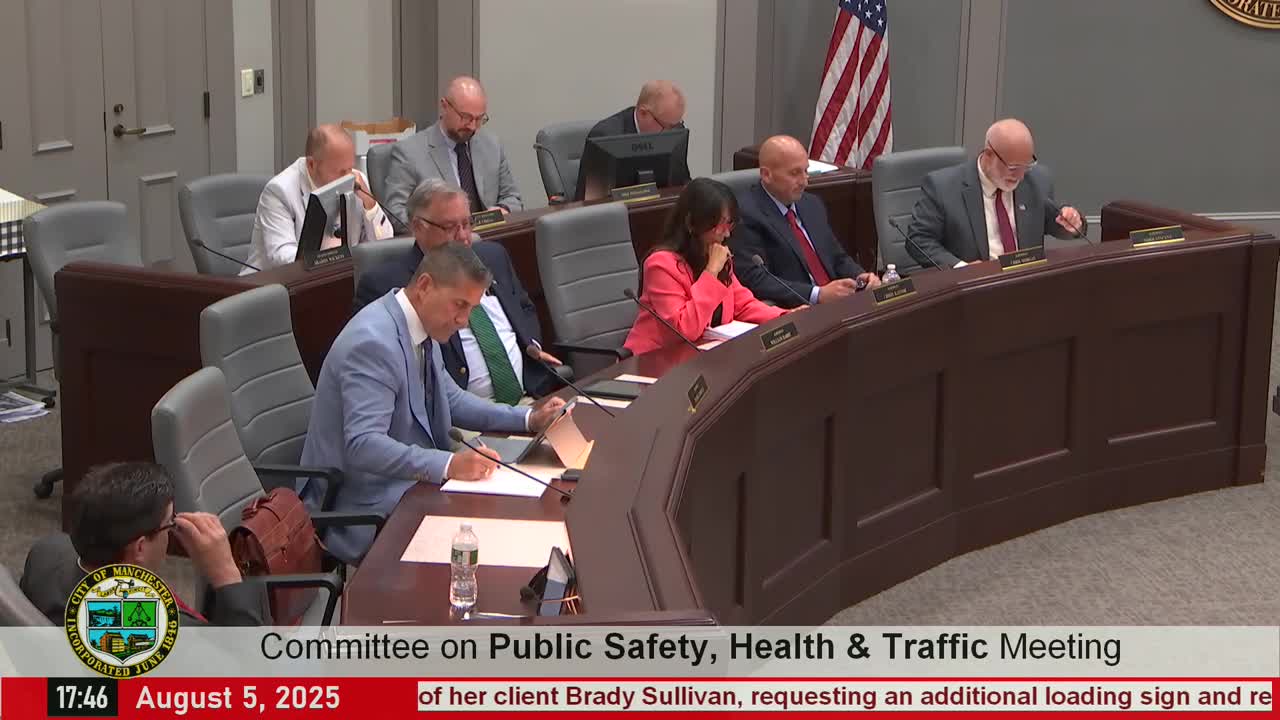
Summary
Manchester committee approved an amendment to Section 91-6-31 that authorizes Public Works to revoke municipal curbside collection eligibility for repeated or serious violations; members debated tenant impact, enforcement levels and alternative penalties for absentee landlords before passing the measure by voice vote.
The Committee on Public Safety, Health and Traffic of the Manchester Board of Mayor & Aldermen voted to approve an amendment to Section 91-6-31 to allow Public Works to revoke a property’s eligibility for municipal curbside collection for cause. The motion was approved by voice vote: “Aye,” and the chair declared “Ayes have it.” The motion was moved by Alderman Barry and seconded by Alderman Morgan.
The measure, described by staff as intended “to give Public Works more latitude in enforcement,” is aimed at properties with repeated trash-collection violations where current fines and enforcement actions have not produced compliance. Tim, a Public Works staff member who answered committee questions, said the change is intended to create an additional enforcement tool and that “the department does not benefit financially.”
Why it matters: Committee members said the amendment is meant to address chronic problems—often tied to absentee landlords and recurring tenant behavior—by creating a pathway for Public Works to revoke curbside service where repeated violations persist. Debate focused on potential unintended consequences, including tenants losing collection service, safeguards such as appeals and who would make revocation decisions.
Committee members raised several concerns and alternatives. Alderman Barry warned about who ultimately would be affected if curbside service were revoked: "Who's actually gonna get penalized out of tenants because if their trash isn't getting picked up ... The tenants in the long run are the ones that are gonna get penalized because their trashes are gonna get picked up." He suggested the city consider picking up trash and charging the landlord or otherwise structuring penalties so tenants do not bear the burden.
Alderman Nance said she feared selective enforcement or targeting and asked about safeguards: "My big concern is ... being targeted. If people are being targeted, oh, they don't like the people that live there." Tim and other committee members responded that revocation authority would be exercised at the director or deputy-director level rather than by individual enforcement officers.
Alderman Fajardo suggested enforcement at the city-planning level, including the possibility of using noncompliance to threaten a certificate of occupancy: "...enforce at the ordinance level with city planning and threaten their... certificate of occupancy." Committee members acknowledged that revoking a certificate of occupancy could be an extreme response and that additional conversations with the director of planning and Public Works could follow.
Members asked about specifics the ordinance leaves discretionary—how many offenses would trigger revocation and how appeals would work. Tim said officers “reach out to property owners with violations” and provide multiple opportunities to correct problems; the draft amendment would allow Public Works discretion after “multiple offenses.” The transcript included a specific example cited by a member of a property with eight violations in the first half of the year where absentee ownership complicated enforcement.
The committee passed the ordinance amendment by voice vote. The committee recorded no roll-call tally in the transcript; the motion was announced as approved after the voice vote.
The committee indicated further discussion may follow on alternative enforcement strategies and the interplay between fines, private collection, charging landlords, and more punitive steps such as certificate-of-occupancy actions. For now, the amendment establishes revocation for cause as an available enforcement tool for Public Works.