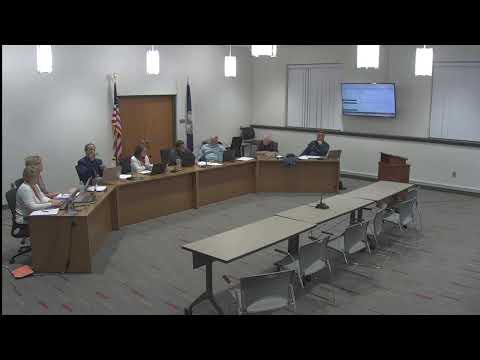
Clarke County school board debates Family Life Education; members consider approving middle- and high-school sections
Loading...
Summary
Board members reviewed state guidance and local curriculum options for Family Life Education (FLE), discussed instructional ownership and opt-out rights, and heard a motion to approve the middle- and high-school portions while deferring elementary-level material for further study.
The Clarke County School Board discussed Family Life Education (FLE) at length during its October meeting, reviewing guidance from the Virginia Department of Education and hearing a range of concerns about who should teach sexual health topics and what materials are age-appropriate. A motion was made to approve the high-school and middle-school sections and to delay action on the elementary curriculum.
Board members and staff framed the debate around two central questions: what the Code of Virginia and the state Department of Education require, and how to ensure instructional ownership and parental transparency. A staff presenter summarized the VDOE review, noting the department's 2022 report and the state code references that guide local decisions on FLE. The presenter said the state allows local divisions discretion over whether to offer FLE, which grades to include and which curricula to use, while some topics are required when a division provides FLE.
The board heard personal testimony underscoring the stakes of early instruction on inappropriate touch and boundaries. One board member described being kissed by an adult tutor as a teenager and criticized reliance on male physical-education teachers to teach some topics; that speaker said, “If I were a girl some place between fourth and seventh grade who was having her first period, I think I'll be a lot more comfortable finding out all the ins and outs of it from a female school nurse than I would be a male phys ed instructor.” The board discussed assigning certain lessons to school nurses or counselors rather than to physical-education teachers.
A staff speaker cited the Virginia Department of Education review pursuant to the 2021 General Assembly amendment (HB 1800) and read findings from a February 2022 report: at that time 113 of 132 school divisions provided family life education; VDOE reported that a large majority of Virginia public school students received FLE, and local divisions retain discretion over implementation and the grade levels served. That staff speaker also quoted Code of Virginia language specifying that the state Board of Education shall develop standards and that local divisions that offer FLE should review content at least every seven years.
Board members raised procedural and content questions: requests to see lesson plans in advance, concerns about role-playing activities and virtual-relationship content, and whether materials define “virtual relationships” or social-media scenarios. One member urged an explicit, written assignment of instructional ownership and stricter guidelines where content could put staff at risk. Another member argued the board had sufficient information to make a decision and urged action.
During the meeting a motion was made to approve the FLE curriculum in full. Separately another motion was proposed to approve only the high-school and middle-school sections and defer elementary instruction pending further review and consultation with elementary staff. The transcript does not record a completed roll-call or voice vote resolving which motion carried.
The board also discussed parental opt-out rights and the importance of notifying families; staff referenced statutory provisions and the VDOE guidance that allow local divisions to set opt-out policies. Several members urged greater transparency, with at least one asking for lesson plans and specific descriptions of role-play activities before approving elementary materials.
Next steps noted by board and staff included: clarifying who will teach each FLE topic at each grade level, sharing lesson plans or summaries with the board and parents, and scheduling additional review of the elementary modules. The board did not adopt final, recorded action on the complete FLE package in the excerpted portion of the meeting.