Get Full Government Meeting Transcripts, Videos, & Alerts Forever!
Get email alerts on the Parks Recreation topic
No spam. Unsubscribe anytime.
Plan Commission adopts Quarry Park master plan, approves preferred concept
Summary
On Oct. 21 the City of Oshkosh Plan Commission unanimously adopted findings and recommended the preferred Quarry Park master plan, a conceptual design that emphasizes naturalized plantings, a central gathering area with surface-mounted musical play equipment, and limited infrastructure because of a closed landfill on site.
The City of Oshkosh Plan Commission voted 8-0 on Oct. 21 to adopt the findings and recommend the preferred Quarry Park master plan, a conceptual guide for long-term development of the neighborhood site.
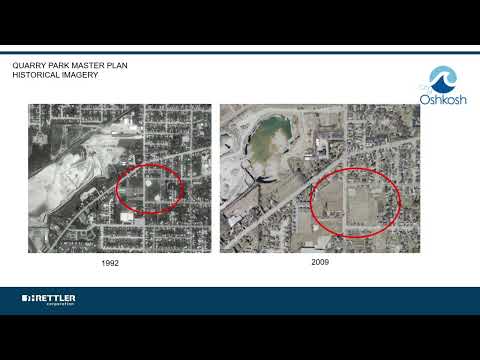
The plan, developed with the city’s Parks Department and landscape consultant Rettler Corporation, calls for a simplified loop trail, a central gravel gathering circle with stone seating, naturalized prairie plantings with shallow-root species, and surface-mounted musical play equipment. Park staff and the consultant emphasized that the site contains a closed landfill, limiting subsurface work: the plan avoids foundations and deep-rooted plantings in the landfill area and identifies existing monitoring wells and vent pipes that will need coordination with consultants and the Department of Natural Resources for any changes.
Ray Mower, Oshkosh park director, introduced the project and turned the presentation to John Kinnear, landscape architect and president of Rettler Corporation. Kinnear described the master plan as “intended to be a conceptual guide to the development for budgeting for your future improvements at that park.” He said the design reflects neighborhood input and the site’s subsurface constraints.
The commission heard three public comments from nearby residents and neighborhood volunteers. Lori Buskirk, representing the Cory Park Neighborhood Association, said neighbors were “thrilled to be moving forward” after multiple outreach meetings. Connie Drexler, a member of the Quarry Park Neighborhood Association core team, told commissioners the design felt “exciting” and that neighbors were looking forward to visible improvements. Resident Ken Larry recounted family history with the old quarries and urged caution about introducing elements that could increase noise; he also raised concerns about long-term settlement of the site based on decades of change.
Commissioners and the consultant discussed several technical limits tied to the capped fill. Kinnear and staff said monitoring wells and some vent piping exist on the site and that any abandonment or modification would require coordination with AECOM and a post-closure modification permit from the DNR. The consultant said typical development on the capped areas would avoid footings and deep plantings; benches and stone seating would be surface-mounted so they could be adjusted if local settling occurs.
Cost estimates presented with the preferred concept show a construction-item total of about $425,000 and a total project estimate — including design, permitting, geotechnical survey and contingency — of roughly $520,000. The consultant said the DNR post-closure modification permitting and specialty engineering fees remain to be nailed down and estimated a permitting-related fee “somewhere in that range” of about $20,500 as a preliminary figure.
Commissioners asked about restrooms and parking. Staff and the consultant said prior buildings and parking had been removed because subsurface conditions made structures and pavement problematic; the presented plan does not include a restroom building. Commissioners were also told that neighborhood parks in Oshkosh do not require on-site parking; the plan relies primarily on street-side parking and walkable access for nearby residents.
After discussion, a commissioner moved to adopt the staff report findings and recommendations for the preferred concept; the Plan Commission approved the motion by roll-call vote 8-0.
Next steps noted in the presentation include securing any required DNR post-closure permits, completing design and geotechnical work, and pursuing funding and placement in the city’s capital improvements program so construction can be scheduled in future budget cycles.