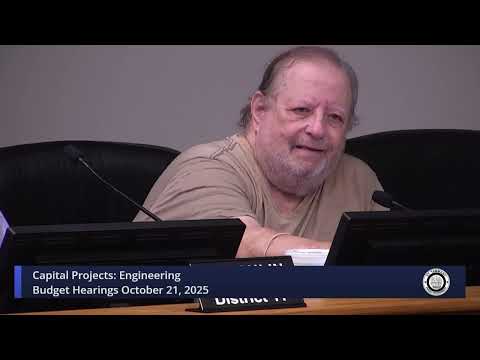
St. Tammany engineers, public works outline $2026 road, bridge and drainage priorities
Loading...
Summary
Parish engineering and public works directors presented the bulk of the 2026 capital and operations requests Tuesday, highlighting major roadway rehabilitations, bridge load‑rating work, a $11.5 million French Branch pond construction and staffing constraints that slow delivery.
St. Tammany Parish engineering and public works leaders on Tuesday outlined their proposed 2026 capital program, saying permitting, right‑of‑way and limited staff capacity are the main constraints on delivering projects already budgeted.
The parish’s engineering director, Daniel Hill, told the council the capital request includes seven major roadway rehabilitation projects totaling roughly $6.8 million, four more extensive road reconstruction projects totaling about $3.3 million, and a drainage program that includes the French Branch pond expansion, for which Hill said the construction request is $11.5 million. Jay Watson, director of public works, described district capital allocations and operational programs that would support those projects.
Why it matters: the work covers large sections of parish roadways, dozens of off‑system bridges and older subdivisions with chronic drainage problems. Hill said projects that avoid interagency permitting can move from design to construction in about a year, but projects needing federal, state or utility approvals take substantially longer.
Hill said the seven major roadway rehabilitations “are handled with in‑house engineering” and listed sample roads by council district (Chris Kennedy Road, Damiano Road, Francis Road, Gladys Road, North Forest Boulevard subdivision, Pine Ridge Road, Willie Garrett Road). He said the projects’ selection was based on road condition and scale and that some nearby small projects will be packaged together to improve procurement efficiency.
On bridges, Hill described an off‑system bridge program that will handle three to four bridges this year and said the state inspects those structures. He warned the council the parish faces a heavy near‑term load‑rating timeline: “at the 2027, all our load ratings for majority of our bridges come due,” and noted the parish has about 74–75 bridges in the off‑system inventory.
Watson said public works maintains roughly 1,600 miles of roadway, 450 miles of laterals and about 72 detention ponds, and proposed roughly $17 million in district capital for 2026. He outlined a strategy of bundling geographically close roads for bid packages to get better pricing, and said public works will deliver about $3.3 million in drainage projects and about $1.2 million in concrete road work next year.
Both directors emphasized staffing and permitting bottlenecks. Hill said engineering headcount has grown by only about four people since 2012 and the department supplements capacity with consultants. On drainage, Hill described a two‑track approach: feasibility/survey/modeling for older subdivisions followed by design and construction where solutions are feasible. He said some large drainage projects (for example, the Westwood detention pond) are ready for construction once real‑estate and permitting clearances are complete and estimated that roughly $30 million in drainage work is awaiting final right‑of‑way clearance.
Funding and priorities: Hill said the major roadway projects he described are funded from “sales tax district 3” and that several projects are identified in the parish capital book as parish‑wide rather than by district. Watson described an operations line for projects under $100,000 (budgeted at about $3.3 million this year) that allows rapid response for small but urgent fixes and concrete panel replacements.
Council members pressed for more location detail (district attribution for each listed road), updates on specific projects such as Sharp Road and Paralow (Hill said Sharp Road remains delayed by utility relocations and Paralow’s timeline depends on coordination with multiple utilities), and a clearer accounting of backlog and staging. Hill and Watson agreed to present more detailed, simplified quarterly project reports in 2026.
What’s next: directors said they will present more granular maps and district attributions at the infrastructure committee and provide a quarterly summary report in 2026. Watson also noted steps to improve constituent transparency for small work orders and suggested further IT integration to reduce manual re‑entry of citizen requests.
Ending: the discussion closed with council members urging the departments to provide clearer lists of prioritized gravel and concrete roads, and to return with a plan for staggering bridge load‑rating work to avoid large simultaneous deadlines.