
Texas Workforce Commission submits strategic fiscal review to LBB, certifies 28 local workforce boards; West Central Texas nominees postponed
Get AI-powered insights, summaries, and transcripts
Subscribe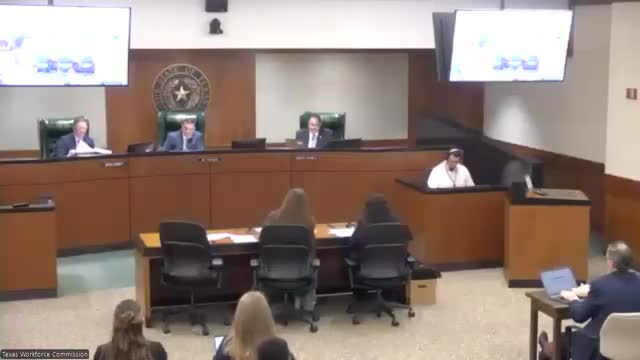
Summary
At its Oct. 21, 2025 meeting the Texas Workforce Commission approved the agency's strategic fiscal review package for submission to the Legislative Budget Board, certified 28 local workforce development boards under WIOA, and postponed action on nominees for the West Central Texas board.
AUSTIN, Oct. 21, 2025
The Texas Workforce Commission on Tuesday approved the agency's Strategic Fiscal Review materials for submission to the Legislative Budget Board and voted to grant subsequent certification under the Workforce Innovation and Opportunity Act for 28 local workforce development boards, while postponing consideration of nominees for the West Central Texas board. The votes passed after staff presentations and brief commissioner discussion.
Caitlin Pearson, director of budget and fiscal policy in the agency's finance division, told commissioners the review is required by statute and will be submitted to the Legislative Budget Board and included in reports to the governor and the Legislature. "TWC is currently undergoing strategic fiscal review by the Legislative Budget Board as required by Senate Bill 68," Pearson said, describing staff's ranking criteria including program funding, relation to workforce customers impacted, and infrastructure impacts.
The action matters because the Legislative Budget Board uses the review as part of its oversight and recommendations on state budgets and agency priorities. Staff said the packet includes program-level funding and what the agency would consider minimum funding to operate each program, and that the ranking exercise itself is descriptive rather than a direct funding cut proposal.
Cara Levy of the Workforce Development Division presented the slate of local board nominees and the subsequent-certification package. She told the commission staff had reviewed board composition, appointments and federal and state compliance for all boards required to be recertified under WIOA. Patricia Martinez of the same division confirmed that, despite postponing one set of nominees, all 28 workforce areas met the certification requirements.
Commissioner Trevino asked whether the review was strictly a reporting function and whether the ranking was intended to signal future funding reductions. "Is it correct that this exercise is a required function'and we don't anticipate that any funding cuts will stem from this exercise and from this ranking?" he asked. Pearson replied that the information being provided includes minimum funding estimates for operations but that the rankings themselves do not automatically trigger specific funding actions.
On nominations, the commission approved nominees for Cameron County, North Central Texas, Heart of Texas, Golden Crescent, Middle Rio Grande, Northeast Texas, Permian Basin and South Plains workforce boards. Commissioner Trevino moved to postpone consideration of nominees for the West Central Texas board to a future meeting while approving the remainder; the motion was seconded and passed.
Separately, the commission voted to submit to the governor its recommendation to grant subsequent certification to all 28 local workforce development boards after staff's review. Commissioners unanimously approved the subsequent certifications.
The meeting record shows staff will forward the ranking materials to the Legislative Budget Board as required and take up West Central Texas nominees at a later meeting.
The commission adjourned after completing the agenda items.
(Notes: the Strategic Fiscal Review was presented as required by statute and cited —Senate Bill 68— in staff remarks; subsequent certifications were conducted under the Workforce Innovation and Opportunity Act.)