Get Full Government Meeting Transcripts, Videos, & Alerts Forever!
Get email alerts on the Building Codes topic
No spam. Unsubscribe anytime.
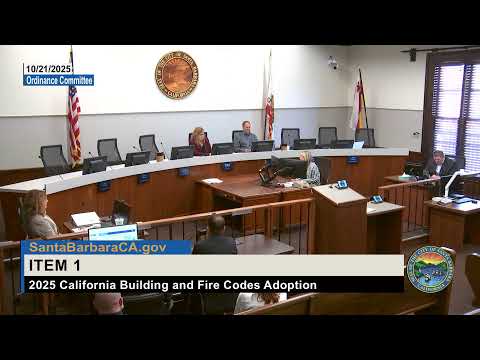
Ordinance committee recommends adopting 2025 California building and fire codes with local amendments
Summary
The Santa Barbara City Ordinance Committee voted Oct. 1 to recommend that City Council adopt the 2025 California Building Standards (Title 24) and associated fire code with select local amendments, readopt prior local changes and repeal Ordinances 6093 and 6094. Staff will correct clerical errors before Council consideration.
The Santa Barbara City Ordinance Committee voted unanimously Oct. 1 to recommend that City Council adopt the 2025 California Building Standards Code (Title 24) and the 2025 fire code, including certain appendices and local amendments, and to repeal Santa Barbara ordinances 6093 and 6094.
City Chief Building Official Tina Dye and Fire Marshal/Battalion Chief Ryan DeGiglio presented the triennial code update, explaining that state building standards are on a three-year cycle and that the 2025 codes take effect Jan. 1, 2026. Dye told the committee, “The state codes are on a 3 year cycle with public hearing with a public hearing process including input from local stakeholders, state agencies, local fire and building officials, and the general public.” She said local adoption is mandatory for compliance and that no local ordinance is required if a jurisdiction makes no local amendments.
The recommendation to send an ordinance to City Council reflects several staff proposals: adopt by reference the 2025 California building and fire codes (parts 1–12), readopt previously adopted local amendments in chapters addressing structural and fire-life-safety provisions, add the standalone 2025 Wildland-Urban Interface (WUI) code provisions into the local adoption package, and make mostly administrative language updates. Dye said staff posted outreach materials on the city website, provided flyers at public counters and planned newspaper notices; the staff report also includes a summary matrix that lists existing and proposed local amendments by code section.
Why it matters: the new state codes take effect Jan. 1, 2026, and compliance will be mandatory. Local jurisdictions may enact more restrictive amendments but must base them on findings tied to administrative, geologic, topographic or climatic conditions. Committee members and staff emphasized that the current cycle is the primary opportunity to make residential code changes before a state-imposed pause on more restrictive residential standards takes effect.
Committee discussion and public comment highlighted three recurring points. First, staff said the package includes clarifications meant to ease plan review and inspections, for example clearer language on what counts as a remodel and a new table for higher-hazard occupancies to help determine when fire sprinklers are required. Council member Jordan asked whether the changes would be disruptive to designers or property owners; Dye responded, “There is nothing significantly different that will have a negative impact on any of our designers or property owners.”
Second, committee members raised conflicts raised between preservation of historic materials and wildfire-hardening requirements in high-fire areas. Chair Sneddon and council members discussed scenarios in which historic window frames or fence materials might conflict with WUI recommendations. Dye said local amendments could be used to make rules more restrictive if the city chose to do so, and staff agreed to look into the overlap between the historic-landmark guidelines and the fire-related requirements. Planning staff member Mr. Buscante said related flexibility is being added through the single-family streamlining project to allow some home-hardening work to be approved administratively.
Third, a staff member noted state Assembly Bill 130 and Assembly Bill 306 create a moratorium on adopting more restrictive residential building standards through June 1, 2031, with exceptions including emergency actions and certain general-plan–implementation measures. A staff speaker told the committee that the moratorium makes this update “our last go at it for 6 years” for residential restrictiveness except where an exception applies.
Public comment focused on technical and editorial concerns in the draft ordinance. Steve Johnson, a member of the public, asked staff to correct clerical errors in section and page numbering and raised a substantive point about Appendix G of the CBC and local floodplain standards. He urged clearer handling of Appendix G and the city’s floodplain policy, noting the interplay of FEMA and ASCE 24 standards and the local “75% test.” Johnson summarized: “My biggest concern is with the . . . treatment of appendix G,” and asked staff to simplify the ordinance language so the appendix’s role is clear.
Staff responded that they would correct clerical errors and review the Appendix G language to ensure it aligns with the local floodplain ordinance and referenced standards. The staff presentation noted the planning department determined the local amendments are exempt from CEQA.
Action: Council member Jordan moved the staff recommendation with corrections to clerical errors; Council member Gutierrez seconded. The committee conducted a verbal roll-call vote. Council member Gutierrez, Council member Jordan and Chair Sneddon voted yes; the motion passed unanimously. The committee recommended that City Council (a) introduce and conduct first reading of the ordinance on Nov. 18, 2025, (b) hold second reading and adoption on Dec. 2, 2025, and (c) direct staff to correct clerical errors in the ordinance and staff report prior to Council consideration. The adopted state codes will be effective Jan. 1, 2026.
The committee separated discussion items (questions about historic-preservation conflicts, plan-review clarifications and outreach) from the formal recommendation. Staff noted appeals of code interpretations would go to the Building and Fire Code Board of Appeals; challenges to an adopted code ordinance would be addressed by the City Council if the ordinance is approved.