
Manchester aldermen hear briefing on ‘community power’ municipal aggregation
Get AI-powered insights, summaries, and transcripts
Subscribe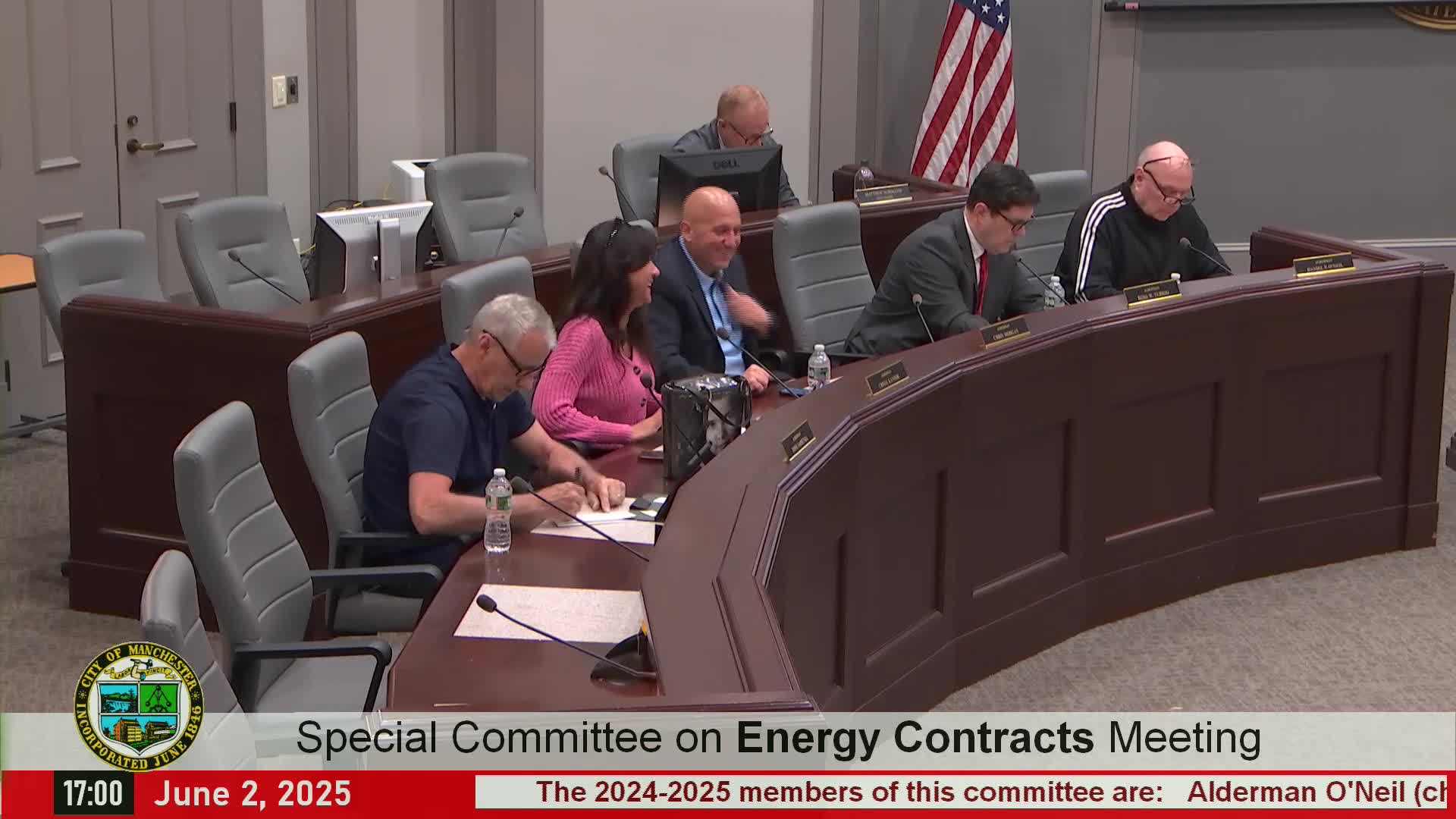
Summary
Representatives of Community Power Coalition New Hampshire briefed Manchester’s Committee on Special Energy on RSA 53‑E municipal aggregation, program structure, recent performance, and next procedural steps. Committee members asked about rates, reserves, enrollment mechanics and local benefits; no formal launch decision was made.
Representatives of Community Power Coalition New Hampshire (CPCNH) presented to the Manchester Board of Mayor & Aldermen’s Committee on Special Energy on June 2, outlining how a municipal “community power” program would work under state law and what steps Manchester would take if it chooses to explore joining.
The presentation explained that RSA 53‑E authorizes New Hampshire cities, towns and counties to become default electricity suppliers for local customers, typically through an opt‑out enrollment. CPCNH said its municipal programs have averaged roughly 70% participation in communities that have launched and that the organization serves about 190,000–195,000 customer accounts statewide. Henry Herndon, CPCNH acting general manager, told the committee that the agency’s current residential offering was 9.7¢ per kilowatt‑hour and that customers may opt up to higher‑renewable products if they wish.
The briefing mattered to Manchester because the city would decide whether to proceed through a staged process: adopt a joint powers agreement (JPA) to join CPCNH as a member (no financial commitment), establish an electric aggregation committee and prepare an electric aggregation plan (EAP) for Public Utility Commission review, then sign a cost‑sharing agreement (CSA) if the city elects to launch and take service. Andrew Hatch, CPCNH engagement manager, said the program is self‑funded from the supply portion of customer bills and that “under New Hampshire law, you cannot spend general city funds on the operation of these programs.”
CPCNH described governance and operations: a member‑elected board and committees oversee risk management, regulatory affairs and member engagement; Calpine Energy Solutions provides retail customer service and billing support; Ascend Analytics advises on wholesale risk management. Herndon said the coalition maintains reserve accounts and has a policy target of roughly 120 days of operating cash on hand to become a load‑serving entity. He said reserves are held by CPCNH and tracked by member contributions; in the event a member withdraws, the member’s proportional share of the joint reserve would be returned subject to contract terms.
Committee members questioned rate competitiveness, volatility, and local benefit. Alderman Morgan asked what direct benefits the city would receive; Herndon replied that the city could enroll its municipal accounts and that municipal accounts could participate in certain local projects — for example, CPCNH described a nearly 5‑megawatt solar project in Warner (the Poverty Plains project) whose municipal participants would receive a credit equal to 12.5% of the prevailing utility rate (CPCNH gave 8.929¢ as a recent Eversource example, implying roughly a 1.1¢ credit for municipal participants under that rate). Herndon said Nashua — an early participant — has about 33,177 accounts and has realized an average savings figure cited by CPCNH for that city of about $204 per customer since launch.
On program mechanics, CPCNH said: most municipal programs in New Hampshire operate as opt‑out defaults (customers are automatically enrolled and may opt out); customers can switch suppliers without a fee on a regular billing cycle, typically effective the next bill if a request is received with sufficient notice; and the coalition generally sets rates every six months but can make mid‑cycle adjustments when market conditions require and after providing notice. Herndon and Hatch emphasized that customers on third‑party supply remain with their supplier unless they choose to opt into the community power program.
Several aldermen pressed CPCNH on reserves and governance. Committee members were told the joint reserves are managed by CPCNH, that contributions are tracked by member, and that CPCNH is reviewing cost‑allocation methods so members contribute proportionally. CPCNH staff said the JPA carries no launch obligation, the EAP is the planning document that goes to the PUC for a 60‑day review, and the CSA is the launch commitment.
CPCNH also described ancillary services it offers or is developing: aggregated renewable energy certificate (REC) purchases to support opt‑up renewable products and local project procurement. The presenters said the coalition has about 64 municipal members and 4 county members statewide and that member communities to date have produced an estimated $20 million in aggregate customer savings relative to utility default service during the periods measured.
The committee did not vote to join CPCNH or to begin the formal aggregation plan process at the meeting. CPCNH agreed to send the JPA, cost‑sharing agreement and other key documents to the city clerk for committee review; aldermen indicated they would continue to evaluate and potentially invite other vendors for comparisons. The committee adjourned on a motion by Alderman Morgan, seconded by Alderman Kantor; the voice motion carried with affirmative votes from the members present.
CPCNH recommended steps for Manchester if it wanted to proceed: 1) join CPCNH via the JPA to participate as a member with no financial obligation; 2) appoint or designate an electric aggregation committee under RSA 53‑E to prepare an EAP and consider alternatives; 3) if the city opts to launch, approve the CSA and schedule a launch window (CPCNH advised that March is often a favorable launch month to avoid costly winter months). CPCNH also invited Manchester to participate in its committees and governance to influence rate, reserve and program development.
The committee requested that CPCNH provide the uniform cost‑sharing agreement and other governing documents for review. No formal timeline for next steps was adopted; aldermen indicated further study and possible fall consideration when the board reconvenes after summer scheduling.