Get Full Government Meeting Transcripts, Videos, & Alerts Forever!
Get email alerts on the Education Budget topic
No spam. Unsubscribe anytime.
Manchester residents, students and educators urge aldermen to restore school budget cuts at public hearing
Summary
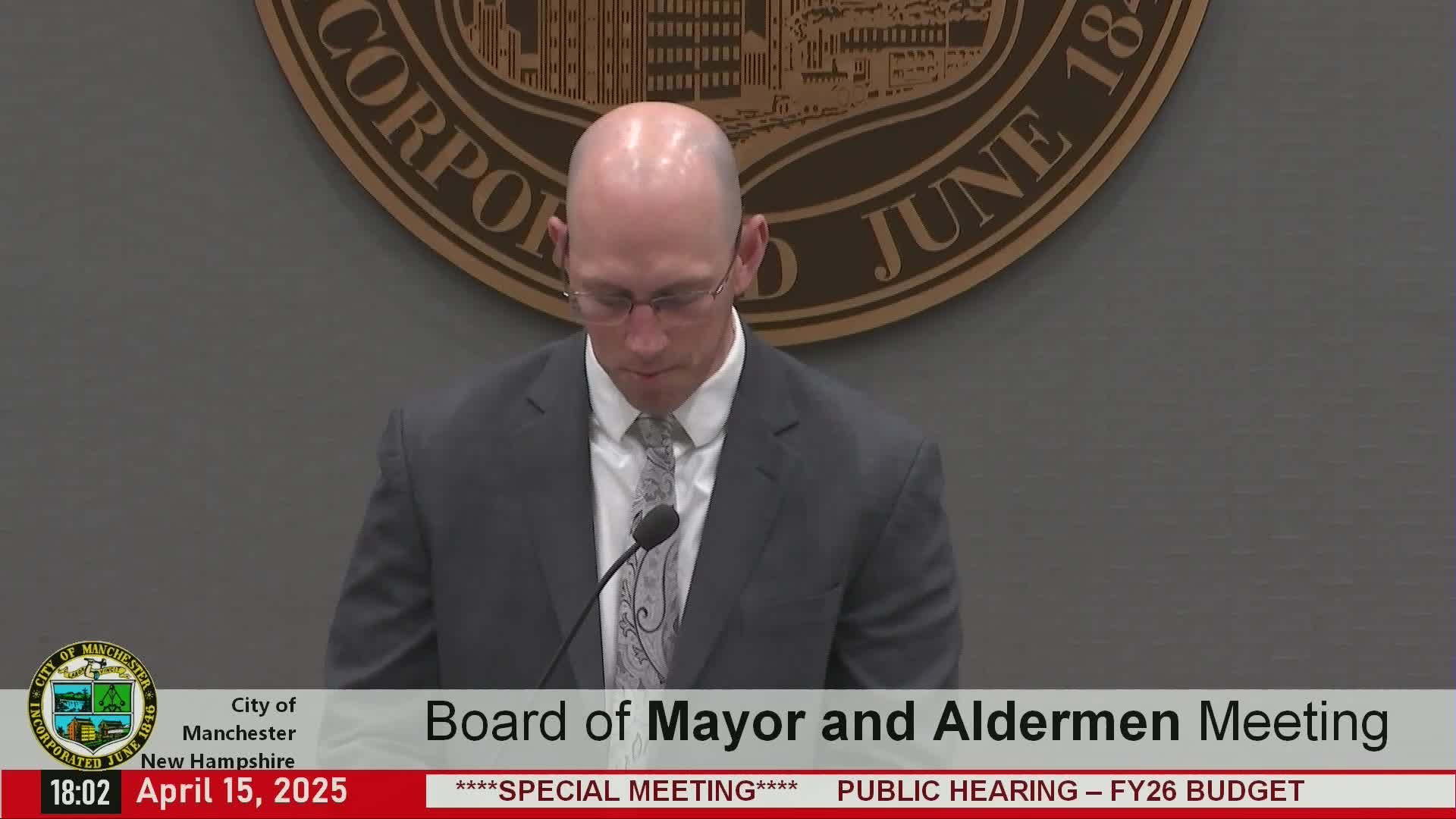
Hundreds of residents, teachers and students spoke at a special Board of Mayor and Aldermen public hearing urging the board to reject proposed reductions to the Manchester School District budget and to fully fund the tax-cap‑compliant request. Speakers said cuts would increase class sizes, reduce transportation and extracurricular access and hit a
A special public hearing of the Manchester Board of Mayor and Aldermen on the proposed fiscal year 2026 municipal budget drew a long line of speakers—many of them students, teachers and school staff—pressing the board to restore about $9.5 million the mayor’s proposal would remove from the school district request.
The hearing, opened by the board to consider a package of proposed resolutions that included a $236,499,925 appropriation for the Manchester School District, attracted dozens of public comments. Speakers emphasized that the school board had submitted a tax‑cap‑compliant request of roughly $246 million and said the mayor’s proposed reduction would force class‑size increases, cuts to athletics and arts, and the introduction of fees for student bus rides.
Why it matters: Manchester is the state’s largest city school district and speakers repeatedly framed the dispute as a choice about investment in a diverse, high‑need student population. Commentators said cuts would disproportionately affect low‑income families, special‑education services and students who rely on school transportation and after‑school activities.
At the hearing, dozens of students from Manchester high schools, school staff and parents described concrete effects they expect if the board approves the mayor’s lower number. “When you invest in our education system, there isn’t an immediate return on investment,” Ward 11 resident Patricia Anglin told aldermen, recounting her own path from teenage parent to certified school nurse and urging support for the larger budget. Amy Colby, reading supervisor at Smith Road School, asked aldermen to “support a full $246 million tax‑cap‑compliant budget.”
Students used the hearing to make similar, practical appeals. Selena Santinelli, a senior at Manchester West, testified that course cancellations and reduced transportation have already limited options at her school. A longtime teacher, Julie Cusano, said smaller class sizes had enabled “the care, attention and support that every child in my classroom deserves,” and warned that a $9.5 million reduction could reverse recent gains.
School board and district officials presented budget detail during the hearing and in accompanying slides. The district’s proposed budget includes roughly $11.5 million in additional spending for FY2026, driven in the district’s materials by an expected increase in adequacy aid (state education funding) and the tax‑cap allowance. District staff also told the board they plan to reduce reliance on one‑time reserve funds (expendable trusts) from about $9 million this year to $4.5 million next year.
Board and auditor context: The mayor’s proposed municipal budget that the board is now considering contained a list of proposed resolutions appropriating funds to multiple city entities. The initial presentation the board heard listed line items including parking, sewer, airport and transit authorities and the school district appropriation. Much of the public comment focused on the school line.
Discussion and possible impacts: District staff said they had reviewed line‑by‑line reductions and drafted a list of possible mitigations to reach a lower figure while aiming to limit harm to classroom instruction. Those measures include pausing the planned expansion of middle‑school athletic offerings, holding some positions vacant and converting some contracted services to employees. District officials told the board they do not plan involuntary layoffs at this stage, saying reductions would be handled through attrition and reassignments; they warned, however, that the changes would still increase class sizes at some elementary schools and reduce services.
Several speakers flagged transportation proposals as especially consequential. The district noted that state law requires busing at a two‑mile threshold but said the district currently provides busing for students living within 1.4 miles of their schools; one district scenario presented to the board would raise the walking radius to two miles and charge high‑school riders a $10 weekly fee—an option many speakers called inequitable and likely to reduce attendance.
Board actions during and after the hearing: The board took formal procedural steps during the meeting. The clerk read a list of proposed FY2026 appropriation resolutions (including the Manchester School District sum noted above). The board also referred a variety of budget resolutions and community improvement program items to committee and voted to waive readings and enroll resolutions as part of the standard process. Committee on Finance met during the meeting and reported back with recommendations; motions to approve CIP authorizations and to lay over certain resolutions were approved by majority vote.
What remains: Aldermen and the mayor signaled an intent to continue negotiations. The mayor stated he would work with district leaders and aldermen on a revised figure and suggested an incremental increase to his earlier proposal to reduce the immediate impact on elementary class sizes, athletics and transportation. The board has scheduled further steps in the budget calendar; district officials said earlier clarity would help recruitment and hiring ahead of the next school year.
Ending: Speakers and district leaders asked aldermen to weigh both near‑term fiscal responsibility and long‑term community consequences. “If you are looking to better understand Manchester … I would love to discuss with you further,” said Deepasha Giri, a student and school‑board representative from Manchester West. The board will consider the amended budget proposals in coming meetings before finalizing the FY2026 appropriations.