Get Full Government Meeting Transcripts, Videos, & Alerts Forever!
Get email alerts on the School Governance topic
No spam. Unsubscribe anytime.
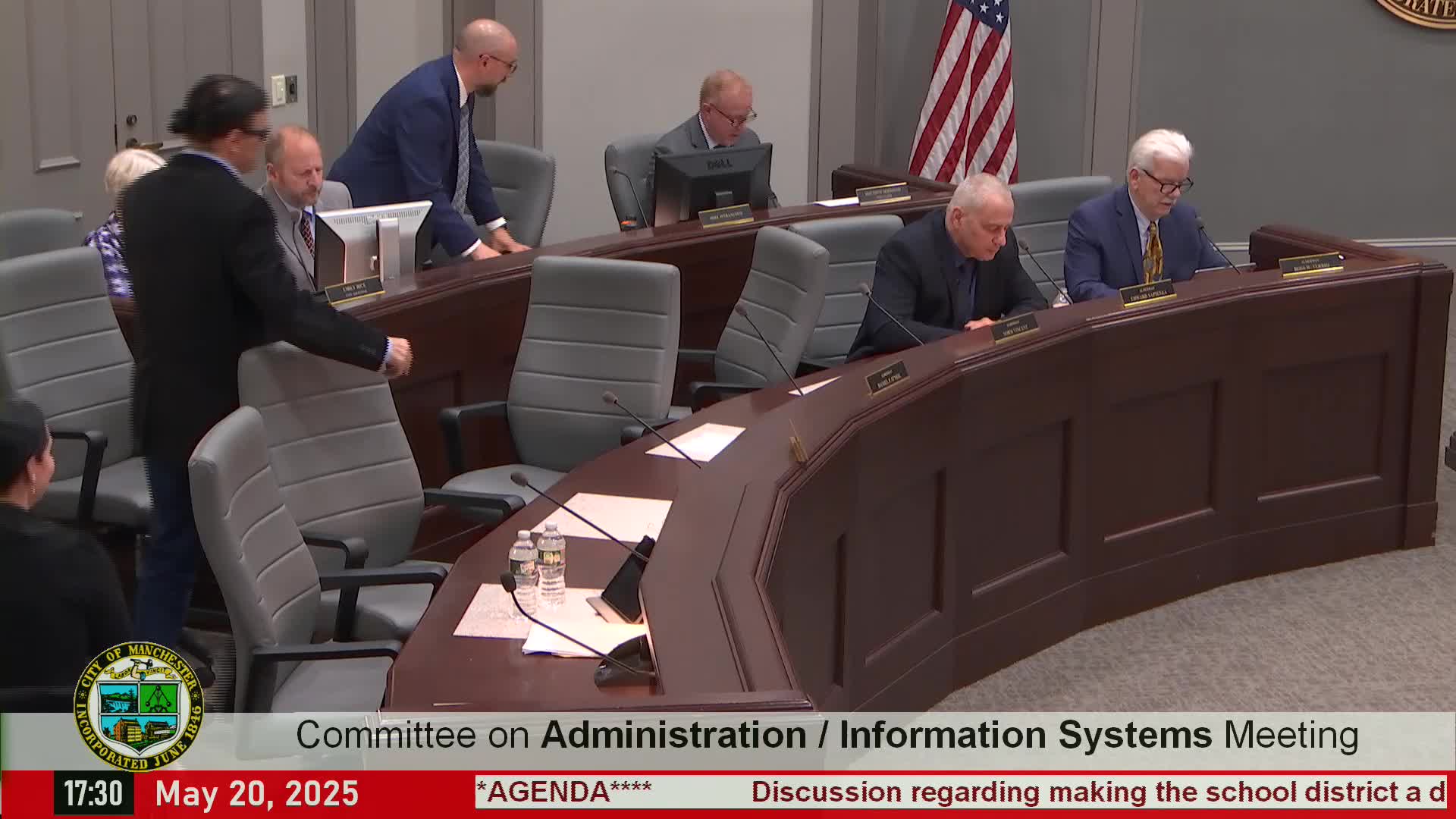
Manchester aldermen debate making school district a city department
Summary
Committee on Administration and Information Systems discussed converting the school district to a city department, focusing on timeline, legal constraints under state RSAs, and mayoral budget authority. The committee directed staff to bring detailed amendments and legal analysis to the full Board of Mayor and Aldermen.
Members of the Manchester Board of Mayor and Aldermen’s Committee on Administration and Information Systems debated whether to make the city school district a department of the city, centering on timeline, state statutory limits and how much budget authority a future mayor would hold. The committee voted to direct staff to bring draft amendments and a legal review to the full Board of Mayor and Aldermen for consideration.
Committee members pressed for concrete details about what a change would mean for operations, which state statutes (RSAs) would apply, and how quickly any change could be implemented if voters approve it. City Solicitor Emily Rice told the committee that a package of proposed amendments could be drafted but stressed those proposals must comply with the many RSAs that govern school districts. "We can call it a department, but we can't do things that RSAs don't allow us to do," Rice said.
The discussion covered several discrete questions: whether the shift would be primarily a budgetary change giving the mayor line-item control, whether the mayor would retain membership on or voting authority on the school committee, and whether aldermen could gain more direct oversight. Alderman Levasseur argued the district has grown large and opaque since 1999, saying, "When I started here in '99, 2000, their budget was, I believe, a 100,000,000," and adding that recent city-versus-district funding raised concerns about transparency and oversight. Aldermen who opposed or questioned the change urged the committee to evaluate performance metrics in addition to finances before proposing ballot language.
Committee members identified a near-term schedule constraint: draft amendments must be in place to meet the board's June 3 drop-dead date for sending items up the chain toward state review. The solicitor noted a potential post-election implementation window: if voters approved a change in November, the city could have until the end of the next fiscal year (June 30 of fiscal year 2026) to finalize structural changes — roughly seven months, Rice said.
Several members asked the solicitor to prepare a list of relevant RSAs and to compare the current charter language with the earlier structure (the pre-1999/2001 arrangement) so the committee and voters could see specific differences. The committee also asked staff to prepare options that might accomplish specific objectives — for example, clearer mayoral budget directives — without necessarily labeling the school system a department, in case a targeted set of charter or ordinance changes would meet the board's goals while avoiding statutory conflicts.
Action taken: Alderman Kanter made a motion to direct staff to present the items Emily Rice outlined and the related legal review to the full Board of Mayor and Aldermen; Alderman Sapienza seconded. The committee voted in favor; the chair announced, "The ayes have it." The item will be reported to the full Board of Mayor and Aldermen on June 3.
The committee closed without finalizing substantive language. Next steps are for the solicitor and city staff to identify the controlling RSAs, prepare draft charter amendment language or alternative options, compare the 1999 structure and associated performance metrics to the present model, and return the materials to the Board of Mayor and Aldermen for further action.