
Merrimack County hears warnings on rising health costs; approves change to ancillary benefits
Get AI-powered insights, summaries, and transcripts
Subscribe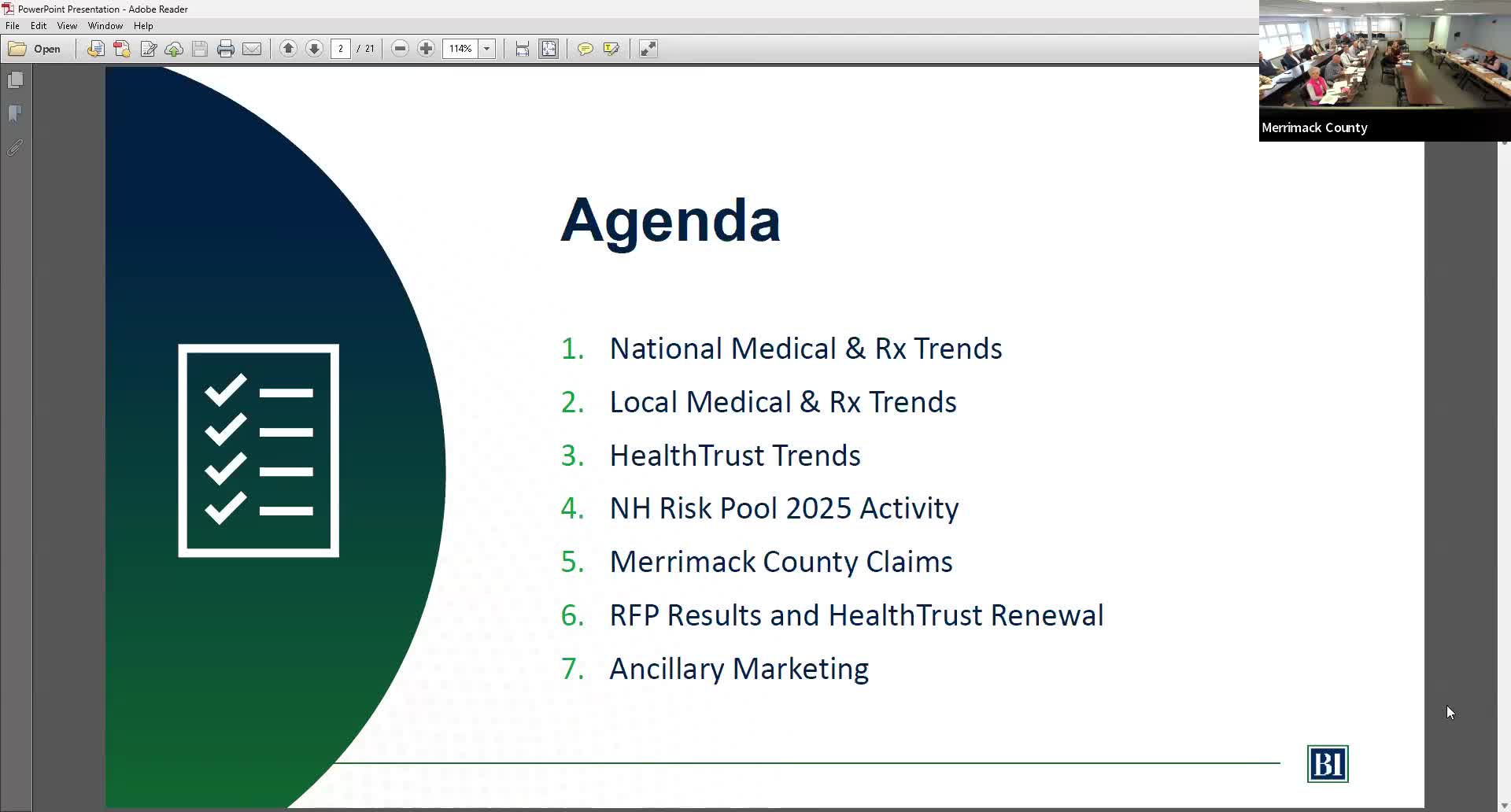
Summary
A consultant told the Merrimack County Board of Commissioners that medical and prescription trends are driving unusually large renewals and that the county's recent spike in catastrophic claims has left carriers unwilling to quote. Commissioners approved switching ancillary benefits to a different carrier with a three‑year rate guarantee.
Kirsty Karpowicz, a benefits consultant with Boreslow, told the Merrimack County Board of Commissioners on Oct. 22, 2025, that national and regional medical and prescription‑drug cost trends are driving unusually large health‑insurance renewals and that the county’s own recent catastrophic claims have left fully insured carriers unwilling to quote the county’s business.
Karpowicz said national prescription trends and “specialty” drugs are producing the largest increases, and that medical trend — the factor carriers use to project how much a procedure or service will cost next year — is running near double digits in many places. She said New Hampshire trends and public risk‑pool activity show sharper increases than the national median and cited the state’s municipal pools as evidence of volatility.
The consultant told commissioners the state began the year with three public risk pools — the Health Trust (Anthem), SchoolCare (Cigna) and the New Hampshire Interlocal Trust (Harvard Pilgrim). She said the smallest pool, the Interlocal Trust, closed earlier in the year, and that SchoolCare issued a large assessment in September after its actuaries projected a negative reserve position. Karpowicz said the Health Trust has reaffirmed language in its bylaws making it a non‑assessable pool and reported relatively strong cash and reserve balances.
Why Merrimack County is harder to insure
Karpowicz presented county‑specific figures showing Merrimack County had exceptionally high claim experience for the 12 months ending April 2025. She said the county’s loss ratio was 131.2 (meaning the pool paid $1.31 in claims for every dollar of premium), total medical and prescription claims rose 63.8% year‑over‑year, and that the county’s total spend over the past 12 months was about $12,800,000. She attributed the jump primarily to several catastrophic claims.
Karpowicz said those large claims made fully insured carriers reluctant to bid: an RFP to Anthem, Cigna and Harvard Pilgrim produced no acceptable, competitive fully insured offers for the county’s medical coverage. She said Anthem “tried very hard” but ultimately could not provide a competitive quote given the county’s claims profile. That lack of offers, she said, is why the county remains dependent on the Health Trust for medical coverage this year.
Karpowicz also reviewed the Health Trust’s reserve figures cited in her presentation, saying the trust reported roughly $61.5 million in cash on hand, exceeding a stated requirement of $37.7 million, and that its capital adequacy reserve was funded at about $43.3 million after a $9.5 million increase. She said the Health Trust expected another increase on renewals of roughly 13.3% in the upcoming year but emphasized that no pool is immune to national medical and pharmacy trends.
Board action on ancillary benefits
After the presentation, commissioners voted to approve a change in the county’s ancillary benefits (life, AD&D and short‑term disability). Karpowicz said the consulting team solicited quotes from 11 carriers and that three carriers returned competitive proposals matching required contract language and service expectations. She recommended The Standard, saying it provided the best combination of rate, contract terms and customer service.
Commissioners approved the motion to move ancillary benefits to The Standard, effective Jan. 1, 2026, with a three‑year rate guarantee. Karpowicz said the change would save the county approximately $16,475 per year under the quoted arrangement. The motion passed on a voice vote with the three commissioners present recorded as voting in favor.
What commissioners asked and what remains unchanged
Commissioners asked whether the county had comparable benefits to neighboring counties; Karpowicz said Merrimack County’s plan design and benefits are comparable and that the spikes were driven by a small number of high‑cost claims rather than plan design. Commissioners also raised complaints about a separate Health Trust MAPD (Medicare Advantage Prescription Drug) rate guarantee that was later broken when federal Part D parameters changed; Karpowicz explained that MAPD subsidies and federal changes can legally negate multi‑year guarantees in the fine print.
The board did not approve any change to medical coverage at the meeting; Karpowicz reiterated that, given the county’s recent catastrophic claims, fully insured carriers declined to offer competitive medical quotes and that the county’s best option for medical coverage this renewal cycle remains the Health Trust.
Ending
The presentation and the ancillary benefits motion together underscore the county’s exposure to national medical and drug cost trends and the local effects of several large claims. Commissioners approved the ancillary benefits vendor change and asked staff and consultants to continue monitoring claims and renewal options going into next year.