Get Full Government Meeting Transcripts, Videos, & Alerts Forever!
Get email alerts on the Fire And Building Code Update topic
No spam. Unsubscribe anytime.
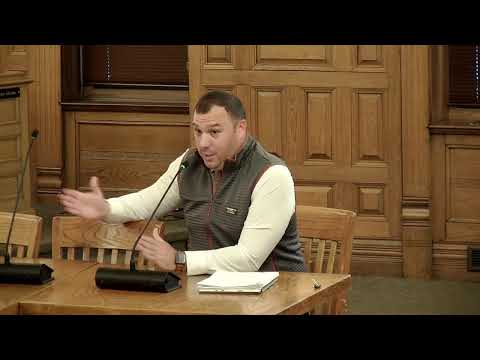
Syracuse committee reviews local-law amendments to align with New York’s 2025 fire and building codes
Summary
Syracuse City staff told the Neighborhood Preservation, Homeless and Housing Committee on an informational agenda item that they have drafted local-law amendments to bring the city’s administration and enforcement rules into alignment with New York State’s updated 2025 uniform fire prevention and building code, which the state says takes effect Jan. 1.
Syracuse City staff told the Neighborhood Preservation, Homeless and Housing Committee on an informational agenda item that they have drafted local-law amendments to bring the city’s administration and enforcement rules into alignment with New York State’s updated 2025 uniform fire prevention and building code, which the state says takes effect Jan. 1.
The amendments largely add administrative language — for example, accepting electronic construction documents, requiring electronically sealed plans, allowing remote inspections, and listing specific items required for certificates of occupancy — so Syracuse can demonstrate to the state that it has the local laws needed to administer the state code. Deputy Commissioner Jake Dushaw said he had not yet completed advanced training on the new code and was presenting summary changes rather than the full 2025 code text.
Why it matters: the updates affect how the city processes permits, inspects work and verifies compliance on residential and commercial projects. Committee members raised concerns about public awareness, unpermitted work, and the fire-safety implications of proposed battery-storage facilities, and staff described the legal and procedural limits on what the city can require without additional approvals from the state.
Staff said the local amendments are intended primarily to add missing verbiage in the city’s existing local law (Local Law No. 5, 2011) so that Syracuse meets the state’s minimum administrative requirements. Examples staff cited include inserting a requirement for a written statement of energy-code compliance on submitted construction documents and explicitly listing established street grades, proposed finished grades and, when applicable, flood-hazard and design-flood elevations.
“Some of it is just language, new language to be added, for the purpose of, again, amending our local code, so that it meets the requirements of the state changes to Title 19,” Deputy Commissioner Jake Dushaw said. He told the committee the city already follows many of the practices in day-to-day work but needs the words on the books.
Staff also proposed adding wording to allow remote (virtual) inspections. Dushaw said the city used virtual inspections during the COVID pandemic and has the permit-software capability to run and record secured video inspections, but that the permitting office currently prefers in-person inspections and is not actively using remote inspections in routine practice.
The draft amendments would also explicitly add carbon-monoxide detection to the certificate-of-occupancy requirements; that language, staff said, was omitted when a previous state-related change (referred to in discussion as Amanda’s Law) was adopted. Operating permits were another addition listed: staff cited specific permit categories fire prevention issues commonly handles, including fumigation and certain industrial uses such as fruit- and crop-ripening facilities.
Commissioner Michael Collins, who identified himself as commissioner for neighborhood and business development, framed the item as an administrative step that shows the state how Syracuse will enforce the statewide code. “This isn’t the code itself. It’s simply how are we guaranteeing in New York State that we are enforcing what they have written as code,” Collins said.
Committee members pressed staff on public outreach and enforcement. Councilors noted recurring unpermitted work and asked how the city can better educate homeowners and small contractors; staff said the department runs an annual Healthy Housing event and conducts on-site education but lacks resources for a broad marketing campaign. Staff said they maintain digital records of permits and applications and will investigate cases where constituents report repeated resubmissions or lost records.
Members also asked about contractor qualifications and liability. Staff said Syracuse requires proof of insurance for contractors who sign permits (workers’ compensation, disability, liability) and enforces trade-specific licenses for work such as HVAC and electrical, but the city does not have a broad general-contractor license that would cover every type of contractor.
Battery-storage projects and fire safety drew sustained discussion. Committee members raised community concerns about fire risk from lithium-ion battery facilities and asked whether the local amendments could require additional suppression systems or other conditions. Staff said the 2025 fire code includes new, more detailed provisions for energy-storage systems and that the city and fire department would review any project under the 2025 minimum standards if a permit application is received. Assistant Corporation Counsel Danielle Smith said that if the city sought to adopt standards more restrictive than state minimums, the state would have to approve that local law change. She also suggested the committee consult Joe Berry (city planning/legal staff) about adding permit conditions through a special-use permit process.
“We can add to it. That would be separate legislation since this has to do with how we administer the code as opposed to what the code itself specifically is,” Dushaw said about the city’s ability to be more restrictive than state minimums.
Staff outlined other specific additions being proposed to the local law: record-keeping requirements for condition-assessment reports, publishing climate and geographic design criteria (ground-snow load, wind design, frost-line depth), and language about parking-garage assessments. Staff noted city reviewers already check many items in practice and that the amendments primarily place those items into the local law text.
Committee members and staff agreed more detailed training and review would follow as certified New York State code officials complete “advanced in-service” training on the new code during 2026; staff identified an April conference where many building officials plan to attend required training.
No formal decision was made at the meeting on adopting the draft local-law amendments; staff framed the session as a summary and said they would return with additional detail after further review and training. The committee adjourned after a motion to adjourn was made and seconded.
Votes at a glance: Motion to adjourn — moved and seconded on the committee floor; voice vote; outcome: approved (no roll-call tally recorded in the transcript).