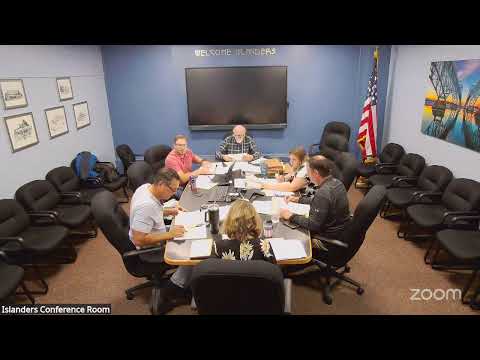
Grand Island board focuses on fire funding, dispatch options and budget cuts at workshop
Loading...
Summary
The Grand Island Town Board spent a budget workshop debating how much to increase town funding for volunteer fire services and whether to pursue outside or shared dispatch services, while also trimming and reallocating several draft budget items to keep the town within its available levy increase.
The Grand Island Town Board spent most of a continued budget workshop weighing a proposed increase in town funding for the volunteer fire companies, whether to pursue shared or outside dispatch services, and a set of nonpersonnel reductions to keep the town under its tax-cap target.
Board members and staff began the session by saying the single largest driver of the levy decision this year is the request from the fire companies. They debated a range of options — including a one-year increase in the companies’ town funding large enough to stay under the state tax-cap, negotiating a multi‑year contract with fixed annual increases, asking for a formal RFP for dispatch services, or seeking a public referendum on a fire district — but did not adopt a final contract during the meeting.
The discussion mattered because board members said growth in dispatch requirements and possible state staffing rules could materially raise costs inside a few years. Town officials repeatedly flagged an uncertain legal requirement that could require two dispatchers on shift; the town attorney and the fire companies have given differing legal interpretations. Because that outcome could double dispatch staffing costs over time, multiple board members recommended including protections in any new contract or pursuing shared services or an RFP to compare options and costs.
On the immediate budget numbers, the board informally signaled comfort with a near‑term package that would keep the town inside its available levy increase and that several members were willing to support an approximate 15 percent increase to the fire line as a working number for the preliminary budget. At the same time the board sought contract language or other commitments intended to limit future escalations tied to changes in state law.
Workshop participants also agreed to a package of targeted reductions and reassignments to shrink the levy impact. Among the adjustments discussed or put into the draft budget during the meeting were: removal of a $65,000 assessor professional‑services line that the board determined could be cut; removal of a roughly $20,000 recreation building shed item; reducing a proposed large community‑center repair line (discussed as about $150,000 in earlier estimates) to a smaller contingency; and budgeting $50,000 as an alternate, off‑site storage solution (for kayaks, equipment and other recreation items) rather than a full repair or immediate demolition of the existing storage room. Board members described those decisions as budgetary/line‑item edits rather than final policy actions; the board asked staff to confirm costs and bring any necessary contract language back for formal action.
Smaller departmental items were also discussed and adjusted. Recreation staff and board members debated replacing an aging Dodge Caravan with a larger 10‑passenger van; one budget line for a Transit‑style vehicle was cited at about $87,692 on the draft. The recreation and senior ("Golden Age") programs also sought split‑system HVAC work; staff reported an estimated figure near $42,000 to add or replace split units as a supplemental or stopgap heat source while a boiler issue is monitored. The board asked staff to gather firm quotes for HVAC, alternative storage and any asbestos abatement before committing spending. For the community center, participants discussed asbestos containment and whether full removal or demolition would be cheaper than repairs; town staff said they had no competitive written quotes yet and that earlier rough estimates for ceiling repairs had ranged from about $80,000 to $100,000.
On personnel and elected‑official compensation, members discussed a proposal to convert future council/judicial compensation to a $4,000 stipend for part‑time elected positions (so those offices would no longer be eligible for full town health coverage for officials sworn in after the change); the board asked for counsel on how to document that change and confirmed it would not affect current elected officials during the current terms. The board also reviewed fund‑balance percentages for enterprise funds (water, sewer, highway) and emphasized that funds cannot simply be mixed across enterprise and general funds.
Procedural items: the board set a preliminary schedule for the budget process, with a public hearing target in early November (discussion indicated a hearing between Nov. 3 and Nov. 6, with adoption possible by mid‑to‑late November) and asked staff to file the required newspaper notice once final numbers are confirmed.
The workshop produced direction — not a formal vote — to have staff collect firm vendor quotes for the largest uncertain items (community‑center repair/abatement, HVAC split units, alternative storage options and vehicle procurement), to refine fund‑balance calculations, and to return to the board with contract language options for the fire services funding that would address the dispatch staffing risk and multi‑year pricing. The board also instructed staff to remove or reduce several identified line items for the draft preliminary budget as described above.
Board members said they will finalize the public‑notice, hearing date and the preliminary budget once staff returns with the requested quotes and clarified contract language; any contract with the fire companies or formal budget adoption will be scheduled for a future meeting with public notice and a recorded vote.
Costs and specific line‑item figures discussed during the workshop were phrased by participants as estimates or contingent on quotes; staff repeatedly requested time to confirm vendor pricing and the town attorney’s advice before the board takes final binding action.