Get Full Government Meeting Transcripts, Videos, & Alerts Forever!
Get email alerts on the Facility Safety Funding topic
No spam. Unsubscribe anytime.
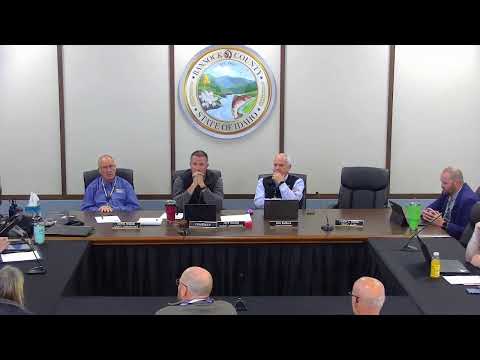
Bannock County sheriff outlines cost options to recharge inert-gas fire-suppression system; commissioners set executive-session personnel discussion
Summary
County sheriff and technical staff described costs and options to reset an inert-gas fire-suppression system in a county server room and discussed funding sources; the board moved into executive session under Idaho Code 74-206(1)(a) and (b) to discuss personnel.
Bannock County Sheriff Tony Bonu and county technical staff briefed commissioners Oct. 21 on the cost and funding options to reset a depleted inert-gas fire-suppression system in a county facility and asked the board to identify a funding source.
Bonu introduced Chief Deputy Alex Hamilton and Chief Technical Officer Adam McKinney and said the system — a large tank that discharges an inert gas to reduce oxygen in a room and suppress electrical fires — had been discharged during testing and needs resealing and component replacement. “It’s considered a hazardous material,” McKinney said. He described the system as a reservoir that, when discharged, removes oxygen from a room to stop combustion and noted seals and valves must be replaced when the tank is emptied.
County staff discussed options for covering the cost, including using grant-match funds, litigation-allocated funds, contingency, or county operations. A county official said the “grant match” option is preferable to early use of contingency funds, and staff said they would reallocate or prepare a resolution to transfer funds; one staff member proposed earmarking up to $31,100 for repairs and replacement of valves and seals if needed.
Commissioners and staff raised insurance coverage questions; technical staff said insurers sometimes exclude coverage for materials they classify as pollutants and that claims have been denied in some cases. “It was listed in one of their exclusions because they consider it a pollutant,” McKinney said, while adding insurers may still cover other losses.
At the end of the meeting the board moved to go into executive session under Idaho Code 74-206(1)(a) and (b) to discuss personnel matters. The motion was made on the record; the transcript records agreement to proceed into executive session but does not include a roll-call vote.