Get Full Government Meeting Transcripts, Videos, & Alerts Forever!
El Paso County review finds Denver Basin aquifers broadly pressurized and usable; consultant urges periodic monitoring
Summary
A consultant told El Paso County commissioners the Dawson, Denver, Arapahoe and Laramie–Fox Hills aquifers remain largely pressurized and usable but are nonrenewable; county staff will post the report and the county attorney will research legal options tied to local development and well interference.
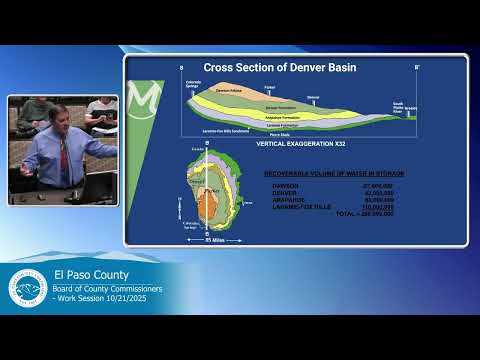
El Paso County commissioners on Oct. 21 received a technical evaluation of the Denver Basin aquifers covering the northern and eastern parts of the county and were told the basin remains largely "confined" — meaning wells often still show pressure above the top of the aquifer — even where localized declines exist.
The study, prepared for El Paso County by consultant Bruce Lytle of Moore Engineering and introduced at a Board of County Commissioners work session by Megan Harrington, the county planning director, synthesizes long-term water-level hydrographs and cross sections from water providers and monitoring wells to assess the reliability and limits of Denver Basin groundwater within county boundaries.
Why it matters: county planners, water utilities and developers rely on Denver Basin groundwater for municipal and commercial supplies in parts of unincorporated El Paso County. The basin is a nonrenewable, geologic resource deposited millions of years ago; how the county and local providers manage pumping, development approvals and well siting affects local water availability, potential well interference and long-range planning.
Bruce Lytle, a water-resources consultant who led the analysis, told commissioners the Denver Basin consists of four principal aquifers — Dawson, Denver, Arapahoe and Laramie–Fox Hills — and that his team used cross sections and multi-decade hydrographs provided by local water suppliers and monitoring programs to evaluate conditions. "With all that preamble," Lytle said, "I don't see the Denver Basin aquifers as being immediately at risk." He added, "I would not recommend that you really do any policy or code changes on the Denver Basin. I think you're adequately protecting that supply as best you can being a nonrenewable resource."
Key findings
- Distribution of resources: El Paso County covers about 17% of the Denver Basin. The basin is commonly…
Already have an account? Log in
Subscribe to keep reading
Unlock the rest of this article — and every article on Citizen Portal.
- Unlimited articles
- AI-powered breakdowns of topics, speakers, decisions, and budgets
- Instant alerts when your location has a new meeting
- Follow topics and more locations
- 1,000 AI Insights / month, plus AI Chat