Get Full Government Meeting Transcripts, Videos, & Alerts Forever!
Get email alerts on the Director Report Exam Cpe Sunset topic
No spam. Unsubscribe anytime.
Board staff reports rising CPA exam pass rates, CPE audit progress and 4-year sunset recommendation
Summary
Director Jennifer Binkley reported that Tennessee candidates’ CPA exam testing volume and pass rates rose through Q2 2025, the board completed most of a 583-license CPE audit (90.1% compliance for processed audits), and a legislative subcommittee recommended a four-year extension at a public sunset hearing.
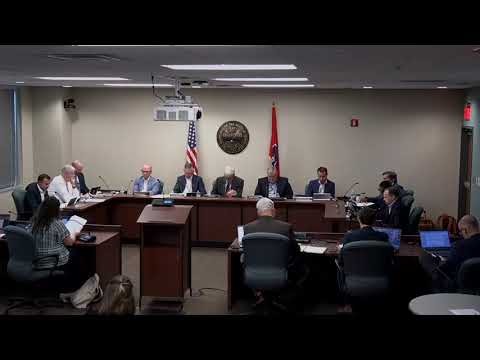
Jennifer (Jen) Binkley, director for the Tennessee State Board of Accountancy, told the board on Oct. 21 that Tennessee’s CPA exam testing volume and pass rates have increased through the second quarter of 2025 and that a recent public sunset hearing resulted in a legislative recommendation to extend the board’s statutory authorization for four years.
Binkley said board staff prepared a questionnaire for the comptroller’s office and appeared before the commerce, labor, transportation and agriculture joint subcommittee of the government operations committee for the public sunset hearing on Oct. 14. “Chairman Gilbert, myself, assistant commissioner Reid Witcher, board counsel Leelotte, and legislative director Candace Dawkins attended the hearing where the committee recommended a 4 year extension for the board,” she said. She added that the recommendation will appear as a bill in the legislature next spring.
On the CPA exam, Binkley summarized materials from NASBA and AICPA briefings: testing volume and pass rates are trending up nationally and in Tennessee through Q2 2025, in part as candidates and test-prep providers adapt to the exam’s new core-and-discipline structure and the return of continuous testing for core sections. Binkley said the board will continue to provide periodic exam performance updates.
On the CPE audit, Binkley said staff selected 583 licenses for audit and completed processing for most cases; the processed audits show a 90.1% overall compliance rate, a figure that includes licensees who self-identified noncompliance at renewal and completed penalty hours. She described the audit-notification timeline: initial audit emails were sent May 1, reminders on June 5 and July 3, and certified letters for nonrespondents as of July 16. Binkley explained that some licensees remain in a status where the board is awaiting submission of penalty hours and that staff will follow up.
Binkley also reported several operational metrics for Q3 2025: the board’s stated licensing goal is seven days, and in 2025 the average days to license was 5.8; customer service rating for Q3 was 97%; the board’s case-resolution rate fell slightly short of the department goal (87% of complaints resolved within 180 days versus a 90% target). She said the board is moving away from routinely printing and mailing certificate versions of license documents (board staff will continue to mail wall certificates), noting licensees can generate and print license documents online.
Binkley described recent outreach: participation in TSCPA events, NASBA and AICPA calls, and a board newsletter planned for release to licensees. She also noted that the Board of Accountancy recently began onboarding administrative responsibilities for additional boards within the Department of Commerce & Insurance; preliminary discussion estimated roughly $60,000 of cost reallocation from the board to other programs, which could affect the board’s fiscal picture.
Board members asked clarifying questions about pass-rate drivers, CPE audit follow-up procedures, and the effect of taking on additional boards’ workloads; Binkley said the added boards created a learning curve but had not materially affected the accountancy metrics reported to the board.