Get Full Government Meeting Transcripts, Videos, & Alerts Forever!
Get email alerts on the Emergency Medical Services topic
No spam. Unsubscribe anytime.
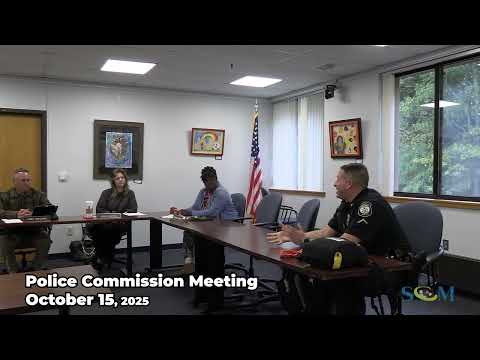
Simsbury officer outlines police role as first responders, equipment and training
Summary
Officer Jamie Ball told the Simsbury Police Commission that department patrol officers are trained to Emergency Medical Responder (EMR) level, carry Narcan and AEDs, and complete recurring medical training to support the town's high volume of 911 medical calls.
Officer Jamie Ball, a Simsbury police officer and certified emergency medical technician, told the Simsbury Police Commission that patrol officers serve as the town’s primary first responders and carry medical equipment including Narcan and automated external defibrillators (AEDs).
Ball said the department holds the primary service area (PSA) designation for Simsbury, which requires officers to be trained to at least the Emergency Medical Responder (EMR) level. "EMR stands for emergency medical responder. It's about 60 hours of training that the officers have to go through," Ball said, adding that EMT and paramedic certifications require substantially more classroom and clinical hours.
The presentation explained what equipment officers carry and why: rugged backpacks stocked with protective gear, bag-valve masks and oxygen, AEDs with adult and pediatric pads, naloxone (Narcan) in a nasal delivery form, and trainer versions of epinephrine devices. Ball said oxygen and Narcan are medications that must be kept near room temperature; officers are required to bring Narcan into the station at the end of each shift to preserve it.
Ball described AED capabilities and post‑event procedures: "We can download all this information, and it tells us a lot of detailed information ... and that's good information that we can send and actually email it directly to the doctors and staff at the hospital so they can help with their course of care." He noted the department keeps spare pads and can support multiple cardiac events during a call-back period.
On forcible medications, Ball said the department does not currently carry epinephrine pens but can assist family members or caregivers who possess them. "At some point, will we carry epinephrine? I'm not sure. That would be, obviously, up to our medical control at Saint Francis Hospital and obviously administration to navigate that," he said. He also identified a portable suction unit as a potentially useful addition in the future, though not required for EMR-level service.
Ball described required and recurring training: officers receive eight hours of continuing medical training each year and must recertify CPR every two years; EMT and paramedic training require substantially more hours. Ball also said he teaches EMR and EMT training for recruits and other departments.
Commissioners and members of the public also described recent uses of department medical resources. The department noted it began carrying Narcan in March 2015 and that AEDs and Narcan have been supported by donations and state supplements. A department speaker said the agency handles roughly 2,000 to 2,400 medical calls a year, or about three to five medical calls per day.
The presentation concluded with a brief question-and-answer period on equipment choices and policy, followed by the commission moving on to regular reports.