
Mental health board details service growth, commissioners accept budget submission
Get AI-powered insights, summaries, and transcripts
Subscribe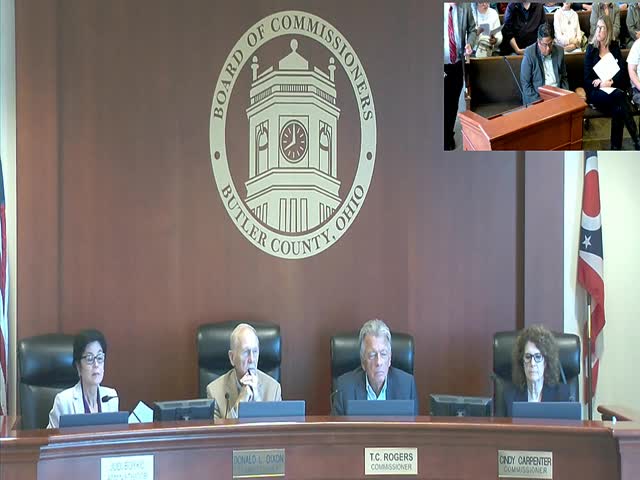
Summary
The Butler County Mental Health and Addiction Recovery Services Board presented its 2026 budget priorities, including program expansions and funding shortfalls; commissioners voted unanimously to accept the board's budget submission.
The Butler County Board of Commissioners heard a presentation from the Mental Health and Addiction Recovery Services Board and unanimously voted to accept the board's budget submission for the coming year.
Dr. Rasmus, presenter for the Mental Health and Addiction Recovery Services Board, told commissioners the board served 43,365 clients in fiscal year 2024 — “about 11% of the county” — and described how those clients break down by service type. He said 35% of services were treatment, 44% prevention and 21% recovery supports and community services. "The cost per client with the board's budget last year ... was under $400 a client," Dr. Rasmus said during the presentation.
The nut of the presentation was the combination of rising need and federal cuts: Dr. Rasmus told commissioners that several federal and other grant sources have been reduced or eliminated, including a reported $110,000 cut to drug court funding, $160,000 from system-of-care adolescent funds, $800,000 in stimulus/opiate-related funds and $125,000 from an Office for Victims of Crime grant. Providers, he said, requested roughly $1.3 million in new funding while the board typically budgets roughly $600,000 for new requests.
Board operations and stewardship. Dr. Rasmus described steps the board takes to manage taxpayer money: auditing providers, setting single rates for services, requiring productivity and billing measures, and using implementation plans that specify outcomes and FTEs. He said SELF, a contractor working under a state grant to abate lead-based paint, had spent about $1.4 million of a roughly $2.0 million award for Butler County, leaving approximately $800,000 to be spent by 2026.
Levy, outreach and program priorities. Dr. Rasmus briefed commissioners on the new levy revenues that begin to be collected next spring and noted the board will seek renewal of a separate 1-mill levy next November. He also outlined program priorities tied to levy language — suicides, overdoses, veterans, children and families, and senior citizens — and described specific initiatives the board plans to expand. He said a geriatric depression program currently reaches about 200–250 seniors a year and the board hopes to double that to about 500.
Prevention, hotline and sliding fees. Dr. Rasmus said prevention is much less expensive than treatment and that prevention work (for example, school-based groups) can cost roughly $50–$100 per participant. He described outreach steps including signs in parks listing the board hotline and the 988 crisis line, and said the board maintains a sliding-scale fee for Butler County residents who cannot pay for services.
Commissioner questions and follow-up. Commissioners pressed staff on follow-up and continuity of care — whether callers who contact the board are tracked into treatment and whether there is a persistent point of contact. Dr. Rasmus acknowledged HIPAA and confidentiality limits but said the board offers consults with licensed staff, provides multiple referrals when an initial referral does not fit and can increase follow-up efforts. Commissioner Dixon repeatedly urged stronger follow-up to keep people from getting “lost in the shuffle.”
Vote. A motion to accept the Mental Health and Addiction Recovery Services Board budget submission passed with all three commissioners recorded as voting yes.
Looking ahead. Dr. Rasmus said the board will bring required cyber policy items to comply with new state requirements (House Bill 96, discussed elsewhere in the meeting) and will continue to present performance and outcome statistics tied to levy priorities.