Get Full Government Meeting Transcripts, Videos, & Alerts Forever!
Get email alerts on the Social Services Policy topic
No spam. Unsubscribe anytime.
County staff outline likely local impacts if federal bill imposes Medicaid and SNAP work and cost‑sharing changes
Summary
Human Services and finance staff warned that proposed federal changes—work requirements for Medicaid expansion population and cost‑shift on SNAP—would increase local workload and could shift millions in costs to counties and the state; commissioners asked for continued legislative engagement and coordinated outreach.
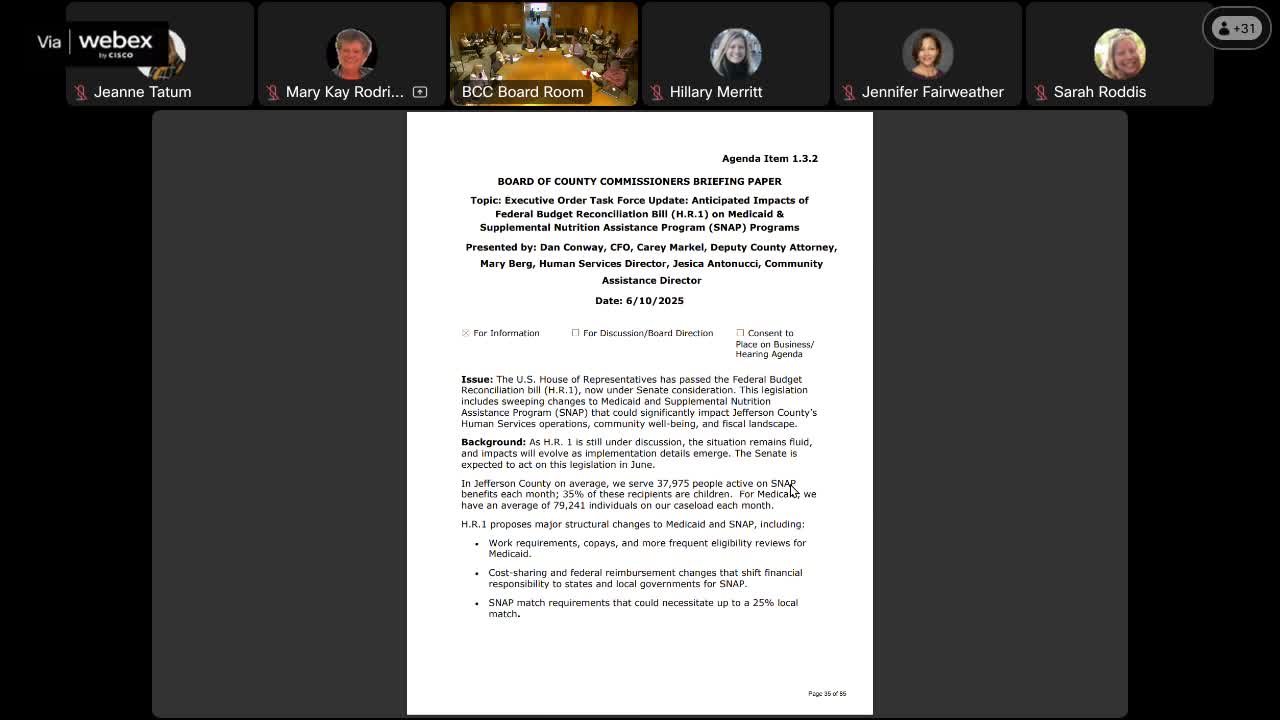
Jefferson County Human Services, finance and related staff briefed the Board of County Commissioners on June 10 about potential local impacts of proposed federal budget reconciliation changes affecting Medicaid and the Supplemental Nutrition Assistance Program (SNAP).
Dan Cono, Chief Financial Officer, and Mary (Human Services) led the presentation, joined by Gary Bird (Human Services Director), Jesse Antonucci (Community Assistance Division Director) and Gina Sagan (Director of Business and Finance). Mary summarized likely major changes: new work requirements for the Medicaid expansion population; shorter retroactive coverage windows; six‑month redeterminations (rather than annual); and increased documentation and verification steps. Staff cited a Colorado Medicaid expansion population estimate of about 377,000 people who could be affected by work requirements and said the rules may accelerate implementation timelines.
"The work requirements would need to be completed the month prior to the application," Mary said, describing how that timing could block coverage for people who lose a job and immediately need care. Staff also noted the bill would reduce the retroactive Medicaid coverage window from three months to one month and add address and death verifications, all of which would increase county workload and risks of procedural disenrollments.
On SNAP, staff highlighted a proposed cost‑shift: federal coverage of benefits would be reduced so states could be required to pay 5–20% of SNAP benefit costs depending on payment error rates; Colorado’s current error rate places it in a higher match tier under the proposal. The bill would also reduce allowable state waivers for able‑bodied adults without dependents and expand work requirements for parents of children older than seven in some cases. Staff estimated Jefferson County’s administrative match could increase by roughly $2 million if the state shifts the extra share to counties, and statewide benefit funding shifts could amount to hundreds of millions.
Commissioners asked about lessons learned from the recent Medicaid redetermination process (the “unwind”), when procedural problems led to many eligible residents losing coverage; staff said lessons learned—improved call‑center capacity, a chatbot pilot, and cross‑agency communications—would be applied but that the proposed federal timelines are aggressive and state system upgrades will be critical.
Staff said they are preparing model letters and coordinated outreach with community partners and asked for the board’s continued engagement with state and federal policymakers. Commissioners signaled support for the county’s outreach materials and asked staff to add local data to advocacy letters. Staff said they will return as rules and fiscal impacts become clearer.
Ending: Staff asked for commissioner feedback on draft letters to state and federal officials and said county teams would continue to coordinate with health and provider partners and public affairs on messaging and mitigation strategies.