Get email alerts on the Affordable Housing topic
No spam. Unsubscribe anytime.
Jefferson County to create fee-refund program to incentivize affordable housing
Summary
County planning staff outlined a proposed development fee reduction and refund program for housing units certified affordable and commissioners directed staff to amend county policy and proceed with implementation.
Jefferson County planning officials asked the Board of County Commissioners on June 10 for direction to implement a development fee refund program that would return planning and zoning fees for housing units certified as affordable.
"Our hope today is to have discussion about this proposed fee refund program and to receive direction to proceed and implement the program," said Chris O'Keefe, Planning and Zoning Director.
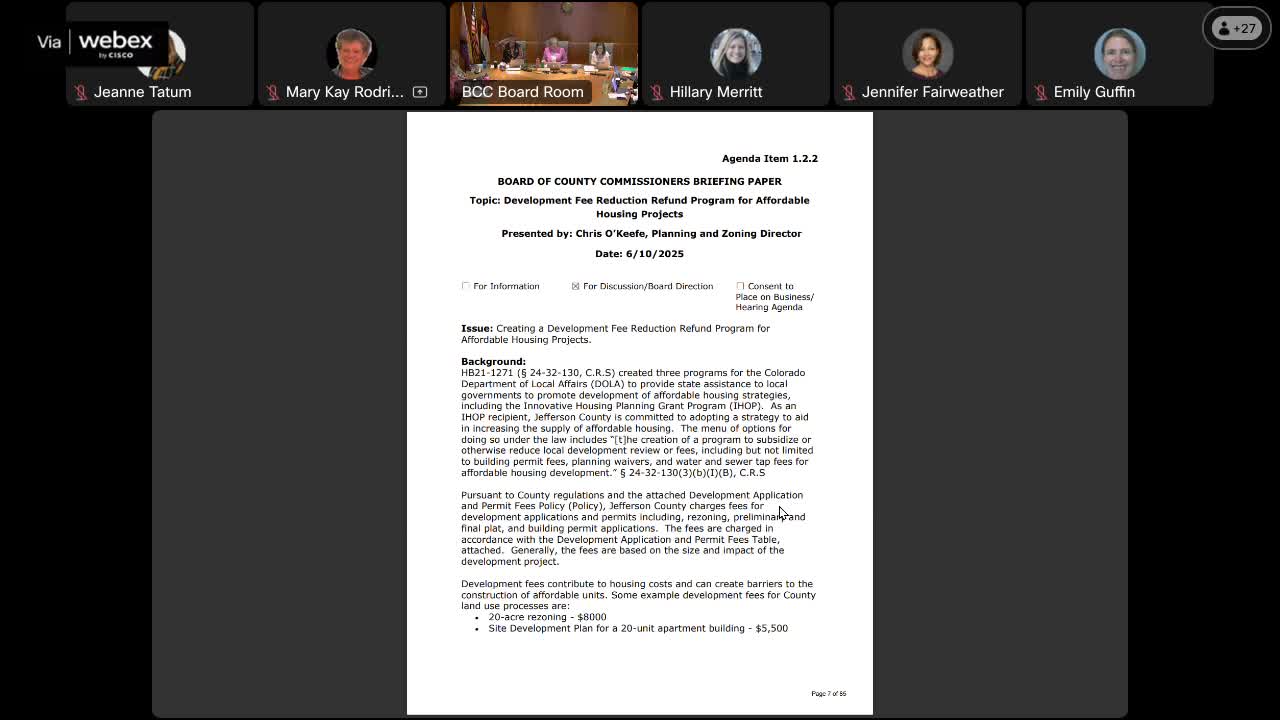
The county described the proposal as a straightforward incentive: developers apply for a fee reduction when submitting development applications, the county certifies how many units meet affordable-housing criteria (in coordination with Human Services), and the county issues a refund for qualifying fees. Staff said the program is designed to meet requirements of a state Innovative Housing Planning grant the county received and to be implemented using existing fee structures.
Under the draft structure staff presented, affordable rental units would be certified at targets tied to area median income (AMI): units affordable at or below 80% AMI would qualify for a 100% refund of selected fees; units at or below 110% AMI for a 75% refund; and units at or below 140% AMI for a 50% refund. Staff described the policy as tiered to focus incentives toward lower‑cost units while still encouraging production across a broader income range.
Planners described how the refund would apply to fees such as rezoning ($8,000 for a 20-acre rezoning example), a slight development plan ($5,500 for a typical multi‑family filing), subdivision ($4,350 for 20 lots) and a typical building permitting review fee ($250). Staff estimated a project that rezoned, subdivided and permitted 20 units could save roughly $17,350 in permit and zoning fees total, split across units. Staff also said traffic impact fees and building permit fees collected separately would be considered for future expansion of the program.
Staff told commissioners they expect the county’s first‑year fiscal exposure to be modest; planners said they do not anticipate the program costing the county more than about $50,000 in the first year, because relatively few current proposals would qualify under the price thresholds used in the staff example. County staff said the program will be coordinated with a newly hired, grant‑funded housing coordinator and with Human Services for income certification.
Commissioners directed staff to proceed. One commissioner asked staff to amend the existing county policy (C C 22‑92) to include the fee‑refund program and to bring the policy back for briefing and subsequent adoption. Staff said they would prepare an application process for developers, track fees for quick refund processing, and report annually on units developed and fees refunded.
The county also said the program will be combined with other housing efforts, including the Together GEFCO comp plan update and unified land‑use code work, to provide broader support for housing goals.
Ending: Staff will return with an amended policy for briefing and later adoption and plan a program launch and public outreach if commissioners confirm final approval.
AI generated
The text on this page is AI generated. Summaries, highlights, analysis, and video transcripts are all produced from the original source material.
AI can make mistakes, so if you spot one, and we will fix it for everyone.
Note: the source content is unaltered by us. Any content source we link to, be it a video, an audio recording, or a document, is presented exactly as its publisher released it. That publisher is usually a government body, sometimes an individual official or another organisation.