Get Full Government Meeting Transcripts, Videos, & Alerts Forever!
Get email alerts on the Lighting topic
No spam. Unsubscribe anytime.
Buncombe planning board continues workshop on proposed exterior lighting rules after hours of technical questions
Summary
Planning staff reviewed a proposed exterior lighting text amendment and fielded questions on Kelvin limits, foot-candle vs. lumen measures, vehicular-canopy rules and nonconforming fixtures; board did not vote and agreed to resume discussion Nov. 17.
Buncombe County Planning Board members spent more than two hours on Oct. 20 reviewing a proposed exterior lighting text amendment (ZPH 2025-24) intended to reduce light pollution, limit glare and promote energy-efficient fixtures. Staff highlighted proposed limits on color temperature (Kelvin), foot-candle maxima at property lines and new exemptions intended to reduce review burden for small projects. The board did not take final action and voted to continue the discussion at its Nov. 17 meeting.
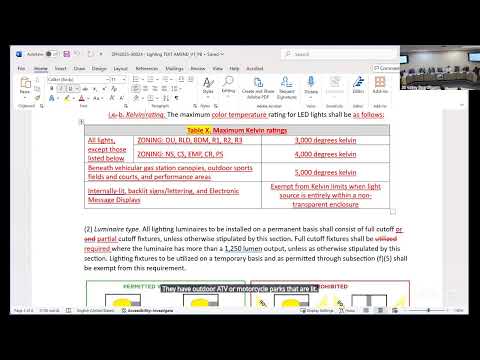
The proposed amendment would centralize lighting standards, add new definitions and create a table of maximum foot-candle and Kelvin values for different contexts (nonresidential property lines, residential property lines, public rights-of-way, parking areas and special uses such as sports fields and electronic message displays). Planning staff told the board they are balancing community health, environmental justice and energy goals with industry practice and enforcement limits.
The discussion focused on three technical areas: how to measure and regulate light (foot-candles versus lumens), the maximum Kelvin (color-temperature) allowed in different zoning contexts, and how to treat long-standing nonconforming fixtures — especially gas-station canopies and stadium or performance lighting.
Resident Bernard Arguier of North Asheville urged the board to use lumens on packages as a compliance option and to explicitly ban or define floodlights; he also pressed staff to clarify how noncompliant fixtures would be brought into compliance. "I recommend you, in that one case, you use something they can relate to, which is, lumens," Arguier said during public comment.
Staff explained that foot-candle measurements (the amount of light reaching a point) are the basis of current reviews and better capture site-specific impacts than lumens (the total light emitted by a fixture). Staff said they had discussed a simpler pathway for very small installations: projects that stay below a defined threshold could avoid submitting a full photometric plan.
Board members and staff debated Kelvin limits. The draft separates residential and rural zoning (a lower Kelvin recommendation) from more commercial zones. Some board members asked whether the draft should set a single, countywide maximum (3,000 K was discussed) or keep differentiated limits. Staff said the earlier draft proposed lower (3,000 K) limits in residential/rural districts and higher limits in commercial areas because some commercial fixtures, especially certain canopy lights, cannot meet the lower limits without replacing existing nonconforming equipment.
Gas-station and vehicular canopies generated repeated questions. The ordinance currently triggers a compliance requirement when a structure is renovated at a cost exceeding 50% of its value; several board members warned that the 50% threshold can allow fixture replacement over time without ever forcing full compliance. Some members urged a phase-out timeline or clearer language tying compliance obligations to fixture replacement rather than to an owner's cosmetic work on a canopy. Staff said they would bring more precise language and options back to the board.
Members also asked staff to separate out and provide clearer standards for three special-use categories: vehicular canopies, outdoor sports fields/courts, and outdoor performance areas. Board members noted those uses have different technical needs (safety lighting and uniformity for sports, bright canopy lighting for fuel stations, and stage lighting for performances) and asked staff to research industry standards where applicable.
Other topics covered: whether animated or video signs should be treated as changeable-copy signs or prohibited when visible from roadways; whether seasonal displays should be specifically defined (staff said complaints are rare and recommended limited intervention); and how to handle temporary construction or public-event lighting. Staff told the board they will consult legal counsel on how the proposed text amendment interacts with recent state-level downzoning provisions and will not schedule a public hearing until that analysis is complete.
The board set a number of follow-ups for staff, including: sharper, separate language for canopy fixtures; technical research on sports-field lighting standards and any visibility/safety tradeoffs associated with lower Kelvin ratings; examples or vendor visuals showing different Kelvin levels; and refinement of the small-project photometric exemption.
Votes at a glance from the Oct. 20 meeting included routine procedural items and the continuation motion on the lighting item. The board approved the meeting agenda and approved the Aug. 18 minutes earlier in the session by voice vote. At the meeting's end the board unanimously agreed to continue the lighting discussion to Nov. 17.
Staff said they will return with revised draft language, technical exhibits on Kelvin/visibility, and suggested language to address canopy nonconformities and timeline options before the public hearing.